




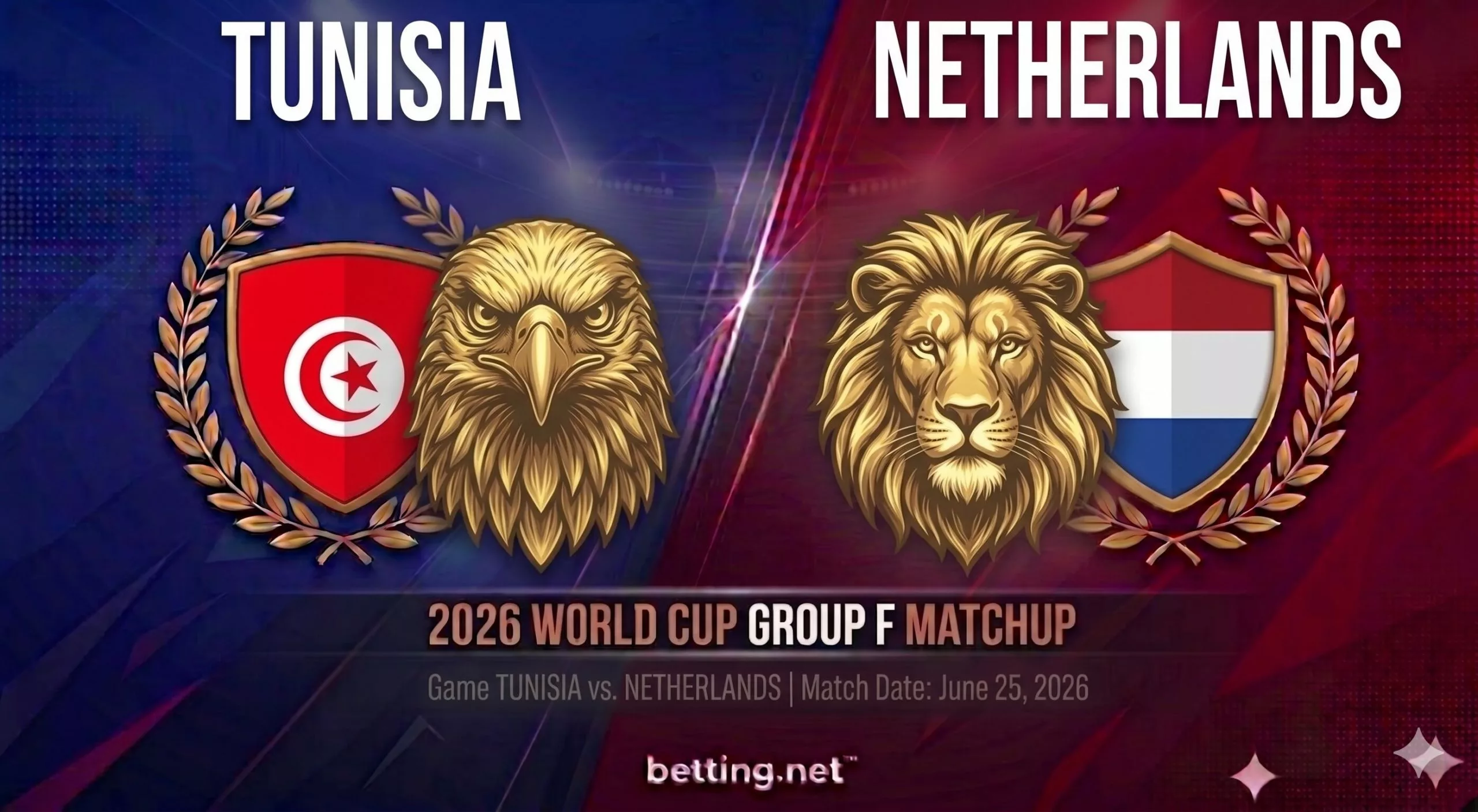


1️⃣ Match Context
This is the kind of World Cup group-stage fixture where the scoreboard pressure arrives before the first whistle. Tunisia don’t get many “free” games at this level: every point is oxygen, every goal swings qualification probability. The Netherlands, meanwhile, live in a different psychological lane — they’re expected to progress, and anything that looks like complication becomes a headline.
That asymmetry matters. Tunisia can play a “low-risk” match and call it pragmatic; the Netherlands can play the same match and get accused of lacking edge. In tournament football, that narrative pressure changes decision-making: whether a team keeps circulating possession patiently, or forces the final ball because the game feels like it should already be won.
Schedule congestion is also part of the texture here. Group games compress recovery windows and amplify small physical issues. A team that wants to press high for 90 minutes needs more than just legs — it needs freshness. Tunisia typically lean on collective intensity and compactness; the Netherlands lean on control. In a tight recovery cycle, control usually ages better than chaos.
2️⃣ Form & Advanced Metrics
Tunisia’s recent competitive profile is familiar: they’re structurally cautious, often conceding territory by design, and trying to turn the match into a sequence of manageable moments. Their chance creation tends to be shot-volume light but situation-dependent — when they do shoot, it’s often after a rare clean transition or a set-piece second ball rather than sustained pressure.
The underlying numbers in these kinds of teams usually tell the same story: lower xG totals, but not necessarily terrible shot quality when they reach the box. The volatility comes from how infrequently they reach those zones. If Tunisia don’t win enough second balls, or if their counters are delayed by one touch, the xG just never arrives.
The Netherlands profile is built around territory and repeatability. They typically post strong field tilt (more time and touches in the attacking third), and their chance creation tends to be more stable because it’s produced through structure: wide rotations, half-space occupation, and consistent box entries rather than single moments. That usually correlates with a healthier xG floor — even on an “average” night, they still manufacture chances.
Pressing is the other separator. PPDA isn’t just a number — it’s a description of intent. A low PPDA means you’re engaging early, trying to win the ball high, and forcing opponents to play under pressure. The Netherlands can press, but they don’t have to live and die by it; they can also suffocate matches through possession and counterpressing. Tunisia, by contrast, are more likely to press in triggers: a backward pass, a heavy touch, a wide trap near the touchline. Over 90 minutes, that usually produces pockets of danger rather than constant pressure.
Home/away splits are less meaningful at a World Cup than in domestic football, but “emotional home advantage” still exists: crowd tilt, momentum swings, and referee psychology can mimic it. Tunisia often benefit from games that feel like a siege — it sharpens their defensive focus. The Netherlands benefit from games that feel like a training exercise — it sharpens their automatisms. The first 20 minutes will hint which environment this match becomes.
3️⃣ League Table Snapshot
World Cup group tables can lie early. One deflection, one red card, one late corner — and suddenly the group is “turned.” Still, the table is the pressure map: it tells you who can accept a draw and who can’t.
| Team | GP | W | D | L | GF | GA | Pts |
|---|---|---|---|---|---|---|---|
| Tunisia | – | – | – | – | – | – | – |
| Netherlands | – | – | – | – | – | – | – |
Takeaway: without confirmed group results embedded here, the cleanest way to read this matchup is incentive-based. Tunisia are incentivized to keep the match close as long as possible; the Netherlands are incentivized to avoid giving the group a “complication narrative.” That usually translates into Dutch control and Tunisian resistance — until the first goal changes the entire decision tree.
4️⃣ Head-to-Head Analysis
Head-to-heads in international football are rarely a reliable sample, but they can reveal structural discomfort. When elite possession teams face compact mid/low blocks, the match often repeats: the favourite circulates, the underdog defends, and the entire outcome hangs on two things — chance quality from settled possession and set-piece margins.
If we look deeper at these archetypes, the Netherlands typically generate enough box touches to eventually create a high-value shot (cutback, penalty-area switch, second-phase cross). Tunisia-type opponents typically rely on one or two high-leverage counters. Past results often flatter the underdog when finishing swings their way, but underlying chance flow usually leans toward the stronger side. The key question isn’t “have Tunisia upset big teams before?” — it’s “can they create enough threat to force the Netherlands to respect transitions?”
5️⃣ Tactical Breakdown (Core Section)
Tempo: control vs disruption
The Netherlands want a match played in long sequences: build from the back, pin the opponent, recycle, and keep the game in front of them. Tunisia want the opposite: short sequences, lots of restarts, and a rhythm where the Netherlands have to re-solve the same problem every 60 seconds.
If the Dutch establish early territory, Tunisia’s block will likely compress centrally — not to win the ball, but to deny the most valuable zone: the central corridor just outside and inside the box. That pushes the Netherlands wide, which is fine… as long as wide dominance becomes cutbacks, not hopeful crosses.
Overload zones: half-spaces and the far-post channel
The Netherlands’ most repeatable way through a compact block is to overload one side, drag the block, then access the far-post lane. Tunisia’s defensive success depends on their weak-side fullback and winger staying connected. If that chain breaks, the Netherlands don’t need many shots — they need the right shot.
Tunisia’s attacking overload is more opportunistic: win it, find the first forward pass, and attack the space behind the Dutch fullbacks. The Netherlands’ rest-defense structure (how they position behind the ball) becomes crucial. If they commit both fullbacks high at the same time, Tunisia’s counters become real. If they stagger — one fullback conservative, one aggressive — Tunisia’s transitions start to look like long sprints into cul-de-sacs.
Midfield battle: second balls and patience
This is where underdogs survive. Tunisia don’t need 60% possession; they need second-ball access after clearances and duels. If the Netherlands’ midfield keeps hoovering up those loose balls, the match becomes a siege. If Tunisia win enough of them, the game becomes a sequence of mini-counters that force tactical fouls and slow Dutch momentum.
Pressing triggers and buildup resistance
Tunisia’s best pressing moments usually come when the opponent’s buildup becomes predictable: a centre-back to fullback pass under mild pressure, or a goalkeeper forced to the weaker side. The Netherlands are generally press-resistant, but tournament matches can create conservative passing — and conservative passing is pressable passing.
Expect Tunisia to spring pressure selectively and then drop fast. The Netherlands’ response should be to avoid forcing central entries early; move Tunisia laterally, then strike when the block is stretched.
Set-pieces: Tunisia’s leverage point
If there’s one phase that can equalize a talent gap, it’s dead balls. Tunisia’s path to value is clear: keep open play quiet, then build a few high-impact corners and wide free kicks. For the Netherlands, discipline in wide areas matters. Avoid cheap fouls. Avoid unnecessary corners conceded under no pressure.
6️⃣ Odds & Market Evaluation
| Market | Selection | Odds | Implied Probability |
|---|---|---|---|
| 1X2 | Tunisia | 7.50 | 13.33% |
| 1X2 | Draw | 4.20 | 23.81% |
| 1X2 | Netherlands | 1.45 | 68.97% |
Market note: implied probabilities sum above 100% due to bookmaker margin. According to our calculations at betlabel.games, the Netherlands still deserve to be a strong favourite, but the key is whether the price correctly captures low-scoring tournament variance. Heavy favourites in group games often win without margin — control, minimal risk, 1–0/2–0 patterns.
From a value perspective, the pure 1X2 on the Netherlands can be “correct” but not necessarily profitable if the market has already priced in the likely script. The more interesting angles often sit around goal lines and handicap splits.
7️⃣ The Hidden Edge (Mandatory Section)
There’s a structural nuance here that markets sometimes lag on: shot suppression doesn’t equal chance suppression. Teams like Tunisia can keep total shots low, yet still allow the opponent into the most valuable pattern in modern football — the cutback zone after a byline entry. When that happens, xG spikes in just one or two actions, and the match breaks open.
The other hidden angle is psychological pacing. The Netherlands in tournament settings often prioritize game-state protection once ahead. That creates a specific betting dynamic: they can be dominant in territory and still finish with a modest shot count in the last 30 minutes. If the market expects a rout and prices overs aggressively, there can be value on controlled scoring outcomes.
Finally, Tunisia’s threat is episodic — not constant — which can mislead casual readers of recent scorelines. A match where Tunisia “looked quiet” might still include two transition moments that would be goals with slightly cleaner execution. That’s why Netherlands’ rest-defense and foul management are not minor details; they decide whether Tunisia can generate the kind of high-leverage chances that flip an under.
8️⃣ Final Prediction
Main Pick: Netherlands -1.0 Asian Handicap
Alternative: Under 3.0 Goals (Asian Total)
Risk Level: Medium
Why these angles:
- Territory and repeatable chance creation should belong to the Netherlands, and Tunisia’s attack is unlikely to sustain pressure without transition access.
- Game script favours a controlled Dutch win: once ahead, the Netherlands can reduce variance through possession and positioning, limiting Tunisia’s counter volume.
- Tournament volatility remains — set-pieces and one counter can change totals quickly — which is why the handicap is preferred over extreme scoreline punts, and the under is kept to an Asian line for protection.
Most likely match shape: Netherlands control, Tunisia compact, and the game decided by whether Dutch wide dominance turns into cutbacks rather than crosses.




Leave a Reply