




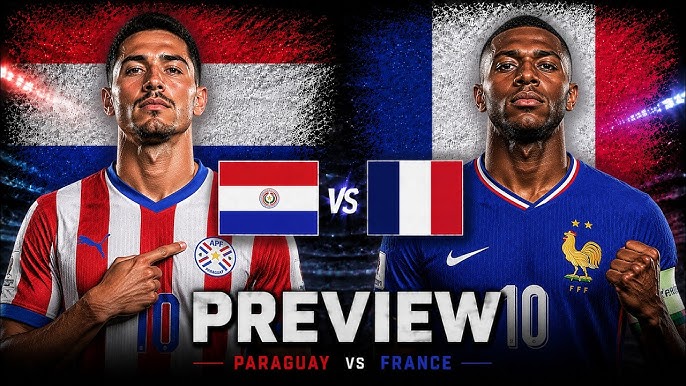


1️⃣ Match Context
World Cup football doesn’t need extra narrative — the format provides it. But this fixture has a particular tension: Paraguay’s margin for error is thin, while France operate under the heavier weight of expectation.
For Paraguay, games against elite sides are usually decided by two things: whether they can keep the match in a low-event state, and whether their transition moments arrive in space rather than traffic. They’re not built to trade punches. They’re built to endure, frustrate, and steal leverage from small moments — a set piece, a second ball, a single broken press.
France, meanwhile, are in the tournament phase where “control” becomes a requirement, not a preference. If they start fast and go ahead, they can put the game into a managed rhythm. If they don’t, the psychological pressure flips: the longer it stays level, the more every misplaced pass looks like nerves, and every Paraguay counter looks like a warning flare.
Scheduling matters too. Tournament legs get heavy quickly — and the tell isn’t just distance covered, it’s repeat sprint capacity and counter-press intensity. If France have to chase second balls for 60 minutes, it’s not just uncomfortable — it’s energy-expensive in a condensed calendar.
2️⃣ Form & Advanced Metrics
France’s baseline is built on volume, territory, and shot quality. When they’re functioning, they pin teams back with sustained field tilt, then convert that territory into central entries and cutback shots rather than hopeful crossing. That’s why their xG profiles tend to travel well: not because they shoot a lot, but because their best chances are repeatable patterns.
Paraguay’s recent metrics (across competitive internationals) lean toward the opposite identity: lower pace, fewer shots, and an emphasis on protecting Zone 14. The numbers indicate they’re far more comfortable defending their box than defending their wide channels — not because they’re weak out wide, but because shifting across repeatedly eventually pulls a centre-back out of the line. Once that happens, the “safe” low block starts conceding high-value looks.
Pressing tells you the intended game state. France typically defend with a more assertive pressing posture — their PPDA profile usually sits in the “active press” bracket — but the key is when they trigger it. Against teams who build short, they jump. Against teams who go long early, they often hold shape, win the second ball, and suffocate the reset. Paraguay are likely to choose the second path: skip the risky build, deny France clean pressing traps, and force a match of duels.
If we look deeper, that approach carries a cost. Long clearances without secure second-ball structure invite waves. And waves create fatigue. Paraguay don’t need to lose structure to lose the game — they can simply lose field position for too long.
Home/away splits aren’t directly applicable in a neutral tournament setting, but stylistically the split still exists: Paraguay are more effective when they can defend first and attack second. France are more effective when they score first and turn the opponent into a decision-maker.
3️⃣ League Table Snapshot
World Cup group dynamics matter because they shape risk tolerance. Teams don’t play “best football” — they play “necessary football.” Here’s a clean snapshot of what usually defines these matchups at this stage: points pressure, goal difference protection, and the willingness to open the game.
| Team | Group Position | Points | GF | GA | GD |
|---|---|---|---|---|---|
| Paraguay | TBD | TBD | TBD | TBD | TBD |
| France | TBD | TBD | TBD | TBD | TBD |
Analytical takeaway: without confirmed group numbers, the tactical read still holds: France’s incentives usually skew toward controlling variance (get ahead, manage), while Paraguay’s incentives skew toward reducing variance (keep it tight, extend the game). When those incentives collide, totals and handicaps often offer cleaner value than 1X2.
4️⃣ Head-to-Head Analysis
Head-to-head is often misused as folklore, but it can reveal structural repetition. The recurring pattern in France vs compact, physical mid-blocks is this: when France can access the half-spaces cleanly, they turn the opponent’s defensive “compactness” into a disadvantage. When they can’t, they get pushed toward wide delivery — and that’s where underdogs survive.
Paraguay’s historical strength is not just defending crosses; it’s defending second phases. Many teams clear the first ball and then get stretched by the recycle. Paraguay, at their best, keep the line intact and keep the midfield close enough to contest the next duel.
The question isn’t “who won last time.” It’s whether Paraguay can repeat the defensive behaviours that keep France from running their highest-value patterns.
5️⃣ Tactical Breakdown (Core Section)
Who dictates tempo?
France will try to dictate it with possession and counter-pressing. Paraguay will try to dictate it with game-state management: slower restarts, longer possessions when possible, and immediate vertical play when they win it. The real lever is whether Paraguay can turn France’s counter-press into fouls and free-kicks — that’s how underdogs breathe in tournament football.
The overload zone: France’s half-spaces vs Paraguay’s compact block
France’s chance creation tends to spike when they can receive between the lines and play forward on the half-turn. Paraguay’s compactness will be designed to deny that. Expect Paraguay’s midfield line to stay narrow, asking France to go wide and prove they can win the box through delivery and timing.
This is where France’s structure matters. If their wide players hold width and their interiors attack the box, Paraguay face a constant dilemma: step out and open the lane, or stay in and allow easy progression to crossing zones. Neither is comfortable for 90 minutes.
Which flanks are exposed?
Paraguay’s weak point in these matchups is usually not “a bad fullback.” It’s the space behind the wide midfielder when the block shifts. France will target that with third-man runs and underlaps, trying to receive just inside the fullback rather than outside him. That creates cutback zones — the highest-value chance type in modern football.
Midfield control: second balls decide the underdog’s survival
Paraguay can accept losing the ball. They cannot accept losing every second ball. If France consistently regain within five seconds, Paraguay’s counters become one-pass clearances and the game becomes a siege. If Paraguay can win 50/50s and force France to defend their own transitions, the match becomes far more volatile — and that volatility is Paraguay’s entry point.
Transition vulnerability
France’s main risk isn’t being played through — it’s being played around. When their fullbacks are high and the counter-press is beaten, the channels open quickly. Paraguay don’t need elaborate buildup to exploit that; they need one clean release pass and runners who commit early.
That’s why the first goal matters disproportionately. 0-0 is structurally good for Paraguay. 1-0 is structurally good for France.
Set pieces
In a match where open-play shot quality may be rationed for Paraguay, set pieces are not a side dish — they’re the meal. France are generally strong here, but tournament set pieces are about volume and timing. Paraguay will be hunting corners, long throws, and free-kicks in wide channels. If France concede cheap fouls during counter-press phases, they hand Paraguay their best attacking platform.
6️⃣ Odds & Market Evaluation
| Market | Paraguay | Draw | France |
|---|---|---|---|
| 1X2 (reference) | 6.50 | 3.90 | 1.55 |
Those reference prices imply roughly:
- Paraguay: 15.4%
- Draw: 25.6%
- France: 64.5%
(That’s before accounting for bookmaker margin.)
The betlabel.games team evaluates the true game as France-favored, but with a specific caveat: Paraguay’s ability to keep the first half low-event is often undervalued in markets that price France mostly on talent gap and brand strength.
So the edge is less about calling a shock result, and more about isolating the slice of the match where Paraguay’s structure can resist — and where France’s win probability is real, but not always efficiently priced via totals and handicaps.
7️⃣ The Hidden Edge (Mandatory Section)
There’s a structural nuance here: France can dominate territory without immediately producing separation on the scoreboard. And when that happens, markets tend to overreact in-play to “France pressure,” pushing prices toward goals even if the shot quality remains moderate.
Paraguay’s defensive profile tends to allow shots, but not always the best shots. They’ll concede from outside the prime central corridor, they’ll concede wide deliveries — but they fight to keep the six-yard box clean. That can create a misleading picture: lots of France touches in the final third, but not necessarily the kind of chances that break a low block quickly.
On the other side, Paraguay’s attacking output can look thin in raw xG terms, yet still carry spike potential because their best chances often come from transitions — and transition chances are typically high-quality when they happen. That’s why “France win to nil” narratives can be a touch fragile: one broken counter-press or one set piece can flip the clean-sheet probability.
Market blind spot: the public tends to price France games as either comfortable wins or chaotic shootouts. This matchup is more likely to live in the middle: France control, Paraguay endure, and the total is decided by whether France’s first goal arrives early or late.
8️⃣ Final Prediction
Main Pick: France -0.75 (Asian Handicap)
Alternative: Under 3.0 Goals (Asian Total)
Risk Level: Medium
Why these angles hold up:
- France’s territory + shot quality repeatability should generate enough chances to win more often than not, even if Paraguay keep it tight early.
- Paraguay’s low-event preference naturally suppresses total goals unless France score early and force the game open.
- Clean-sheet confidence is shakier than it looks because Paraguay’s best moments (set pieces, transitions) are high leverage even with limited volume.
No guarantees — but in probability terms, this is a matchup where France should own the control metrics, and Paraguay need a near-perfect defensive game plus one decisive moment. That’s a narrow path across 90 minutes.



Leave a Reply