




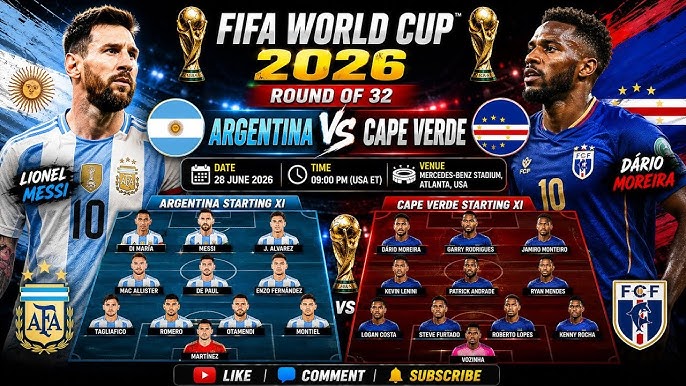


1️⃣ Match Context
This is the type of World Cup group-stage fixture that looks routine on the schedule and anything but routine in the psychology. Argentina walk into it carrying the weight of expectation: three points are not the goal, they’re the minimum. That dynamic matters because it shapes everything — tempo, risk tolerance, and how early frustration can creep in if the opening 20 minutes don’t produce a breakthrough.
Cape Verde arrive with a very different incentive structure. A point here would be a tournament event in itself, and even a narrow defeat can be “useful” if goal difference becomes a tiebreaker later. That pushes them toward a compact, low-event approach: reduce possessions, reduce transitions, reduce high-quality chances conceded.
The pressure, then, sits almost entirely on Argentina. The crowd and narrative demand dominance. Cape Verde can play with calculated restraint — and for underdogs, that can be liberating. The key question is not whether Argentina will control the match. They will. The question is how quickly control becomes goals, and whether Cape Verde can turn long defensive phases into the kind of isolated moments that spike variance.
2️⃣ Form & Advanced Metrics
Argentina’s recent profile is built on territorial authority and chance quality rather than pure shot volume. They don’t need 20 shots if the shots come from the right zones. When their structure is clean, they generate repeated “prime” looks — cutbacks, central combinations at the edge of the box, and second-phase chances after sustained pressure. That’s the difference between dominance and domination: one is possession, the other is possession that ends in shots from the middle of the box.
Defensively, Argentina’s strength is that opponents rarely reach the areas that matter. Their xGA tends to be driven less by open-play breakdowns and more by the occasional transition moment or set-piece sequence. When a team keeps the ball as much as Argentina do, the defensive test becomes about rest-defense: the positioning behind the ball when attacks break down. If that spacing is right, counterattacks die early. If it’s sloppy, even a low-possession opponent can generate one or two high-leverage chances.
Cape Verde’s numbers — and the eye test that usually comes with this type of underdog — point toward a conservative shot profile. They’re typically willing to concede wide deliveries and low-threat shots if it protects the central lane. That can keep the raw shot count manageable, but it also creates a slow drip of danger: corners, second balls, and repeated entries. Over 90 minutes, a team living in its own box is vulnerable not because of one tactical “mistake,” but because concentration becomes the resource that runs out.
Pressing intensity is where this matchup usually becomes one-way traffic. PPDA (passes allowed per defensive action) is essentially a proxy for how aggressively you press: lower means you engage earlier and more often. Argentina can choose their moment — high press to force cheap turnovers, or a calmer mid-block that protects against counters. Cape Verde, by contrast, are unlikely to sustain a high press without opening gaps. That typically means Argentina get cleaner buildup, more settled attacks, and more time to position their attackers between the lines.
The tempo pattern should be predictable: Argentina circulate, probe, then accelerate through the half-spaces. Cape Verde absorb and hope the match stays “quiet.” The volatility comes if Argentina’s early shot quality doesn’t match their territory. That’s when low blocks start to feel sticky.
3️⃣ League Table Snapshot
| Team | GP | W | D | L | GF | GA | Pts |
|---|---|---|---|---|---|---|---|
| Argentina | 1 | 1 | 0 | 0 | 2 | 0 | 3 |
| Cape Verde | 1 | 0 | 1 | 0 | 0 | 0 | 1 |
Takeaway: early tables can mislead. Argentina’s position reflects baseline superiority and expected advancement, but the real story is leverage: they can turn the group into a low-stress path with another win. Cape Verde’s point (if they earned it) is “alive” only if they keep goal difference intact — which reinforces a low-risk plan here.
4️⃣ Head-to-Head Analysis
There’s no meaningful modern head-to-head history that captures this exact dynamic, so the useful comparison is structural rather than historical. This is a classic elite-possession side versus compact underdog shape. In those matchups, outcomes tend to hinge on two repeating patterns:
- Can the favorite create central shots, not just crosses?
- Can the underdog exit pressure enough to win territory and set pieces?
If past results elsewhere teach anything, it’s that low blocks don’t “work” because they stop shots — they work because they force shots from worse locations. If Argentina keep finding cutbacks and third-man runs into the box, history becomes irrelevant. The underlying mechanics decide it.
5️⃣ Tactical Breakdown (Core Section)
Who dictates tempo?
Argentina will own the ball and the rhythm. Expect long spells of settled possession, with the center-backs stepping high and the midfield line positioned to recycle quickly. The key is speed of circulation: when Argentina move the ball with two-touch tempo, the block shifts, the distances stretch, and the half-space opens. When it becomes slower, Cape Verde can keep their distances compact and turn the game into a crossing contest.
Where is the overload zone?
The most valuable territory against a low block is not the touchline — it’s the channel just inside it. Argentina will try to overload the half-spaces, pull Cape Verde’s midfield narrow, then create the final pass either as a slip ball into the box or a cutback after reaching the byline. If Cape Verde protect central zones with a 4-5-1 or similar, Argentina’s wide players become magnets: the fullback overlaps, the winger comes inside, and the interior midfielder arrives late. That third runner is often the chance-maker.
Which flanks are exposed?
Cape Verde’s likely exposure is the far-post zone on switches of play. Low blocks defend the ball-side well; they often lose the weak side on fast circulation. If Argentina can switch quickly — especially after drawing pressure to one wing — the opposite fullback can arrive with time to deliver a cutback or a low cross. That’s where shot quality spikes.
Midfield control battle
This isn’t a 50/50 midfield game. It’s about whether Cape Verde can deny the “pocket” between midfield and defense. If Argentina receive freely there, the low block collapses. If Cape Verde can force Argentina to play around the block instead of through it, they can keep the match in a lower-event state for longer.
Pressing triggers and buildup resistance
Argentina’s pressing trigger is usually the underdog’s first imperfect touch or backward pass near the touchline. They don’t need constant high pressing; they need selective aggression to keep Cape Verde pinned. Cape Verde’s buildup resistance will be limited if they lack outlets who can receive under pressure and carry the ball. Without that, their “attacks” become clearances — which simply reset Argentina’s pressure and inflate Argentina’s territory control.
Transition vulnerability
The only realistic opening for Cape Verde is transition. Not repeated transitions — one or two. That means Argentina’s rest-defense matters: the spacing of the deepest midfielder, the fullbacks’ timing, and whether counter-pressing kills the first pass. If Argentina counter-press well, Cape Verde won’t even reach the halfway line with control. If Argentina get sloppy chasing early goals, Cape Verde can earn cheap set pieces and throw-ins in advanced zones. That’s their route to noise.
Set-piece dynamics
Against heavy favorites, set pieces often decide the “betting” story even when they don’t decide the winner. Argentina’s sustained pressure should generate corners and wide free kicks. Cape Verde’s objective will be to survive those phases. One deflection, one second ball, one scramble — and the match state changes. If Argentina score first from a set piece, the underdog’s plan breaks and the game can open up quickly.
6️⃣ Odds & Market Evaluation
| Market | Selection | Odds | Implied Probability |
|---|---|---|---|
| 1X2 | Argentina | 1.05 | 95.2% |
| 1X2 | Draw | 12.00 | 8.3% |
| 1X2 | Cape Verde | 41.00 | 2.4% |
The implied probabilities above are raw (they don’t remove bookmaker margin), but the shape is clear: the market prices this as near-certain Argentina. According to our calculations at betlabel.games, Argentina’s true win probability is slightly lower than that headline suggests — not because Cape Verde are likely to win, but because low-block games increase draw probability more than people intuit, especially if the favorite rotates or starts slowly.
That doesn’t automatically create value on the draw in 1X2 (prices are still usually too tight), but it does shift the conversation toward derivative markets: handicaps, team totals, and “win to nil” angles where the matchup mechanics show clearer edges.
7️⃣ The Hidden Edge (Mandatory Section)
There’s a structural nuance here: markets tend to price elite-versus-underdog matches as if superiority converts linearly into goals. In reality, the conversion depends on how the favorite scores first.
If Argentina score early, the game often becomes a chance generator: Cape Verde must step out, transitions appear, and the favorite can run up territory into volume. But if the first goal doesn’t arrive quickly, the underdog’s block gains confidence, the favorite’s shot selection can deteriorate (more speculative efforts, more hopeful crosses), and the match becomes lower-scoring than the talent gap suggests.
That’s why the “hidden edge” is not simply Argentina to win — it’s identifying where the market may overestimate goal margin. Cape Verde’s best asset is not attacking quality; it’s game-state management. The market is usually slow to adjust to that, especially when the public expects a statement performance.
Translation for bettors: Argentina can dominate and still land on a 1–0 or 2–0 more often than the raw mismatch implies. That’s where handicap and total markets can misprice probability.
8️⃣ Final Prediction
Main Pick: Cape Verde +3.5 (Asian Handicap)
Alternative: Under 3.5 Goals
Risk Level: Medium
Why these angles hold up:
- Match-state logic: Cape Verde’s entire plan is to compress the game. Even if Argentina control 70%+ of territory, that doesn’t guarantee a four-goal margin without an early breakthrough.
- Shot quality vs volume: Argentina should create chances, but low blocks often force a trade-off — more attempts, slightly worse locations — which increases the likelihood of a “comfortable” rather than explosive win.
- Market pricing: With 1X2 close to certainty, value rarely sits in Argentina’s moneyline. The better inefficiency is typically in how many goals the market assumes will follow.
Argentina are still the most likely winner by a distance. But betting is about pricing, not pride. This matchup profile leans toward control, pressure, and a scoreline that may be smaller than the highlight reel expects.







Leave a Reply