




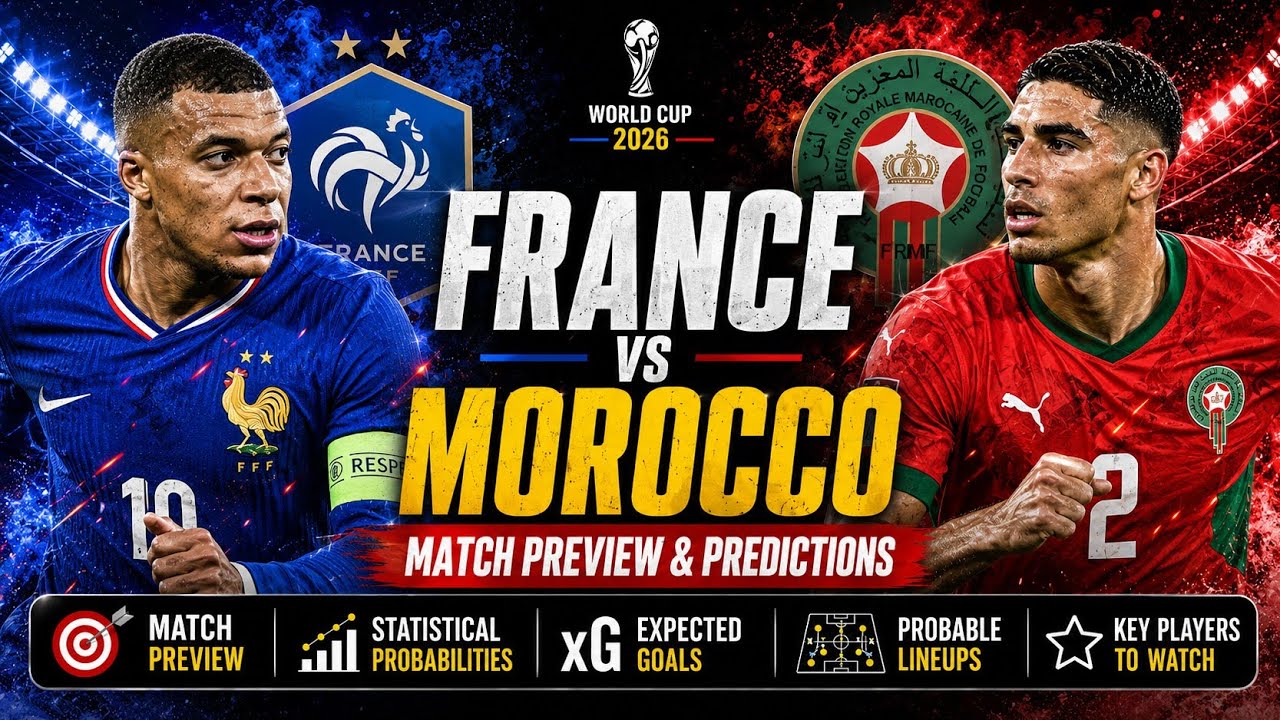


1️⃣ Match Context
This is the kind of World Cup game where the football is only half the story. The other half is consequence. Knockout pressure compresses decision-making, magnifies small tactical edges, and turns “one bad five-minute spell” into an exit.
France arrive with the burden that always follows an elite squad: anything short of a deep run is framed as failure. That changes risk appetite. They can dominate phases and still play slightly tighter than usual once they go ahead, because control becomes the priority. Morocco, meanwhile, live in a different psychological space—less expectation, more permission to be stubborn, to suffer without panic, and to lean into the identity that’s made them a difficult draw in tournament football.
Schedule and fatigue matter here too. Tournament minutes pile up, recovery windows shrink, and teams that rely on repeated high-intensity sprints—especially in pressing and wide transitions—can lose sharpness late. France generally have the depth to rotate without downgrading quality. Morocco’s margin is thinner. In a one-off, that often shows up after the hour mark: distances widen, second balls drop, and the game becomes about who can still execute at speed.
2️⃣ Form & Advanced Metrics
France’s recent profile is what you’d expect from a team built to win tournaments: strong shot quality, territorial pressure in spells, and a defensive base that rarely collapses. The key isn’t just volume—it’s where the chances come from. France consistently manufacture central access through half-space combinations and late runners, which pushes their expected goals upward without needing chaotic shot counts. When they are “on script,” they don’t have to force low-percentage efforts from distance.
Defensively, the numbers indicate France are hard to break cleanly, but not untouchable. Their vulnerability tends to be transitional rather than structural: when full-backs advance and the first counter-press is beaten, opponents can reach the space behind the midfield line. That’s where xGA can spike in small samples—one or two high-value chances rather than sustained concession. It creates a specific kind of volatility: long periods of control, then a single moment where the opponent is suddenly running at a backpedaling line.
Morocco’s form trends are more about game-state control than raw dominance. They are comfortable in matches where possession is conceded by design. Their shot profile is usually more selective: fewer total attempts, but a clear emphasis on transition entries, cutbacks, and set-piece creation. That can look “quiet” in standard stats, but it’s often intentional. They keep the match inside a narrow corridor where the opponent must be patient—and patience is a scarce resource in a World Cup knockout.
Pressing intensity is where the stylistic gap becomes obvious. PPDA (passes per defensive action) helps translate this: a lower PPDA means a team disrupts earlier and more frequently; a higher PPDA means they prefer to hold shape and defend zones. France can press high when it’s a trigger-based decision—bad opponent touch, backwards pass, isolated full-back. Morocco are more likely to press in waves, then drop into a compact mid-block. The real battleground is whether France can pin Morocco in their own third with sustained field tilt, or whether Morocco can keep resetting the game to neutral.
Tempo patterns matter. France are best when they can accelerate through the second line quickly—one vertical pass to break pressure, then immediate support runs. If Morocco slow that down and force France into wide circulation, the match becomes more of a lock-pick job than a track meet. And that’s where the draw starts to enter the conversation.
3️⃣ League Table Snapshot
World Cup football doesn’t offer a league table in the traditional sense, but the “table dynamic” in a knockout is still real: it’s about perceived tier, pathway pressure, and what each team considers a successful outcome. Here’s a clean snapshot of tournament positioning context.
| Team | Tier Expectation | Primary Objective | Psychological Pressure |
|---|---|---|---|
| France | Title contender | Advance with control | High |
| Morocco | Dangerous outsider | Keep it close, strike late | Moderate |
Takeaway: France’s position reflects expectation and depth—wins are assumed. Morocco’s reflects variance management: they maximize the odds of a close game, then try to win the decisive moments. That difference shapes everything from substitution timing to shot selection.
4️⃣ Head-to-Head Analysis
Head-to-head history is only useful if it reveals a repeating structural pattern. In this matchup, the recurring theme is Morocco’s ability to make elite sides play in front of them. When France have faced compact, well-drilled blocks in tournament settings, the match often hinges on two things: whether the wide players can create separation without over-committing numbers, and whether France can prevent the first clean outlet pass that starts the counter.
Psychologically, Morocco tend to grow into games when the opponent fails to score early. That’s not folklore; it’s tactical reinforcement. The longer the block holds, the more confident their transitions become, and the more France are forced to take “one extra risk” to create the opener. If we look deeper, prior results in similar matchups often align with underlying metrics: France can win on xG and still end up in a one-goal game because the opponent’s chances are concentrated and high-value.
5️⃣ Tactical Breakdown (Core Section)
Who dictates tempo?
France want a match with alternating gears: slow circulation to move the block, then a sudden vertical punch once the defensive line shifts. Morocco want one speed: controlled, compact, low event rate. If Morocco succeed, France’s attacking possessions become longer, more predictable, and more reliant on individual creation rather than structural advantages.
Overload zones and the key corridor
The decisive zone is the half-space just outside Morocco’s box—where the last midfielder steps out and the center-back has to decide whether to follow. France’s best chances often come when they can receive between lines and slip runners behind, or pull the block narrow and then hit the far-side channel. Morocco’s entire plan is to deny that first reception. They’ll gladly concede the “safe” pass wide if it prevents central penetration.
Which flank is exposed?
Morocco’s threat typically arrives when they win the ball near their full-back zone and immediately find the winger running into space. France’s full-backs can be aggressive; if their rest-defense (the shape behind the attack) is not set, Morocco can create 3v3 or 3v2 transition moments quickly. That’s the matchup dynamic: France’s width creates attacking volume, but it also opens the door for Morocco’s most dangerous sequences.
Midfield control battle
This isn’t about possession share; it’s about second balls and “who owns the next action.” France will try to keep Morocco pinned with territorial control—high line, short recoveries, repeat attacks. Morocco will try to force France’s midfield to take extra touches under pressure and then spring forward. If Morocco can win even a small share of duels in the middle third, France’s field tilt becomes less suffocating, and the game resets more often—exactly what Morocco want.
Pressing triggers and buildup resistance
Expect France to press selectively rather than constantly. The trigger is usually a Morocco back-pass or a receiver facing their own goal near the touchline. Morocco will aim to play through that pressure with simple third-man combinations or direct outlets. If they can bypass France’s first wave even a few times, France may drop their press a few meters to protect space, which reduces their ability to keep Morocco trapped.
Transition vulnerability
This is where the match can flip. France will generate the cleaner xG, but Morocco can generate the sharper “moment.” A single broken counter-press can become a cutback chance. Conversely, if Morocco’s outlet is sloppy, France can win the ball in an advanced area and attack a disorganized block—high-value territory for shot quality.
Set-piece dynamics
In knockout football, set pieces are not a side note; they’re an equalizer. Morocco are typically comfortable turning corners and wide free kicks into pressure events. France have the aerial and delivery quality to punish any lapse. If open-play chances are rationed, the market often underestimates how much a single set-piece swing changes the probability tree.
6️⃣ Odds & Market Evaluation
| Market | Selection | Odds | Implied Probability |
|---|---|---|---|
| 1X2 | France | 1.55 | 64.5% |
| 1X2 | Draw | 3.90 | 25.6% |
| 1X2 | Morocco | 6.80 | 14.7% |
The implied probabilities above include margin; they won’t sum to 100%. According to our calculations at betlabel.games, France are rightly favored, but the market often prices them like this will be a comfortable, chance-rich win. Morocco’s style works against that assumption.
Our lean: the edge isn’t necessarily in fading France outright—it’s in resisting a price that assumes France will separate early and turn it into a clean two-goal margin. The inefficiency, if any, sits in totals and handicaps rather than the straight 1X2.
7️⃣ The Hidden Edge (Mandatory Section)
There’s a structural nuance here the market can be slow to price: Morocco are excellent at dragging favorites into a “single-decision match.” Even when they concede territory and shots, they often limit the truly premium chances—central, close-range, off cutbacks—by keeping the box dense and forcing attempts from less optimal angles. That suppresses conversion even if xG accumulation looks healthy.
On the other side, France’s defensive numbers can look airtight because they don’t concede many shots. But when they do concede, it’s often a transition chance with real value. That creates a profile where Morocco don’t need many looks to land one goal. And if Morocco score first, the entire market script breaks: France’s shot volume rises, but shot quality can drop as the game becomes more urgent and less structured.
Translation: the match may be lower-scoring and tighter than a generic “elite vs outsider” price implies, simply because Morocco are built to keep the game inside a narrow band of outcomes. That’s a different kind of underdog strength—less about outplaying France, more about limiting how much France can turn superiority into separation.
8️⃣ Final Prediction
Main Pick: Morocco +1.5 (Asian Handicap)
Alternative: Under 2.5 Goals
Risk Level: Medium
Why this makes sense:
- Match geometry favors tight margins: Morocco’s compact mid/low block reduces premium central chances and encourages a lower event rate.
- France’s control doesn’t always equal separation: they can dominate territory and still end up in a one-goal game if the opponent’s box defense holds.
- Transition/set-piece variance keeps Morocco live: even with less ball, they can create one or two high-value moments that tilt the handicap and totals.
No guarantees—France can absolutely win this. But in probability terms, the better value often lies in respecting how Morocco compress outcomes, rather than paying a premium for a comfortable French margin.





Leave a Reply