




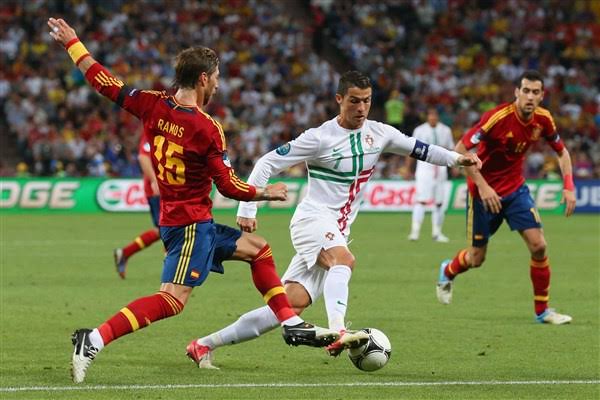


1️⃣ Match Context
This is the kind of World Cup group-stage fixture that doesn’t just shape the table — it shapes the psychology of the entire group. Portugal vs Spain lands with knockout-level tension because one mistake can turn “top spot” into a brutal last-round dependency, where goal difference, yellow cards, and fatigue suddenly matter more than performance.
Portugal arrive with a familiar dynamic: high technical ceiling, but a constant demand for control. Spain arrive with a different kind of pressure — not to qualify (they usually do), but to prove that their possession dominance can still translate into tournament leverage against elite opponents who can live without the ball.
With schedule compression always lurking in World Cup weeks, this is also about energy management. Not just legs — concentration. Teams that dominate territory tend to switch off on the one moment they’re structurally exposed. Teams that sit in mid-blocks tend to concede if their spacing goes sloppy. In a match like this, the margin is often one transition, one set-piece, one bad rest-defense angle.
2️⃣ Form & Advanced Metrics
Portugal’s recent profile is built on controlled chance creation rather than pure shot volume. They don’t need 20 attempts; they want the right 12. Their best attacking sequences come when they can establish territory on the edge of the final third, pull a midfielder out of the line, and then attack the seam — either the half-space cutback zone or the channel between fullback and centre-back. The numbers indicate strong shot quality when they arrive in those zones, but also a slight dependency on timing: if the first pass into the pocket is delayed, the whole move becomes a perimeter recycle.
Defensively, Portugal tend to look “fine” until you look deeper. Their concession profile often comes from moments rather than waves — a lost duel after an ambitious fullback position, a vertical pass that breaks the first line, or a second-ball situation where midfield spacing is a half-step late. That’s why their xGA can remain respectable while the game still feels volatile. They’re not constantly under siege; they’re intermittently exposed.
Spain’s story is more continuous: sustained territory, sustained possession, sustained pressure. Their field tilt is typically strong — they spend long stretches camped in the opponent’s half, pinning fullbacks and forcing clearances. But Spain’s key debate is always the same: how much of that control becomes truly high-value chance creation? If the ball circulates without disorganising the last line, the shot quality trends toward low-to-medium value efforts: edge-of-box strikes, crowded lanes, blocked attempts. When Spain are at their best, they don’t just dominate the ball; they dominate the space behind the midfield line.
Pressing intensity matters here. Spain’s PPDA profile tends to signal an active hunt in the opponent’s build — not necessarily constant all-out pressing, but smart triggers: backwards passes, heavy touches from centre-backs, and receiving on the wrong foot. Portugal, meanwhile, can press, but they’re often more selective, preferring to protect central zones and force play wide, then collapse on the second pass.
Home/away splits are less relevant in a World Cup environment, but what does travel is identity. Portugal are comfortable in games that oscillate. Spain prefer to remove oscillation entirely. That philosophical clash defines the metrics: Spain usually win territory; Portugal usually want to win the decisive moments inside it.
3️⃣ League Table Snapshot
| Team | Group Position | Pts | GF | GA |
|---|---|---|---|---|
| Portugal | — | — | — | — |
| Spain | — | — | — | — |
Takeaway: In World Cup previews, the table is often a trap because two matches can create a misleading hierarchy. What matters is the underlying game-state control: who can sustain pressure without opening transition windows, and who can create high-quality chances without needing a chaotic match. Portugal vs Spain is essentially a referendum on that balance.
4️⃣ Head-to-Head Analysis
Recent Portugal–Spain meetings tend to repeat a structural theme: Spain accumulate territory and passes in the opponent’s half, while Portugal look for the cleanest exits — the first progressive pass into midfield, then a fast attack into the channels before Spain’s rest-defense is fully set.
The psychological layer is subtle. Spain rarely feel “outplayed” even when games are level, because their possession provides emotional control. Portugal rarely panic without the ball, because their plan is built for patience. That means head-to-head history often aligns with tight game scripts: long spells of Spain control, punctuated by Portugal chances that look sharper than Spain’s volume suggests.
If we look deeper, the key question is whether Spain’s territorial dominance converts into consistent central entries. If it becomes too wing-to-wing, Portugal’s box defending improves dramatically. If Spain can pin the double pivot and play through the half-spaces, Portugal’s defensive structure becomes much more fragile.
5️⃣ Tactical Breakdown (Core Section)
Who dictates tempo?
Spain will try to dictate the speed of the game through possession, but Portugal can dictate the importance of moments through transitions. That’s not a cliché — it’s a tactical reality. Spain’s best scenario is a match with few turnovers in the middle third. Portugal’s best scenario is a match where Spain lose the ball with fullbacks high and midfielders ahead of the ball.
Overload zones and the key corridors
The overload zone is likely the half-spaces just outside Portugal’s box. Spain will want their interior midfielders receiving between the lines, forcing Portugal’s midfield to step and then opening the cutback lane. Portugal’s defensive priority is to deny that. Expect them to protect Zone 14 aggressively and allow more circulation wide, betting on crossing variance and crowded box clearances.
For Portugal, the most valuable corridor is the space behind Spain’s advanced fullbacks. When Portugal break, the first pass isn’t always the killer — it’s the second one, once Spain’s centre-backs are running toward their own goal. That’s where shot quality spikes: cutbacks, square passes, and 1v1s created by a disorganised line.
Midfield control battle
Spain’s midfield structure is designed to create numerical superiority around the ball. But there’s a structural nuance here: superiority can become congestion. If Portugal’s midfield can remain compact and force Spain to play outside the block, Spain’s possession becomes predictable. If Portugal overreact and step out too often, Spain will simply play through the vacated lane.
Portugal’s counter-argument is verticality. They don’t need to “win” midfield by passes; they can win it by bypassing it at the right moment. That’s where Spain’s counterpress must be clean. Any hesitation after losing the ball — one player late, one angle wrong — and Portugal have the runway they want.
Pressing triggers and buildup resistance
Spain will press Portugal’s first phase with clear triggers: slow circulation across the back line, passes into a marked pivot, or touches facing their own goal. Portugal’s resistance will depend on their ability to create a third-man escape: centre-back into pivot, bounce pass into fullback/inside channel, then accelerate. If Portugal’s buildup becomes too cautious, Spain’s pressure becomes suffocating and territory swings heavily.
Transition vulnerability
Spain’s vulnerability is not “defending” — it’s defending after losing the ball with numbers committed. Their rest-defense is usually strong, but if their structure gets stretched by wide positioning and a high line, Portugal can create high-quality chances with very few passes.
Portugal’s vulnerability is the opposite: if they defend too deep for too long, they invite the kind of second-wave attacks where Spain recycle possession and probe until a lane appears. That can inflate expected goals through repeated entries, even if Spain’s first shots are blocked.
Set-piece dynamics
In tight elite fixtures, set pieces often become the cleanest edge. Portugal generally carry more direct aerial threat, while Spain’s set-piece value often comes from routines and second balls rather than pure power. If the match trends cagey, the dead-ball quality — delivery, blocking, and rebound awareness — can decide it.
6️⃣ Odds & Market Evaluation
| Market | Odds | Implied Probability |
|---|---|---|
| Portugal win | 3.10 | 32.3% |
| Draw | 3.15 | 31.7% |
| Spain win | 2.45 | 40.8% |
Those prices paint Spain as a modest favourite, which matches the territorial expectation. According to our calculations at betlabel.games, the gap is real but not wide: Spain’s control is valuable, yet Portugal’s transition threat keeps the match closer to a coin-flip than the casual “Spain dominate” narrative suggests.
Market inefficiency: The value doesn’t scream; it whispers. Any edge is likely to be found in derivative markets — protection lines (Draw No Bet), Asian handicaps, or totals that respect a lower-chaos script.
7️⃣ The Hidden Edge (Mandatory Section)
The hidden angle is how possession control can inflate confidence while hiding chance-quality risk. Spain can look dominant for 60 minutes without creating a clear xG advantage if Portugal’s block keeps them outside the premium zones. That creates a deceptive live-reading: the public sees Spain “on top,” but the shot map may still be low-quality and the biggest chance might arrive for Portugal on the break.
There’s also a tournament nuance the market is sometimes slow to price: elite teams protect downside in group games. Portugal are structurally comfortable playing for long phases without the ball, and Spain are structurally comfortable avoiding transition chaos. That mutual preference can drag the match toward a lower-variance state — fewer clear chances, more midfield control, and a higher draw tendency than people expect when two big names meet.
Finally, watch for second-half dynamics. Spain’s control can be constant, but if they don’t score early, they often face a late-game problem: opponents grow into the idea that the draw is valuable, the block gets deeper, and central space disappears. That’s when Spain’s shot profile can become repetitive. If the market prices Spain’s dominance as inevitable, it can be late to adjust to how quickly the game can become strategically “locked.”
8️⃣ Final Prediction
Main Pick: Under 2.5 Goals
Alternative: Portugal +0.5 (Asian Handicap)
Risk Level: Medium
The logic is straightforward:
- Style clash reduces chaos. Spain want controlled possession, Portugal want controlled suffering and selective breaks. That combination often compresses clear chances.
- Portugal’s threat is real but episodic. They can create high-quality looks in transition, yet not necessarily in high volume — which suits an under.
- Spain’s territory doesn’t always equal premium shot quality. If Portugal protect central lanes, Spain may rack up pressure without consistently producing top-tier chances.
No guarantees, and one early goal can change the script. But in probability terms, the more likely game-state is a tight, tactical match where one decisive moment is enough — and where protecting against Spain’s slight edge with handicap cover also makes sense.





Leave a Reply