




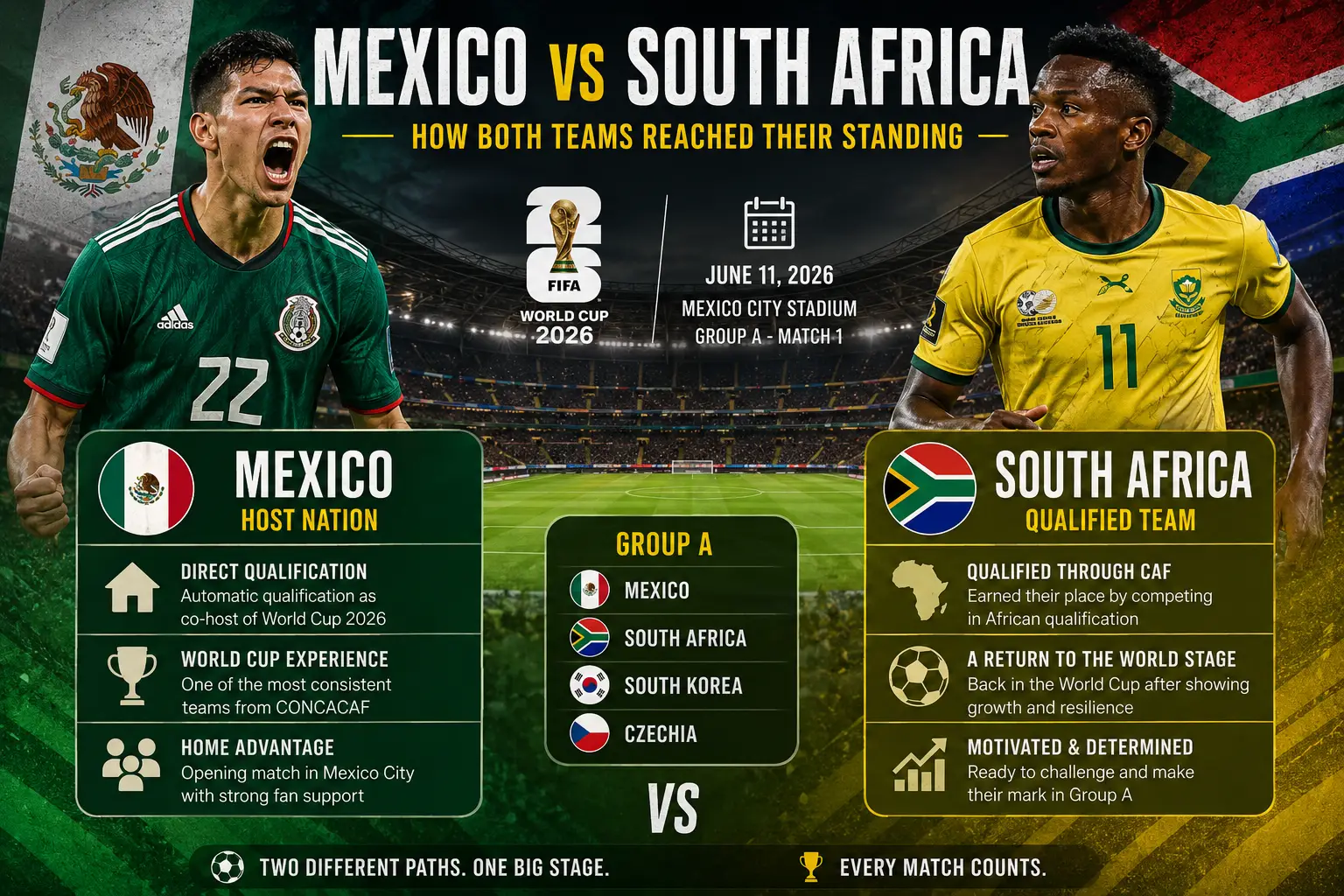


1️⃣ Match Context
World Cup group-stage football rarely offers a “quiet” night, but this one carries a particular kind of pressure. Mexico enter with the familiar weight of expectation: not just to qualify, but to look like a team that belongs in the tournament’s sharp end. For South Africa, it’s a different psychological load — the opportunity to punch above seeding, where one well-managed point can reframe the entire group.
The stakes are straightforward but brutal. Three points for Mexico would validate pre-tournament assumptions and reduce the risk of a nervy final-round scenario. For South Africa, avoiding defeat keeps qualification routes open and, crucially, preserves their ability to play the next matches on their terms rather than chasing.
In tournament football, game state is everything. Mexico tend to face low blocks and must prove they can create clean chances without overcommitting. South Africa’s challenge is to survive Mexico’s early pressure phases without conceding set-piece or transition penalties — the type of goals that feel like “bad luck” but are often structural mistakes under stress.
2️⃣ Form & Advanced Metrics
Mexico’s profile in recent competitive cycles has been consistent: they can control territory, win the ball back quickly, and keep opponents pinned — but their finishing outcomes swing more than the underlying chance creation suggests. The numbers indicate Mexico’s chance volume is usually healthy, yet the shot quality can flatten when opponents deny central access. That’s the key distinction: lots of shots doesn’t always mean lots of danger.
When Mexico’s attack clicks, it’s because their possession has purpose. Their best spells come when they establish field tilt (sustained pressure in the final third), then use third-man runs to attack the half-spaces instead of settling for hopeful wide deliveries. When that rhythm breaks, you see sterile circulation and a jump in low-value shots from outside the box — a recipe for a one-goal game.
Defensively, Mexico generally suppress shots well through proactive pressing. PPDA (passes allowed per defensive action) tends to reflect a team willing to engage high: lower PPDA means more frequent pressure on the ball. But there’s a trade-off. High pressure can expose the space behind the midfield line if the first press is broken. In tournament settings, that’s where “one mistake” goals appear — not necessarily because the back line is poor, but because the rest-defense structure isn’t set when possession turns over.
South Africa’s recent identity leans more pragmatic. They’re comfortable without the ball, and their best football often arrives in transitions: quick forward passes, diagonal switches into space, and direct carries that force defenders to run toward their own goal. Shot volume can be modest, but the shot type matters: fewer attempts, more of them coming after a defensive disruption or second-ball recovery. That’s how underdogs create “real” chances without dominating possession.
The question is whether South Africa can progress the ball under pressure. If Mexico’s press pins their fullbacks and blocks central outlets, South Africa may be forced long, turning the match into repeat waves of Mexican territory control. If they can bypass the first press even occasionally, Mexico’s aggressive positioning becomes a risk rather than a strength.
3️⃣ League Table Snapshot
| Team | Group Position | Points | GF | GA |
|---|---|---|---|---|
| Mexico | TBD | 0 | 0 | 0 |
| South Africa | TBD | 0 | 0 | 0 |
Takeaway: Early group matches are less about current table position and more about shaping future incentives. Mexico want a game state that avoids late chaos. South Africa want a scoreboard that keeps Mexico anxious. Those incentives often push the first half toward control-and-contain rather than pure end-to-end.
4️⃣ Head-to-Head Analysis
With limited recent high-stakes meetings between these specific nations, the most useful “head-to-head” lens is structural rather than historical: how a possession-favored side handles a compact transition team. In these matchups, the pattern is usually stable. The favorite dominates territory and touches in the final third, while the underdog’s best moments come in short bursts — typically after pressing traps, throw-ins, or poorly protected rest-defense.
Past results in similar stylistic pairings often mislead because they over-reward finishing runs. If we look deeper, the decisive factor is whether the underdog can turn defensive stands into genuine shot quality, not just relief clearances. If South Africa can turn 2–3 transition sequences into high-value central entries, the game becomes uncomfortable for Mexico regardless of overall possession numbers.
5️⃣ Tactical Breakdown (Core Section)
Who dictates tempo?
Mexico will try to set the match in a mid-to-high tempo possession rhythm: quick circulation, aggressive counter-pressing, and long spells of territorial pressure. South Africa’s incentive is to slow Mexico’s progress through the middle, let them have the ball in harmless zones, then spike the pace only when transition windows appear.
The overload zone: half-spaces vs wide funnels
Mexico’s most sustainable chance creation comes from half-space occupation — receiving between fullback and center-back, then cutting back into central zones. Expect South Africa to defend with a compact block, prioritizing central protection and forcing Mexico wide. That “wide funnel” can look like control for Mexico, but it often reduces shot quality if the box is well protected.
If Mexico’s fullbacks push high, the cross volume can rise. But crossing is only efficient when the delivery is cut back from the byline or arrives after a defensive rotation. Early, floated crosses usually inflate shot counts without inflating expected goals.
Midfield control battle
This match tilts on Mexico’s ability to prevent South Africa from playing through the first pressure line. Mexico’s midfield needs to stay connected behind the press: close enough to win second balls, but disciplined enough not to leave a clean runway for carries.
South Africa will likely target the space next to Mexico’s advanced fullback. The mechanics are simple: win the ball, hit the channel, force the nearest center-back to step out, and then attack the gap created. Those are the few moments where an underdog can create high-quality chances without needing long possession phases.
Pressing triggers and buildup resistance
Mexico’s pressing triggers tend to activate on slow lateral passes and heavy touches in the first phase. If South Africa’s center-backs and keeper are comfortable playing through pressure, they can turn Mexico’s aggression into a source of instability. If they aren’t, Mexico will live in the final third.
That’s why the first 20 minutes matter: not for goals, but for information. Can South Africa exit? Can Mexico trap? The tactical answer often decides the betting angle before the scoreboard does.
Transition vulnerability
Mexico’s risk is structural: committing numbers forward without clean rest-defense spacing. South Africa’s risk is physical and mental: absorbing pressure for long spells can lead to a single lapse — a missed runner at the far post, a poorly defended cutback, or a set-piece second ball.
Set-piece dynamics
In tight tournament matches, set pieces are a hidden equalizer. Mexico’s territorial control can create a steady flow of corners and free kicks, which increases the chance of a “cheap” goal. South Africa, meanwhile, will view every dead-ball delivery as a high-leverage moment — especially if open-play chance creation is limited.
6️⃣ Odds & Market Evaluation
| Market | Odds | Implied Probability |
|---|---|---|
| Mexico Win | 1.72 | 58.1% |
| Draw | 3.60 | 27.8% |
| South Africa Win | 5.40 | 18.5% |
Note: The implied probabilities above include overround, so they won’t sum to 100%.
According to our calculations at betlabel.games, Mexico’s win probability is a touch lower than the market’s headline confidence, largely because this matchup can compress into a low-margin game state: Mexico controlling, South Africa surviving, and the outcome hinging on one finishing moment or one transition mistake.
That doesn’t mean Mexico aren’t the rightful favorite. It means the current price can be slightly tight if you expect South Africa’s defensive compactness to drag the game toward a draw-friendly script.
7️⃣ The Hidden Edge (Mandatory Section)
There’s a structural nuance here: Mexico’s territorial dominance often looks more decisive than it is. When opponents successfully deny central entries, Mexico can end up with impressive field tilt but only moderate shot quality. In betting terms, this creates a common market trap — overrating “control” and underrating how often that control turns into low-value attempts.
On the other side, South Africa’s threat can be underpriced because transition football doesn’t show up as constant pressure. It shows up as two or three sequences that matter. Markets sometimes price underdogs as if they need sustained attacking volume to score; transition teams can score with far less volume if the chances are the right type.
Another angle: tournament psychology. Mexico often carry the burden of having to “prove” superiority. That can accelerate decision-making in the final third — faster shots, riskier passes — which increases variance. If this stays 0–0 into the second half, the match becomes more volatile, and the underdog’s value rises through game-state pressure alone.
8️⃣ Final Prediction
Main Pick: South Africa +1.0 (Asian Handicap)
Alternative: Under 2.5 Goals
Risk Level: Medium
The logic is clean:
- Matchup compression: Mexico can dominate territory yet still be funneled into lower-quality shooting zones, keeping the margin tight.
- Transition threat: South Africa don’t need many attacks — they need a few high-leverage breaks, which Mexico’s aggressive rest-defense can allow.
- Tournament incentives: Early group games often produce controlled second halves unless the favorite scores early; that supports both the handicap and the under angle.
No guarantees — but the value case is that the market may be pricing Mexico’s control more than Mexico’s separation. In a game where one moment can decide it, taking the underdog protection is a rational way to buy margin.





Leave a Reply