




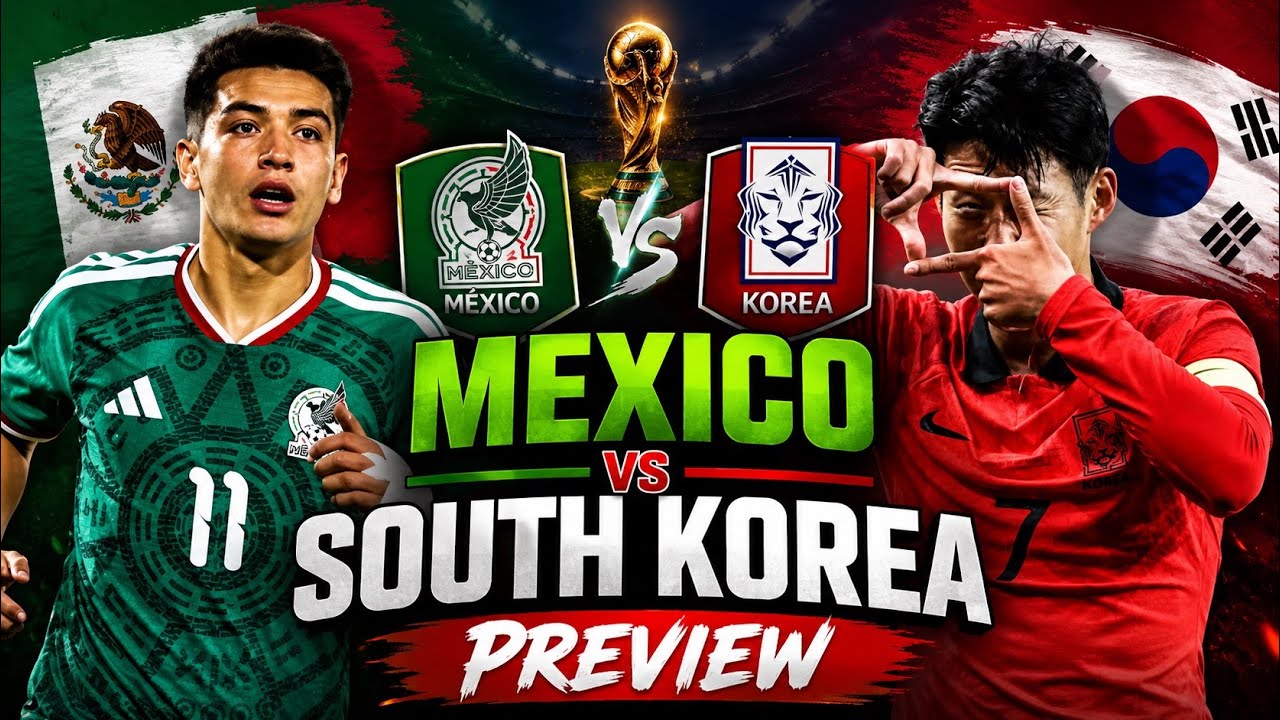


1️⃣ Match Context
World Cup group games rarely feel “routine”, but this one has a particular edge: it’s a classic hinge fixture. Mexico arrive with the familiar weight of expectation — not just to qualify, but to do it convincingly. South Korea, meanwhile, tend to live in the margins at tournaments: competitive in most games, rarely blown away, and often one moment away from flipping a group.
That psychological split matters. Mexico are usually judged on control and initiative; Korea are judged on resilience and transitions. In a group setting, those identities create pressure asymmetry. Mexico are expected to dictate. Korea are allowed to be pragmatic — and that freedom can make them dangerous.
Schedule context also plays a role. Tournament minutes accumulate fast, and teams that rely on high-tempo pressing and sprint volume can show visible second-half drop-offs by match two or three. Korea’s game is built on intensity. Mexico’s is built on rhythm and territory. If we get a game-state where Mexico lead, Korea’s chase can open spaces. If Korea score first, Mexico’s possession can turn into anxiety.
2️⃣ Form & Advanced Metrics
Mexico’s recent profile is built on territory control and repeatable chance creation rather than pure shot storms. They typically generate a healthy stream of box entries and cutback situations — the kind of chances that don’t always inflate shot volume, but do raise shot quality. In xG terms, Mexico tend to look better when their wide rotations create central finishing lanes instead of early crosses.
Defensively, the numbers often show a team that limits total shots but can be punctured by directness. Opponents don’t always shoot often, but when they do, it can come from a higher-value location — especially if Mexico’s fullbacks are advanced and the rest-defence spacing is stretched. That’s where volatility creeps in: Mexico can look in control, then concede one transition that counts.
South Korea’s metrics usually lean into a different kind of stability. They are comfortable without long spells of possession, and their best attacking sequences are frequently built on quick vertical access after turnovers. When Korea’s press is working, their PPDA (passes per defensive action) tends to drop — meaning they engage earlier and force shorter possessions from the opponent. But that intensity comes with a cost: if the first press is bypassed, Korea can be exposed in the channels, defending while running toward their own goal.
Tempo-wise, this matchup is a clash. Mexico prefer controlled pace, circulating to move the block and create the one clean entry. Korea prefer a game with more edge — more duels, more second balls, more transitions. If Mexico can slow the game and keep field tilt (share of territory/attacking time) in their favour, Korea’s threat lowers. If Korea turn it into a sprint contest, Mexico’s defensive structure is tested.
3️⃣ League Table Snapshot
| Team | Group Position | Points | GF | GA |
|---|---|---|---|---|
| Mexico | — | — | — | — |
| South Korea | — | — | — | — |
Takeaway: early group dynamics often lie. A team can look “fine” on points while living off low-probability finishing, or look “in trouble” while posting strong underlying shot quality. For Mexico and Korea, the truer read tends to come from how sustainable their chances are: Mexico want repeatable entries; Korea want repeatable transition wins. Whichever is happening more often is usually the real table.
4️⃣ Head-to-Head Analysis
The most useful thing about this head-to-head isn’t the scores — it’s the recurring pattern. Mexico generally look to pin Korea’s wide defenders and create overloads that lead to cutbacks. Korea generally look to turn Mexico’s fullback advances into counter lanes. When these teams meet, the game often becomes a tug-of-war between Mexico’s positional play and Korea’s ability to keep the match in a “broken” state.
If we look deeper, past meetings tend to reflect a simple truth: Mexico are more comfortable when they score first; Korea become far more dangerous when they don’t need to manage risk. So the first goal is not just a scoreboard event here — it changes the match ecosystem.
5️⃣ Tactical Breakdown (Core Section)
Who dictates tempo?
Mexico will try to. Expect longer spells of circulation, with their midfield trying to pull Korea’s first line out and then find the half-spaces. The key is whether Mexico can progress through the second line cleanly. Korea’s mid-block can look passive until a pressing trigger appears — a backwards touch, a heavy reception, a lateral pass near the touchline — and then the jump is aggressive.
Overload zones and exposed flanks
Mexico’s best attacking moments usually come when their wide players aren’t isolated. They want a winger + underlap/overlap + a central midfielder arriving as the third man. That can overload Korea’s fullback zones and create the classic low-cross chance. But it also means Mexico often commit numbers to one side, leaving the far-side spacing thinner.
Korea will target that. Their transition preference is to attack into space early, especially into the channel behind an advanced fullback. If Mexico’s rest-defence is a flat line, one diagonal run can force a emergency recovery sprint — and those are exactly the moments where high-value chances appear.
Midfield control battle
This match is likely decided in the “boring” area: second balls, rebound control, and who wins the next action after an initial duel. Mexico want to play through. Korea want to interrupt and restart. If Mexico’s midfield can receive on the half-turn consistently, Korea’s press becomes less effective and the game settles into Mexico’s preferred rhythm.
Pressing triggers and buildup resistance
Korea’s press is most dangerous when it forces Mexico into predictable wide buildups. If Mexico’s centre-backs can break lines with a vertical pass into a secure receiver, Korea’s PPDA advantage disappears and the press becomes chasing. Conversely, if Mexico are forced into repeated wide resets, Korea can compress the touchline and win turnovers in advanced areas — the highest leverage scenario for their attack.
Transitions and set pieces
Transition defence is the swing factor. Mexico can look dominant until they lose one pass with both fullbacks high. Korea can look under pressure until they win one duel and suddenly have a 3v3 running at pace. On set pieces, Mexico’s threat is typically stronger through delivery and bodies attacking zones, while Korea’s danger often comes from second-phase chaos. In tournament football, that chaos is value — it’s how “even” matches break.
6️⃣ Odds & Market Evaluation
| Market | Selection | Odds | Implied Probability |
|---|---|---|---|
| 1X2 | Mexico | 1.95 | 51.3% |
| 1X2 | Draw | 3.35 | 29.9% |
| 1X2 | South Korea | 4.10 | 24.4% |
Market read: Mexico are priced as the clear favourite, but not an overwhelming one. According to our calculations at betlabel.games, Mexico’s true win probability is closer to the high-40s than the low-50s, largely because Korea’s transition profile tends to travel well in neutral-site tournament games.
That doesn’t automatically make Korea “value” — it just means the favourite is slightly expensive at current pricing. The more interesting angle is often in derivatives: protection against the draw, or totals that reflect game-state volatility.
7️⃣ The Hidden Edge (Mandatory Section)
There’s a structural nuance here that markets often underweight: Mexico’s control can be real without being safe. They can win the territory battle, rack up decent xG, and still allow a small number of very high-quality Korea chances — the kind that don’t show up as “lots of shots conceded”, but do show up as big moments.
This is where xG composition matters. If Mexico’s chances are steady but mostly medium-value (cutbacks contested, shots under pressure), while Korea’s are fewer but cleaner (first-time finishes in transition, central lanes), the match becomes more draw-prone than casual pricing implies.
Add tournament psychology: Mexico often feel the need to turn dominance into a win. If it stays 0-0 into the later phases, their risk appetite increases — and that can feed directly into Korea’s best phase of the game. The market tends to price “Mexico control” as “Mexico safety”. Those are not the same thing.
8️⃣ Final Prediction
Main Pick: South Korea +0.75 (Asian Handicap)
Alternative: Under 2.75 Goals
Risk Level: Medium
Why these angles hold up:
1) Matchup logic: Korea’s transition threat is specifically designed to punish Mexico’s fullback height and rest-defence spacing. That keeps Korea “alive” even if Mexico dominate territory.
2) Game-state volatility: Mexico can generate the better overall chance volume, but Korea’s chance quality spikes in fewer moments. That often translates into draws or narrow margins rather than comfortable favourites’ wins.
3) Pricing discipline: Mexico at sub-2.00 needs a clean control-to-conversion pathway. Korea +0.75 gives room for the most likely resistance outcomes — a draw, or even a one-goal Mexico win — without needing Korea to dominate.







Leave a Reply