




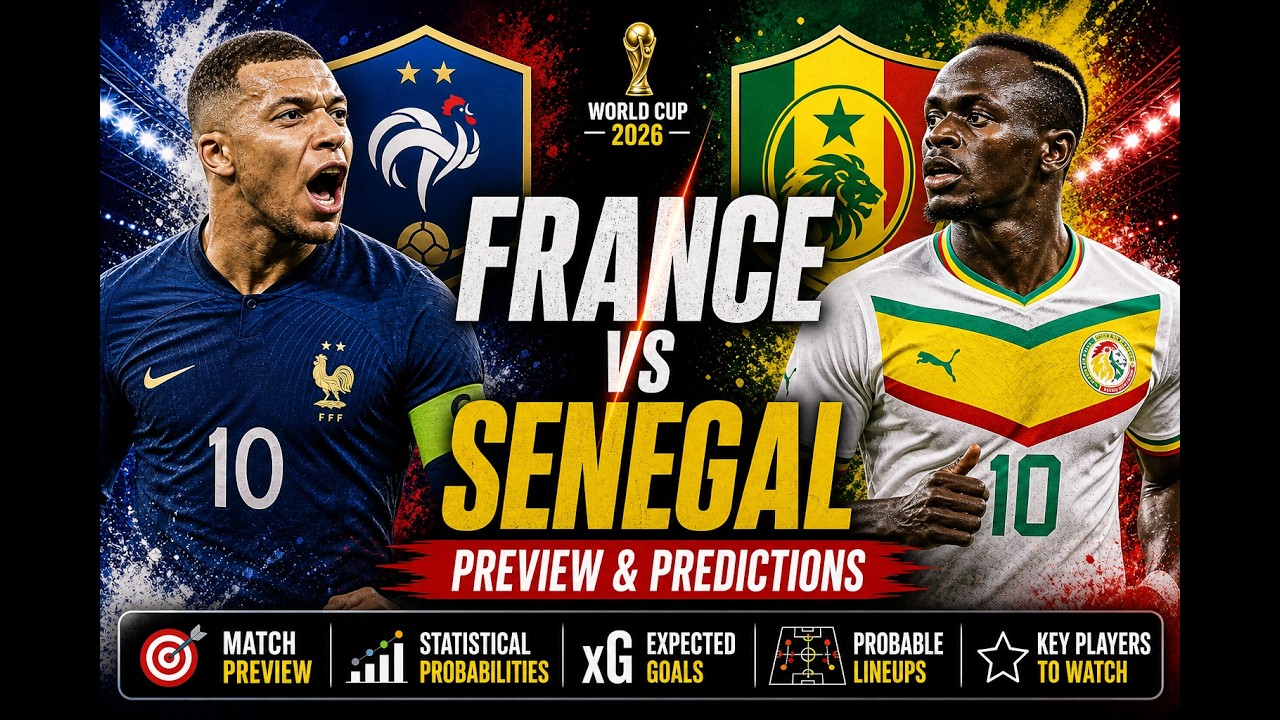


1️⃣ Match Context
This is the kind of World Cup game where the name on the shirt sets the price, but the game state sets the truth.
France arrive with the familiar burden of expectation: anything short of control feels like underperformance, even when the opponent is elite in their own right. Senegal, meanwhile, step into a pressure profile they tend to enjoy—underdog on the board, equal on the grass for long spells, and dangerous the moment a favorite loses structure.
In tournament football, the first order of business isn’t beauty. It’s leverage. Points change the geometry of a group: win and you can manage minutes, manage risk, and manage emotion in the next round of fixtures. Drop points and the schedule becomes louder—more urgency, more exposure, more fatigue.
That psychological layer matters here. France can carry the ball and dominate territory, but domination without separation is where anxiety starts creeping into decision-making: early crosses, rushed shots, a few extra men committed forward. Senegal’s best moments often come precisely in those windows—when the opponent feels they “should” be ahead.
2️⃣ Form & Advanced Metrics
France’s underlying profile is typically built on two pillars: territorial pressure and shot quality. They don’t just shoot a lot—they engineer shots that matter, especially from the half-spaces where cutbacks and delayed runs create high-value chances. When they’re right, you see it in the pattern: sustained field tilt, opponents pinned, and a steady drip of penalty-box touches rather than speculative volume.
The interesting bit is the trade-off. France can look defensively solid for long stretches, but the moments they concede are often clean—a transition that bypasses midfield, or a direct run at a back line that’s spaced for possession rather than protection. That creates a specific kind of volatility: low shot volume conceded, but higher average shot quality when the press is beaten.
Senegal’s numbers tend to reflect a side comfortable without the ball and comfortable arriving quickly. Their attacking xG profile usually isn’t about 18-shot nights; it’s about fewer shots with better routes—fast entries, central access, and the kind of one- or two-pass sequences that force defenders to turn. If we look deeper, Senegal’s best work comes when they can pull a fullback high, win the second ball, and attack the channel behind the advanced wide defender.
Pressing intensity is the other hinge. France can play through pressure when their spacing is clean—third-man combinations, goalkeeper involvement, and a pivot who can receive under contact. Senegal’s pressing is less about constant chase and more about triggers: a backward pass, a heavy touch to the fullback, a square ball in front of the midfield line. That’s where PPDA context matters. A low PPDA doesn’t just mean “they press a lot.” It means the opponent is being forced into decisions earlier than they’d like—and earlier decisions tend to be simpler, more predictable, and more direct.
Home/away splits are less relevant at a World Cup venue, but what does translate is game-state behavior. France with an early lead slow the pace and suffocate; France chasing tends to open the floor. Senegal are the opposite: they’re at their most dangerous when the match is still negotiable—0–0 or 1–0 either way—because their transition threat stays credible and keeps the opponent honest.
3️⃣ League Table Snapshot
World Cup 2026 – Group snapshot (pre-match)
| Team | MP | W | D | L | GF | GA | Pts |
|---|---|---|---|---|---|---|---|
| France | 0 | 0 | 0 | 0 | 0 | 0 | 0 |
| Senegal | 0 | 0 | 0 | 0 | 0 | 0 | 0 |
The table says nothing yet, but the stakes are already visible: a France win buys control of the group narrative. A Senegal result forces France into a higher-variance path where every next match becomes a must-manage scenario rather than a must-win scenario.
4️⃣ Head-to-Head Analysis
Head-to-head history isn’t a blueprint here; the squads, cycles, and contexts change too quickly. What does translate is the stylistic friction we’ve seen whenever a top-tier possession favorite meets an opponent with real athletes in the middle and real pace on the last line.
France usually want the opponent to defend deep and narrow, because that creates predictable patterns: circulate, isolate a winger, cutback, finish. Senegal’s best version doesn’t give you that comfort. They’ll defend compact, yes, but they also step into midfield duels early, contest second balls, and make the favorite restart attacks rather than keep flowing.
When past meetings between similar profiles have swung, it’s rarely been about shot counts. It’s been about who wins the “first five seconds” after possession changes. That’s where Senegal can bite.
5️⃣ Tactical Breakdown (Core Section)
Who dictates tempo?
France will try to dictate by possession structure: a controlled build, fullbacks providing width, and midfielders arriving into the half-spaces to overload the zone between Senegal’s midfield and back line. Expect France to push territory—high field tilt, longer spells in the attacking third, and a rhythm designed to wear down Senegal’s concentration.
Senegal’s tempo control is different. They don’t need the ball to control the match. They need the match to be punctuated. Short defensive phases, then sharp attacks that force France to run back toward their own goal. Every sprint back is a tax on France’s ability to sustain pressure.
The overload zone
The key zone is France’s right half-space (and Senegal’s left defensive channel). France’s best chance creation often comes when they can combine wide-to-inside: winger holds width, interior runner attacks the seam, and a late arrival threatens the edge of the box. Senegal will likely counter by keeping a midfielder close enough to help the fullback—turning 1v1s into 2v2s and asking France to beat them with circulation rather than direct isolation.
Which flanks are exposed?
France’s fullbacks/wingbacks (depending on the exact shape) can be aggressive. That’s opportunity and risk in the same breath. If France lose the ball with the wide defenders high, Senegal’s first pass will look for the channel behind them. The danger isn’t just the sprint; it’s the decision that follows: center-backs stepping wide opens the middle, staying compact concedes territory. Senegal thrive in forcing that dilemma.
Midfield control battle
This is where the match is priced. France have the higher technical ceiling, but Senegal can compress space and make receptions uncomfortable. Watch for France’s pivot options: if the deepest midfielder can receive on the half-turn, France progress cleanly and camp in the final third. If Senegal can force side-on receptions and backwards touches, France’s attacks become slower—and slower attacks let Senegal set their block.
Pressing triggers and buildup resistance
Senegal’s pressing triggers should be clear: passes into the fullback under pressure, or square balls in front of the midfield. France’s solution is to create a spare man—either by dropping a midfielder between center-backs or by using the goalkeeper to stretch the first line. If France do that well, Senegal’s press becomes costly and gaps appear behind the first wave.
But if France are even slightly loose, Senegal can generate the best kind of shots in tournament football: fast, central, and before the defense is set.
Transition vulnerability
The biggest structural nuance here is France’s rest defense—the shape they hold behind the ball while attacking. If their attacking structure leaves only two true protectors against Senegal’s first outlet, you’ll see a match that looks comfortable until it suddenly isn’t. Senegal don’t need ten counters; they need two or three high-quality ones.
Set-piece dynamics
Set pieces could be a silent swing factor. France will generate corners simply through territory. Senegal, with their physical profile, won’t fear defending them—and can flip them into counter opportunities if France commit too many bodies. On the other side, Senegal’s own dead-ball delivery is a real threat against any team that switches off for half a second. In tournament football, those half-seconds decide outcomes.
6️⃣ Odds & Market Evaluation
| Market | Selection | Odds | Implied Probability |
|---|---|---|---|
| 1X2 | France | 1.62 | 61.7% |
| 1X2 | Draw | 3.75 | 26.7% |
| 1X2 | Senegal | 5.80 | 17.2% |
Implied probabilities are raw (not margin-adjusted).
According to our calculations at betlabel.games, the true win probability for France is slightly lower than what a “name-driven” price often implies in this matchup. Not dramatically—France are rightly favorites—but enough to create interest in Senegal-friendly structures rather than taking the short home price.
This looks like a market where the edge is marginal on 1X2, but clearer once you move into handicaps and totals that account for Senegal’s transition threat and France’s tendency to control territory without always blowing teams away.
7️⃣ The Hidden Edge (Mandatory Section)
The market’s slowest adjustment in games like this is usually not about team quality. It’s about how the favorite’s control translates into separation.
France can dominate field tilt and still end up with a match stuck in one-goal margins because the opponent’s defensive scheme doesn’t concede the “easy” shots. Senegal are built to force you wide, contest cutbacks, and turn the box into a crowded decision tree. That often lowers shot volume quality even when xG looks healthy on paper—because a chunk of that xG comes from repeated medium-quality situations rather than one or two huge chances.
Meanwhile, Senegal’s attacking output can look quiet in raw volume, but their shot quality spikes when they do arrive. That’s a classic regression trap for casual pricing: low shot count gets interpreted as low threat, even when the type of shots are the ones that beat elite teams in tournaments.
There’s also a structural second-half angle. Favorites who control territory tend to push even higher late on when the score is close—more bodies forward, more fullbacks advanced, more counter-exposure. Senegal’s bench profile historically fits that moment: fresh legs, direct running, and a willingness to turn a single turnover into a decisive sequence. If the match is level or France are only one ahead after 60 minutes, Senegal’s live threat increases more than most pre-match models account for.
8️⃣ Final Prediction
Main Pick: Senegal +1.0 (Asian Handicap)
Alternative: Under 3.0 (Asian Total)
Risk Level: Medium
Why these angles hold value:
1) Matchup elasticity. France should control territory, but Senegal’s transition profile can keep the game within one goal for long stretches—exactly what +1.0 is built to capture.
2) Shot quality distribution. France will likely generate more, but Senegal’s best moments are high-value and central, creating a tighter expected-goal gap than the 1X2 price implies.
3) Tournament incentives. In a World Cup setting, France are less likely to play a high-chaos second half unless forced. That tends to suppress blowouts and supports handicap and under positions.
No guarantees—France have the individual quality to break any structure. But if you’re pricing probability rather than prestige, Senegal +1.0 is the cleaner way to express the read.





Leave a Reply