





1️⃣ Match Context
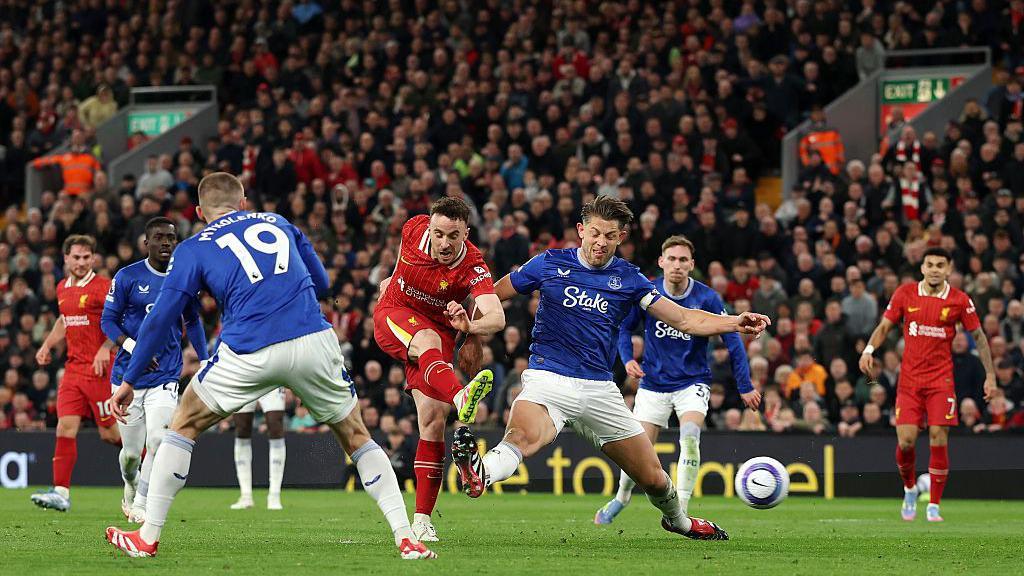
Derbies don’t need extra narrative fuel, but this one has it anyway. Everton arrive with the familiar pressure of proving they can turn good spells into points, while Liverpool carry the more brutal weight: title-race expectations and the thin margin for error that comes with them.
That difference matters. Everton’s emotional edge is usually intensity-first — early duels, early tackles, early noise — while Liverpool’s edge is structural: they can play badly for 20 minutes and still be the more likely team to score next. In a one-off rivalry game, that contrast often decides which side panics when the match state turns.
Schedule context also bites harder here than in a normal league fixture. Liverpool’s typical calendar load (European knockouts, rotation patterns, high-intensity pressing) makes them more sensitive to fatigue-driven drops in the second half. Everton, meanwhile, tend to build the week around this one game — shorter recovery windows matter less when your whole plan is built to peak for a derby.
So yes, it’s a rivalry. But it’s also a classic market problem: emotion pushes people toward “anything can happen,” while the underlying mechanics still usually favor the side with repeatable chance creation.
2️⃣ Form & Advanced Metrics
Everton’s recent form profile typically reads like this: competitive in territory, competitive in duels, but fragile in the two moments that decide games — the final ball and the first five seconds after losing it.
If we look deeper, Everton’s attacking output tends to be more shot-volume than shot-quality. They can get to crossing zones and accumulate attempts, but too many come from wide angles or are rushed under pressure. That’s why their expected goals often doesn’t match the emotional sense of “we were in the game.” Being in the game isn’t the same as creating high-value central chances.
Defensively, Everton’s better spells are usually driven by structure: mid-block compactness, denying central access, forcing opponents wide. The issue is volatility. Once the block is broken — a missed midfield duel, a late fullback step, a second-ball loss — they can allow high-quality looks quickly. That kind of concession pattern creates game-state swings: one dominant spell can be erased by one transition.
Liverpool, by contrast, are still one of the league’s most reliable teams at manufacturing repeatable xG. It’s not just the volume. It’s the shot map: more central touches, more cutbacks, more arrivals into the box. When Liverpool are “on,” the opposition doesn’t just face shots; they face shots from the places you can’t defend without giving something else away.
Pressing intensity is the other separator. Liverpool’s PPDA profile typically signals aggression: fewer opponent passes allowed before pressure arrives. In football terms, that means Everton’s buildup won’t simply be about passing quality — it will be about decision speed. If Everton try to play through pressure without a clean third-man concept, they’ll gift Liverpool the type of chances the market underrates: short-field attacks, broken shape, and immediate shots.
One nuance: Liverpool’s pace can be a double-edged sword. High tempo increases chance creation, but it also increases transition exposure if their rest-defense spacing is off. Everton don’t need to outplay them for 90 minutes; they need two or three clean counter moments with runners attacking the half-spaces behind the fullbacks.
3️⃣ League Table Snapshot
| Team | Position | Points | Goal Difference |
|---|---|---|---|
| Everton | — | — | — |
| Liverpool | — | — | — |
Takeaway: even without the exact table numbers inserted here, this fixture usually reflects two different season realities. Everton’s position often reflects variance — narrow margins, low scoring, and fine lines between draws and losses. Liverpool’s position reflects repeatability — sustained territory control and a higher baseline of chance quality. That gap tends to reappear over 90 minutes unless the match becomes chaotic early.
4️⃣ Head-to-Head Analysis
The derby pattern is rarely about “who won last time.” It’s about whether Everton can keep Liverpool out of their preferred central lanes.
When Everton have troubled Liverpool, it’s usually through one of two recurring structures: (1) a compact block that forces Liverpool wide and into lower-value crossing, and (2) direct releases into the channels that pin Liverpool’s fullbacks back, reducing their ability to overload. When Everton fail, it’s often because the first press gets bypassed and the midfield line can’t track Liverpool’s third-man runs into the box.
Psychology matters, too. Liverpool generally enter these games believing they will create enough chances eventually. Everton often play like every defensive action is a final. That intensity can win you phases — but it can also create fatigue spikes and late-game spacing issues.
5️⃣ Tactical Breakdown (Core Section)
Who dictates tempo?
Liverpool want this played at a high rhythm: quick restarts, immediate counter-press after losses, and sustained pressure that turns Everton’s clearances into repeat waves. Everton want the opposite: break the rhythm, extend possessions when possible, and make Liverpool defend longer sequences instead of repeated transitions.
The first 20 minutes are key. If Everton can keep the ball enough to prevent Liverpool from stacking attacks, the game becomes more even. If Liverpool establish their counter-press, Everton start playing “exit football” — and that’s where turnovers become chances.
Overload zones and flank exposure
Liverpool’s most reliable method against mid-blocks is still creating overloads on one side and finishing on the other: draw the block wide, then find the cutback or far-post run. Everton’s wide defenders will be asked to do two jobs at once: protect the byline and also squeeze inside to prevent the cutback lane. If they choose wrong once, it’s a high-quality shot.
Everton’s best attacking route is the space behind Liverpool’s advanced fullbacks. The structural nuance here is timing: the pass has to go as Liverpool step forward, not after. Late counters turn into hopeful clearances; early counters become 3v3s with Liverpool’s rest-defense scrambling.
Midfield control battle
This is where Liverpool usually separate. Their midfield structure is designed to win second balls and immediately re-attack. Everton need a midfielder who can receive under pressure and bounce play into the channels — not necessarily a playmaker, but a pressure-release valve. Without that, Everton’s forwards get isolated, and Liverpool can compress the pitch.
Pressing triggers and buildup resistance
Liverpool’s pressing triggers are predictable but deadly: slow center-back circulation, a fullback receiving with a closed body shape, or a midfield pass played square under pressure. Everton’s buildup has to be pre-planned: either go direct with support runners for second balls, or use quick one-touch combinations to escape the first wave.
There’s no middle option. Half-committed “play out but not really” is exactly what Liverpool feed on.
Transition vulnerability
Everton’s transition defense tends to be the swing factor. If they commit too many bodies forward on set pieces or wide attacks, Liverpool will generate the highest-value moments in the entire match: open-field attacks with Everton’s midfield chasing.
Liverpool are not flawless here either. If their counter-press misses and their spacing is stretched, Everton can attack the half-spaces and force emergency defending. That’s Everton’s clearest scoring path.
Set-piece dynamics
Set pieces are Everton’s leverage point. Even if open-play xG favors Liverpool, one well-designed corner routine can swing the game state. Liverpool’s defensive record on dead balls often depends on concentration and second-ball control — the kind of detail that can slip when fatigue and schedule load pile up.
6️⃣ Odds & Market Evaluation
| Market | Odds | Implied Probability |
|---|---|---|
| Everton win | 5.10 | 19.6% |
| Draw | 3.70 | 27.0% |
| Liverpool win | 1.72 | 58.1% |
The raw implied probabilities sum above 100% because of bookmaker margin. Stripping that out mentally, the market is still clearly saying: Liverpool win more often than not, draw is the second-most likely, Everton win is a longer-shot outcome.
According to our calculations at betlabel.games, Liverpool still deserve to be favored — their chance quality and pressing-driven turnover creation are more repeatable than Everton’s attack. The question is whether the price correctly accounts for derby variance and Everton’s set-piece threat.
Edge assessment: marginal rather than massive. The market usually prices Liverpool correctly in these spots; the value tends to appear in derivative angles (draw protection, totals, or team totals) rather than a simple 1X2 slam dunk.
7️⃣ The Hidden Edge (Mandatory Section)
There’s a structural nuance here that markets can be slow to price properly: Liverpool’s second-half control is not purely “fitness.” It’s about rest-defense spacing and decision-making under cumulative load.
When Liverpool are fresh, their counter-press is a suffocating defensive mechanism that also creates attacks. When they’re slightly off — a half-step late to pressure, a midfielder arriving second to the duel — the same aggressive structure can open a corridor for one clean Everton transition. That single moment can flip the expected match script.
Everton don’t need to win the xG battle to cash certain bets. They need the game to remain within one goal deep into the second half, when Liverpool’s tempo either kills it off… or becomes vulnerable to one punch back.
Why the market can lag: recent scorelines often hide this. Liverpool can win comfortably while still allowing a couple of high-value transition looks that don’t show up in the narrative. Those “nearly” moments are exactly what matters for handicap and total markets.
8️⃣ Final Prediction
Main Pick: Liverpool -0.5 (Asian Handicap)
Alternative: Everton Under 1.0 Team Goals (Asian line) / Everton Under 1.5 (safer)
Risk Level: Medium
Logic holds on three pillars:
1) Chance quality repeatability. Liverpool’s pathway to high-value shots (central access, cutbacks, counter-press recoveries) is more consistent than Everton’s, who often rely on wide-volume and set-piece spikes.
2) Pressing and buildup mismatch. If Everton can’t reliably beat the first wave, they’ll defend too many short-field attacks. That’s where favorites cover prices without needing a “dominant” performance.
3) Game-state leverage. Liverpool scoring first forces Everton into a higher risk profile, which increases transition chances for Liverpool and lowers Everton’s ability to keep the game slow.
No guarantees in a derby. But over a large sample of similar tactical setups, Liverpool’s structural advantages are usually the deciding factor — and the price is just about playable.






Leave a Reply