




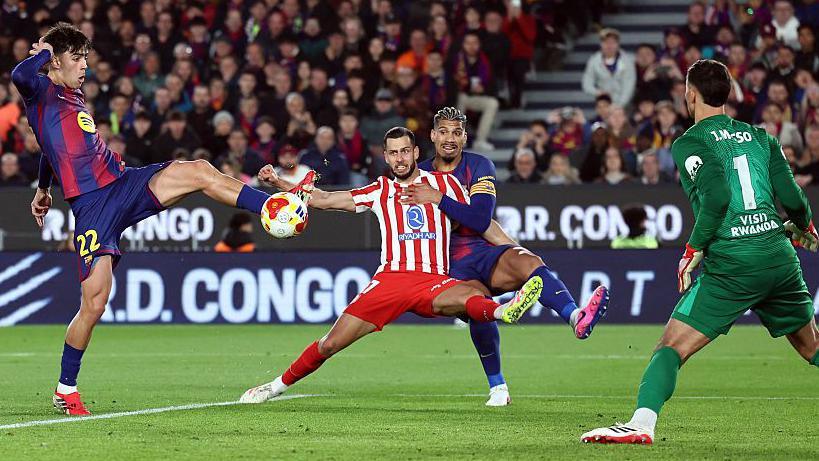


1️⃣ Match Context
This is the kind of Champions League night where the game starts before kickoff. Barcelona at home in April is usually a statement setting: control the ball, control the tie, control the narrative. Atletico Madrid arrive built for the opposite storyline — reduce the game, dirty the rhythm, and keep the scoreline alive for the return leg.
The pressure profiles are different. Barcelona carry the expectation of dominance and “should” progression; Atletico carry the comfort of being the opponent nobody enjoys playing. That asymmetry matters in UCL ties: the favorite often plays with a thin layer of anxiety if the first 25 minutes don’t produce a lead. Atletico’s entire strategy is designed to amplify that feeling.
Schedule load is the invisible third team. Both clubs will be in the thick of domestic title races and late-season minutes management, but Barca’s model typically asks for more repeated high-intensity possession recoveries (counter-pressing, rest-defense sprints). Atletico can conserve without conceding territory psychologically. In a two-leg context, that energy differential can show up late — exactly when market totals and late-goal prices get interesting.
2️⃣ Form & Advanced Metrics
Barcelona’s recent European form tends to look the same on the pitch: long spells in the opponent’s half, high field tilt, and a steady stream of shots created from structured possession. The key nuance is shot quality. Barca can generate volume without always accessing the prime central corridor; when opponents keep the box compact, Barca’s chance map often stretches wide — cutbacks and second-phase shots rather than a constant diet of 0.30+ xG looks.
Defensively, Barca’s profile is usually less about allowing lots of shots and more about the type of shot they allow when the press is broken. If the first line gets bypassed, the game can become binary: either the counter-press kills the transition instantly, or the opponent finds a high-value run into the space behind the midfield. That’s where volatility lives — not in “shots conceded,” but in the quality of the few they do concede.
Atletico’s metrics typically read like a team that refuses to overextend. Their xGA is often driven down by location control: opponents shoot, but from where Simeone wants them to shoot. The trade-off is that Atletico rarely flood the shot count themselves. Their attacking output is more state-dependent: they spike xG in transition moments, set pieces, and short combinations after winning the ball in a pre-defined trap zone.
Pressing intensity matters here. Barcelona’s PPDA generally indicates a proactive press — fewer passes allowed before a defensive action — but the real story is what happens after the press. Barca want immediate re-circulation in the final third. Atletico want immediate verticality or a foul to reset. That clash shapes tempo. Expect phases: Barca throttle up, Atletico slow it down, then one transition decides the emotional temperature of the entire tie.
Home/away dynamics sharpen the contrast. Barca at home usually push their territorial control higher and compress the field. Atletico away are comfortable with long stretches without the ball, but they become dangerous if the opponent over-commits fullbacks and leaves the rest-defense in 2v2 situations. The numbers indicate a game where Barca’s baseline chance creation is stable, while Atletico’s is spiky — fewer chances, but often cleaner when they arrive.
3️⃣ League Table Snapshot
| Team | Domestic Position | Points | Goal Difference | Last 5 (All Comps) |
|---|---|---|---|---|
| Barcelona | — | — | — | — |
| Atletico Madrid | — | — | — | — |
Takeaway: With domestic standings not provided, the key is contextual rather than numeric: both clubs operate with “must-win” weekly pressure. That tends to compress variance in big European nights — coaches lean into their most repeatable structures, not experiments. Expect fewer tactical surprises and more execution battles.
4️⃣ Head-to-Head Analysis
Barcelona vs Atletico rarely becomes an open shootout by accident. The repeated pattern is structural: Barca dominate possession, Atletico dominate the emotional rhythm. Barca probe; Atletico delay. Barca want the ball in Zone 14 and the half-spaces; Atletico want Barca forced wide into lower-value crossing decisions, then punish the rebound or the turnover.
Psychologically, Atletico are comfortable being out-shot as long as they are not being carved centrally. That’s why head-to-head outcomes can look “Atletico-friendly” even in games where Barca’s underlying control is strong. The question is always the same: does Barca turn control into high-quality chances, or does it become sterile territory?
If we look deeper, past meetings often align with the underlying mechanics: when Barca’s rest-defense holds and their chance creation stays central, they win. When they rely on wide volume and allow 2–3 clean counters, the tie becomes a coin flip regardless of possession.
5️⃣ Tactical Breakdown (Core Section)
Who dictates tempo?
Barcelona will try to dictate the ball tempo; Atletico will try to dictate the game tempo. That sounds like wordplay, but it’s decisive. Barca want quick circulation to shift Atletico’s block and create a second of indecision. Atletico want long stoppages, controlled fouls, and slow restarts that remove Barca’s momentum.
Overload zones and the half-space battle
Barcelona’s best work typically comes when they overload a half-space with a triangle: interior midfielder, winger tucked in, and an overlapping fullback to pin the outside defender. The goal is to force Atletico’s wide midfielder to choose: track the overlap or protect the inside lane. Atletico’s block is designed to avoid that choice by staying narrow and handing the outside lane away.
So Barca’s decision point is clear: accept wide progression and cross, or find a way to break the narrowness with third-man runs and underlaps. Against Atletico, the highest-value chance often comes not from a cross, but from the cutback after the byline is reached. That means Barca must get beyond the block, not just around it.
Atletico’s transition threat: fewer attacks, cleaner attacks
Atletico’s best moments will come when Barca’s fullbacks are high and the first counter-press wave is bypassed. Atletico don’t need volume; they need separation. One forward pins, one runs, one midfielder arrives late. The key is the first pass after the regain — if it’s clean, Barca’s defense is suddenly defending a big space with few numbers.
There’s a structural nuance here: Barcelona’s rest-defense shape in possession is the real “defensive line” in this match. If Barca keep a stable back line plus a midfielder screening, Atletico’s counters become low-percentage. If Barca chase the early goal with too many bodies, Atletico’s chance quality jumps dramatically.
Pressing triggers and buildup resistance
Barcelona will press aggressively after losses, but Atletico’s buildup is built to absorb that and escape via direct options. The pressing trigger for Barca is usually a backward touch or a wide reception facing their own goal. Atletico’s counter is simple: draw the press, then go over it with a direct ball into a duel they’ve prepared to win.
That’s why second balls are massive. The match could hinge less on “passes completed” and more on who wins the messy moments after a clipped clearance.
Set pieces: the quiet leverage point
In a match where open-play shot quality may be contested, set pieces are leverage. Atletico consistently treat corners and wide free kicks like a scoring phase, not a bonus. Barcelona must avoid cheap fouls in wide areas and defend the second phase with concentration — the first clearance is not the end of the danger against Atletico.
6️⃣ Odds & Market Evaluation
| Market | Selection | Odds | Implied Probability | betlabel.games Probability |
|---|---|---|---|---|
| 1X2 | Barcelona | 1.90 | 52.63% | 54% |
| 1X2 | Draw | 3.40 | 29.41% | 26% |
| 1X2 | Atletico Madrid | 4.20 | 23.81% | 20% |
The implied probabilities above are raw (they don’t remove bookmaker margin), but they’re enough to frame value. According to our calculations, Barcelona are priced slightly shorter than fair, but not aggressively so. The draw is the awkward outcome the market often inflates in first legs; our numbers keep it lower because Barcelona’s territorial control tends to generate enough shot volume to break stalemates more often than the public expects.
Edge assessment: marginal on the 1X2. The stronger angles are usually derivative markets — protection against a low-margin win, or totals that reflect how Atletico try to compress shot quality.
7️⃣ The Hidden Edge (Mandatory Section)
The market tends to treat Atletico’s defensive reputation as a constant. It isn’t. The difference is not “do they defend well?” — it’s how long they can keep the box pristine before fatigue, cards, or repeated wave pressure forces a breakdown.
Here’s the angle: Barcelona’s chance creation against low blocks often looks low-quality early, then improves as the opponent’s distances stretch. In other words, the first 30 minutes can be misleading. Barca may rack up low-probability shots from wide angles, and the live market will shade toward unders or draw-heavy outcomes. But if Atletico’s wingers start dropping deeper and deeper to protect the fullbacks, the half-space opens for cutbacks and late arrivals — higher xG chances that don’t show up until the game’s second act.
Atletico also live on fine margins in transition defense. One mistimed step when their wide midfielder jumps to press, one lost second ball after a clearance, and suddenly Barca are attacking an unset line. Those moments are more frequent late, and they’re often underpriced pre-match.
8️⃣ Final Prediction
Main Pick: Barcelona -0.25 (Asian Handicap)
Alternative: Under 3.0 Goals (Asian Total)
Risk Level: Medium
Why this makes sense:
1) Structural control vs spiky threat. Barcelona’s territorial dominance should produce the higher baseline xG, even if the early shot map is wide and messy.
2) First-leg dynamics favor the home side’s patience. Atletico won’t chase; they’ll wait. That keeps the game in Barca’s preferred possession zones and reduces chaos unless Barca over-commit.
3) The draw is not as “inevitable” as the narrative suggests. Atletico can survive long spells, but repeated defending increases the probability of one decisive breakdown — especially via cutback patterns or second phases after set pieces.
No guarantees. Just the cleaner side of the price: Barca with a little insurance, in a match where control should eventually translate into a thin but real edge.







Leave a Reply