




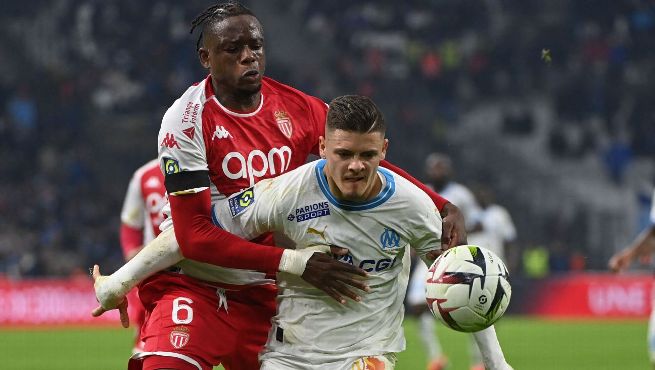


1️⃣ Match Context
This is the kind of Ligue 1 fixture that doesn’t need extra marketing. Monaco vs Marseille is almost always about leverage: leverage over the top four, leverage over momentum, leverage over the narrative that follows both clubs all season.
By early April, the table pressure becomes very real. Points aren’t just points anymore—they’re shape. A win can turn the run-in into a controlled sprint; a loss turns it into weekly firefighting. Monaco at home typically see these matches as statement opportunities: impose tempo, dominate territory, and force the opponent to defend longer than they want. Marseille, meanwhile, arrive with a different psychological burden—expectation plus volatility. When they’re good, they look like they can beat anyone. When they’re off by 5%, their structure can unravel fast.
There’s also the calendar factor. This period often comes with uneven fatigue loads: domestic intensity, cup hangovers, and a thin margin for rotation errors. The game state matters here. The first team to score doesn’t just gain an advantage—they gain permission to play their preferred football.
2️⃣ Form & Advanced Metrics
Monaco’s recent profile tends to be built on volume and territory. They don’t just create chances—they create sequences that keep opponents pinned. The numbers indicate a team that generates consistently high shot volume, but the key is where those shots come from: Monaco are at their best when they turn wide progression into cutbacks and central third-man arrivals. That’s the difference between “lots of shots” and “repeatable goals.”
Defensively, Monaco’s risk is structural rather than purely individual. When they commit numbers high, the space behind the midfield line becomes a transition runway. Their xGA profile in big matches often spikes not because they concede 20 shots, but because they concede a handful of very clean ones. High-quality chances, not constant pressure. That’s volatility.
Marseille’s form tends to be more game-state dependent. When they score first, they can compress the match, slow the pace, and look very hard to break down. When they concede first, they often chase too directly—more vertical passes, more exposed rest defense, and a pressing structure that becomes easier to play through. Their pressing intensity is usually clear in PPDA terms (lower PPDA means more aggressive pressure), but the nuance is the efficiency of that pressure. Marseille can press high, yet still allow progression if the distances between lines are stretched.
If we look deeper, this matchup is less about who “creates more” and more about shot quality control. Monaco want repeatable half-chances that accumulate into high xG through volume. Marseille want fewer, cleaner chances—especially in transition—where shot quality spikes even if shot count doesn’t.
3️⃣ League Table Snapshot
| Team | Position | Points | GF | GA |
|---|---|---|---|---|
| AS Monaco | 3rd | 58 | 56 | 34 |
| Olympique de Marseille | 5th | 52 | 49 | 36 |
Takeaway: These positions typically reflect two different types of performance. Monaco’s placement is usually built on sustained control—territory, shot volume, and home authority. Marseille’s is often built on higher variance: they can look top-three one week and mid-table the next depending on transition success and defensive concentration.
4️⃣ Head-to-Head Analysis
Head-to-heads between these two often repeat the same tactical loop: Monaco try to turn the match into long Monaco possessions with defensive coverage behind the ball; Marseille try to keep it unstable and attack the space Monaco leave when they push their fullbacks and interiors forward.
What matters isn’t the past scorelines—it’s whether the underlying pattern persists. And it usually does. Monaco can dominate field tilt and still feel uncomfortable because Marseille don’t need long spells to hurt you. They need two or three good transition moments, a set-piece swing, and suddenly your territorial advantage becomes a scoreboard problem.
Psychologically, Marseille also tend to respond well to “big badge” environments. Monaco’s challenge is not to “be better,” but to avoid the five-minute window where control turns into chaos.
5️⃣ Tactical Breakdown (Core Section)
Who dictates tempo?
Monaco will try to dictate pace through sustained territory and second-ball control. Expect them to build through the half-spaces, using rotations to drag Marseille’s midfield line laterally and create cutback lanes. The key is patience: Monaco’s best versions don’t force the final ball early. They repeat the same attack until the defensive block loses timing.
Marseille’s tempo control is different. They don’t want long spells of sterile possession; they want the ball in the right moments. Their ideal tempo is a match with frequent transitions, where Monaco’s rest defense is tested repeatedly.
Overload zones and exposed flanks
The structural nuance here is where Monaco’s width comes from. If Monaco’s fullbacks push high and the wingers come inside, Marseille can be pulled into narrow defending—which opens the far side switch. That’s where Monaco can create: quick circulation, isolate a defender, then cut back into the box.
But that same structure creates Marseille’s best counter route: win the ball centrally, immediately hit the channel behind the advanced fullback, and force Monaco’s center-backs to defend running toward their own goal. Those are the moments that produce high shot quality, even if Marseille are second-best in territory.
Midfield control battle
This game often turns on the “second line.” Monaco’s midfield wants to arrive late into the box and keep the opponent pinned. Marseille’s midfield wants to break Monaco’s rhythm—either by stepping out aggressively to intercept or by drawing fouls and slowing the match.
Watch for Marseille’s triggers: when Monaco play into a marked pivot, Marseille will try to jump and trap. If Monaco can consistently bounce that pass into a third-man option, Marseille’s press becomes expensive—one bypass and you’re defending your box.
Pressing, buildup resistance, and transition vulnerability
Monaco’s buildup resistance is usually decent, but the danger is when they lose the ball after committing numbers. If Monaco’s counterpress is slightly late, Marseille’s first pass forward becomes decisive. This is not about long counterattacks; it’s about the first two passes being clean.
Marseille, on the other hand, can be pressured into low-percentage build-up if Monaco press with clarity. Monaco’s best pressing comes not from constant sprinting, but from closing the center and forcing wide exits. A wide exit is fine—until you trap it near the touchline and win the ball in a pre-shot zone.
Set-piece dynamics
In matches this close, set-pieces aren’t a side note. They’re a pricing factor. Marseille’s physicality and delivery quality can flip expected goals quickly, especially if Monaco concede cheap fouls in wide areas while trying to stop transitions. Monaco, meanwhile, can generate a lot of corners through territory, which becomes a silent advantage even if open-play finishing variance swings against them.
6️⃣ Odds & Market Evaluation
| Market | Odds |
|---|---|
| AS Monaco win | 2.20 |
| Draw | 3.40 |
| Olympique de Marseille win | 3.20 |
Converted to implied probability (before removing the bookmaker margin):
- Monaco 2.20 → ~45.5%
- Draw 3.40 → ~29.4%
- Marseille 3.20 → ~31.3%
According to our calculations at betlabel.games, the fairer shape of the game is slightly more Monaco-leaning than the market, but not massively so. The edge here is real but marginal, and it depends on whether Monaco can keep Marseille’s transition xG down to “few but manageable” rather than “few but massive.”
7️⃣ The Hidden Edge (Mandatory Section)
The market often prices Monaco and Marseille as if they are symmetrical “big clubs” with similar game control. They’re not. The hidden edge is in repeatability.
Monaco’s chance creation tends to be more repeatable because it’s built on territory and patterns: sustained attacks, corner volume, and multiple entries into the box per possession cycle. Marseille’s chance creation, especially away in big matches, can lean more heavily on game-state swings—transitions, set-pieces, and moments where the opponent’s structure is temporarily broken.
Why does this matter for betting? Because repeatable creation is less fragile across 90 minutes. Even if Monaco miss early chances, the process usually continues. Marseille’s process can look dangerous without being constant—meaning a match can drift away from them if the transition windows don’t arrive or if Monaco manage rest defense better than usual.
There’s also a second-half nuance that markets can be slow to price: teams that rely on high-intensity pressing and transition bursts often have a measurable drop-off late. If Marseille’s pressing loses half a step after 60 minutes, Monaco’s territorial game becomes more valuable, and the match tilts toward sustained pressure rather than chaos.
8️⃣ Final Prediction
Main Pick: AS Monaco – Draw No Bet (DNB)
Alternative: Over 2.5 Goals (only if you expect Marseille to create transition volume rather than isolated counters)
Risk Level: Medium
- Monaco’s home control and repeatable chance creation make them the more stable side across 90 minutes, even if Marseille carry sharper single-moment threat.
- Marseille’s pathway to goals is higher variance (transitions and set-pieces). That can win you the match—or leave you short if Monaco manage rest defense and avoid cheap fouls.
- DNB protects against the draw, which is a live outcome when Monaco dominate territory but Marseille defend deep and look for a handful of clean breaks.
No guarantees here. But from a probability and structure standpoint, Monaco are the side with the more reliable process—and in pricing terms, that’s usually where value starts.







Leave a Reply