




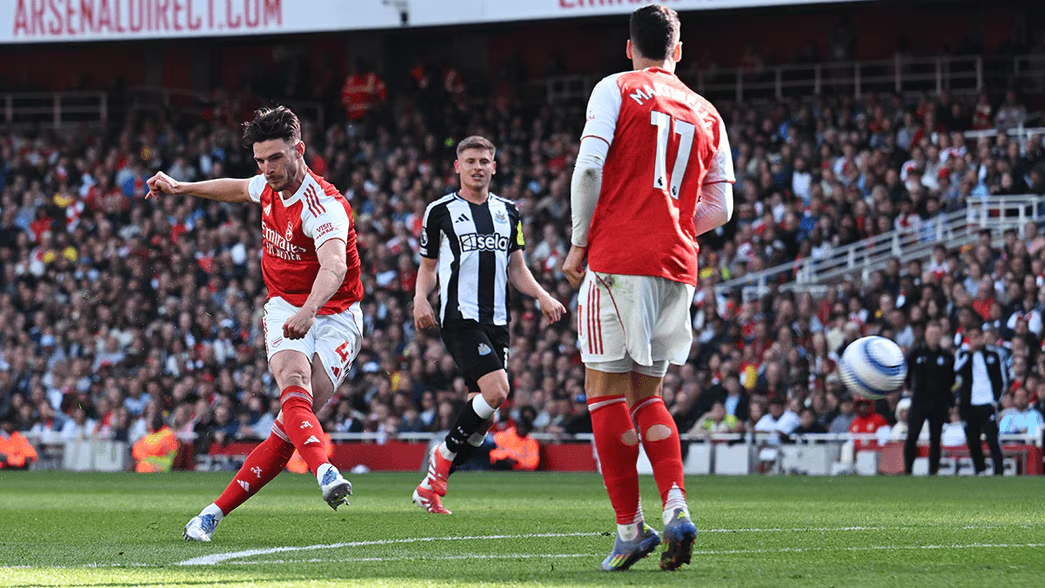


1️⃣ Match Context
Late-April Premier League fixtures don’t need marketing. They carry their own gravity.
Arsenal vs Newcastle is the kind of game that can re-shape a season in 90 minutes: Champions League positioning, momentum into May, and the psychological edge of winning a “six-pointer” against a direct rival. For Arsenal, home games at this stage are less about performance and more about conversion — three points, minimal drama, no hangover. For Newcastle, it’s the classic pressure test: can their game model travel to elite territory without becoming passive?
Context matters because the margins change. Players feel it in duels, coaches feel it in substitutions, and markets feel it in price sensitivity. Expect sharper risk management, more deliberate tempo swings, and a heavier emphasis on set-piece moments. This isn’t a match built for romance. It’s built for leverage.
2️⃣ Form & Advanced Metrics
Arsenal’s recent profile is typically Arsenal: sustained territory, controlled chance creation, and a defensive structure that limits opponents’ clean looks rather than chasing highlight tackles. Their shot map tends to be “clean” — a higher share from central lanes and cutback zones instead of hopeful wides. That matters against a Newcastle side that can defend crosses reasonably well but can be pulled apart by low, fast deliveries after a third-man run breaks the line.
Newcastle’s outputs are more state-dependent. When they start well, their pressing and transition game can spike the match into volatility: quick regains, early shots, and an uncomfortable rhythm for the home side. But the deeper you look, the more you see a split: their chance volume often holds up, yet the shot quality can swing wildly based on whether they win the midfield’s first contact and force Arsenal’s buildup into wide cul-de-sacs.
Pressing numbers (PPDA in particular) tell you intent, not guaranteed success. Arsenal generally press with structure — they don’t just sprint; they trap. Newcastle’s press can be more emotional: intense when the cues are right, but prone to being bypassed if the first wave is beaten. If Arsenal can find the spare man in the first phase, Newcastle’s back line tends to face a difficult choice: step out and open the channel, or drop and surrender territory. Neither is comfortable for 90 minutes at the Emirates.
Tempo is the other key layer. Arsenal can play fast when they smell instability, but they’re equally happy to slow the game into long possessions and squeeze the opponent’s oxygen. Newcastle are at their best in a quicker match with transitions. If Arsenal control pace and field tilt — keeping play in Newcastle’s half and forcing longer defensive sequences — Newcastle’s attack becomes more reliant on isolated moments rather than repeated high-quality entries.
3️⃣ League Table Snapshot
| Team | Position | Points | Goal Diff |
|---|---|---|---|
| Arsenal | 2nd | 74 | +38 |
| Newcastle United | 5th | 62 | +19 |
Takeaway: Arsenal’s position reflects week-to-week control — fewer “coin-flip” matches, fewer chaotic concessions. Newcastle’s spot is more about variance: high-ceiling performances mixed with games where they get pinned and have to survive. In a top-four race, that difference is everything.
4️⃣ Head-to-Head Analysis
This matchup often becomes a test of whether Newcastle can keep the game in the middle third without conceding territory for free. When Arsenal are allowed to camp around the box and recycle attacks, Newcastle’s defensive phases get longer, and concentration errors start to appear — a late runner, a missed handoff on the wing, a second ball not attacked with conviction.
What’s more important than past scorelines is the structural pattern: Arsenal tend to produce repeatable entries into the half-spaces against Newcastle’s shape, especially when the wide player pins the fullback and the interior runner attacks the channel between center-back and fullback. Newcastle can hurt Arsenal too — but it usually requires winning the first duel after a regain and playing forward instantly before Arsenal’s counter-press closes the door.
In short: the history leans toward Arsenal controlling the territory battle, while Newcastle’s success depends on efficiency in their limited high-quality moments.
5️⃣ Tactical Breakdown (Core Section)
Who dictates tempo?
Arsenal, by design. Their buildup and positional play are built to decide where the game is played. Expect them to stretch Newcastle horizontally, then accelerate through the inside channel once the defensive line shifts. Newcastle will try to disrupt that with pressing triggers — likely jumping on back-passes, poor body shape receptions, or sideways circulation near the touchline.
The key is Arsenal’s resistance to the first press. If they play through it, Newcastle’s midfield gets dragged into long recovery runs. If Arsenal get forced wide and slowed, Newcastle can compress the center and make the match a sequence of contested wide duels. That’s Newcastle’s preferred defensive story.
Overload zones and exposed flanks
Arsenal’s most consistent advantage is the half-space overload: creating a 2v1 around Newcastle’s wide center-back and fullback. The moment Newcastle’s winger tracks deep, Newcastle lose a counter outlet; if the winger doesn’t track, the fullback gets isolated. Either way, Arsenal gain a predictable access point.
Newcastle’s threat comes from the opposite dynamic: isolations for their wide attackers in transition. If Arsenal’s fullbacks are high and the rest defense isn’t balanced, Newcastle can attack the space behind the first line quickly. The speed of the first pass after regain is everything. A half-second delay and Arsenal’s counter-press swallows the move.
Midfield control battle
This is where the match will be decided. Arsenal want stable central progression and second-ball dominance around the edge of the box. Newcastle want to make central possession uncomfortable — not necessarily by winning it cleanly every time, but by forcing Arsenal’s midfield to receive under pressure and play backwards.
If Newcastle’s midfield line gets pinned too deep, Arsenal’s shots improve in quality: more cutbacks, more central touches in the box, fewer speculative efforts. If Newcastle can hold the line higher and protect the top of the box, Arsenal’s shot volume might remain high but shot quality can fall. That’s the defensive “win condition” for an underdog at the Emirates: allow shots, but make them worse shots.
Transitions and rest defense
Newcastle’s best moments will come from Arsenal mistakes, not Newcastle artistry. That’s not an insult — it’s a tactical reality. Arsenal commit numbers forward; the price is exposure if the counter-press is beaten. Arsenal will try to keep a strong rest defense: at least two center-backs plus a holding midfielder ready to delay counters and prevent straight-line runs through the middle.
Newcastle need verticality, not possession. The longer they hold the ball after winning it, the less dangerous they become.
Set-piece dynamics
In tight, high-pressure matches, set pieces often become the “hidden 0.3 xG” that swings everything. Arsenal’s ability to generate repeat corners and free-kicks through territorial pressure is a quiet edge. Newcastle are physically equipped to defend them, but repeated defending invites lapses — losing a blocker, missing a runner, failing to clear the second ball. If the open-play chance flow is balanced, this is where Arsenal can separate.
6️⃣ Odds & Market Evaluation
| Market | Odds | Implied Probability |
|---|---|---|
| Arsenal Win | 1.80 | 55.6% |
| Draw | 3.70 | 27.0% |
| Newcastle Win | 4.60 | 21.7% |
Those raw implied probabilities include margin, but the shape is clear: Arsenal are priced as a solid favorite, not an overwhelming one. According to our calculations at betlabel.games, Arsenal should be a touch shorter than this in a home, high-stakes setting where their territorial control tends to be reliable and Newcastle’s best path requires high efficiency.
Market read: slight value sits with Arsenal-side positions, but the edge is not massive. The cleaner approach is often to reduce draw exposure with protection-based lines.
7️⃣ The Hidden Edge (Mandatory Section)
There’s a structural nuance here: Newcastle’s “good” performances can look stronger on the scoreboard than in the chance quality layer, because their transition game converts moments into shots quickly — but not always into premium shots. That can create a perception that they’re consistently creating big danger, when in reality a portion of their volume comes from lower-probability looks taken early in possessions.
Against Arsenal, that tendency matters. Arsenal’s defensive scheme is comfortable giving you an early shot from a non-ideal lane if it prevents a deeper penetration and keeps their rest defense intact. So Newcastle can finish the match with a reasonable shot count and still feel like they were kept at arm’s length.
The market can be slow to price this because it reacts to headline indicators: “Newcastle had chances,” “Newcastle were brave,” “Arsenal conceded shots.” But shot quality and territorial repeatability are the real drivers. Arsenal’s ability to generate multiple attacks per phase — and force opponents into long defensive sequences — is the kind of edge that doesn’t always pop in a highlight reel, but shows up in long-run results.
8️⃣ Final Prediction
Main Pick: Arsenal – Draw No Bet
Alternative: Arsenal to Win & Under 4.5 Goals
Risk Level: Medium
The logic is straightforward:
1) Territory and pace control: Arsenal are more likely to dictate where the game is played, which increases their share of repeatable chance creation.
2) Newcastle’s reliance on efficiency: their best route is transitions and quick vertical strikes — dangerous, but typically lower-frequency against a strong counter-press.
3) Set-piece accumulation: Arsenal’s ability to turn sustained pressure into dead-ball opportunities is a late-game lever in a tense match.
No guarantees. Newcastle have the athleticism to punish mistakes. But on balance, Arsenal’s structural advantages at home make them the more rational side of the market — especially with draw protection.







Leave a Reply