




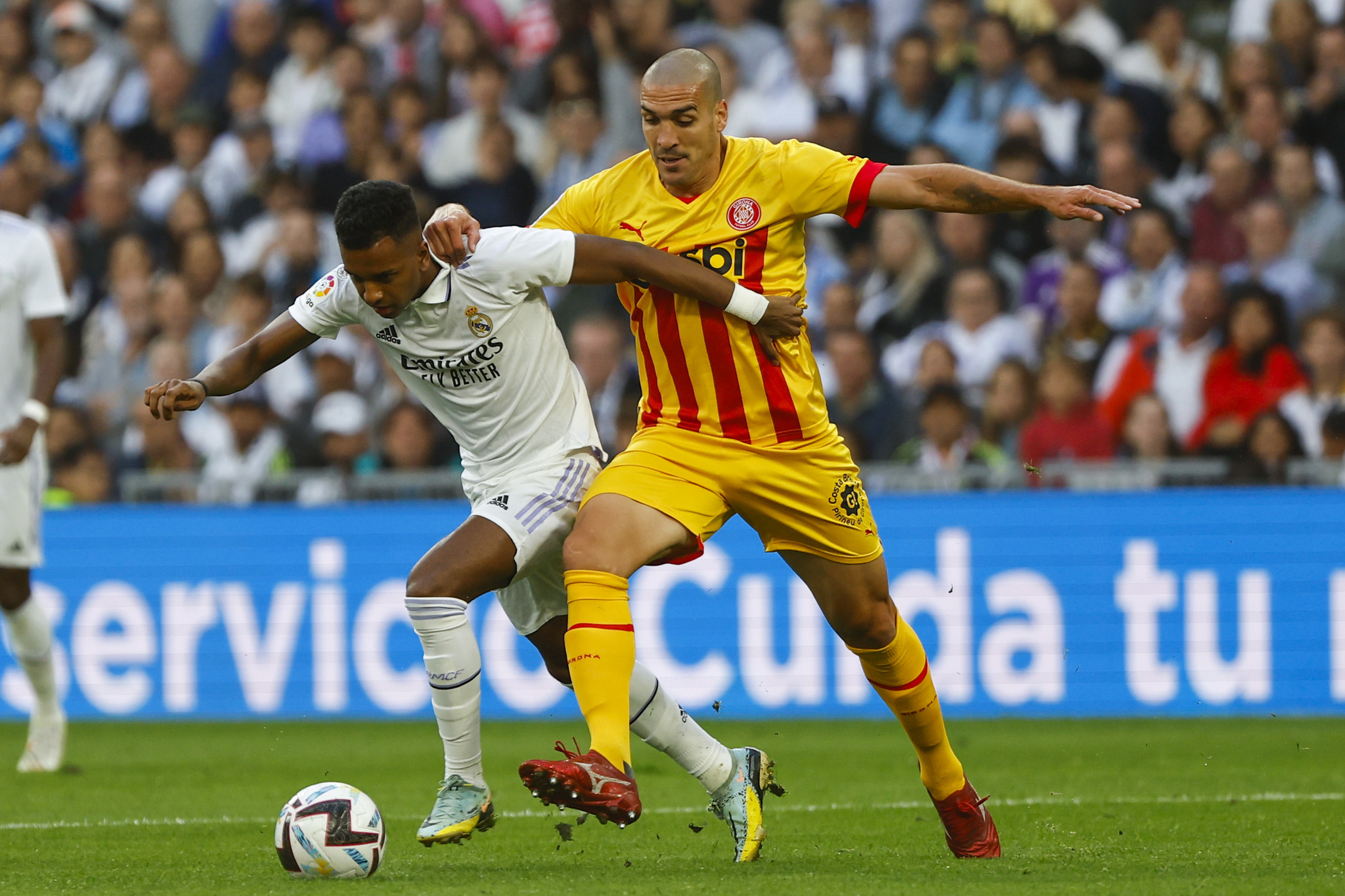


1️⃣ Match Context
Early April in La Liga is where games stop being “three points” and start being leverage. For Real Madrid, this is the part of the calendar where title pressure becomes structural: every dropped point turns into a week-long narrative, and every win compresses the margin for everyone chasing. For Girona, it’s a different kind of weight — the push to secure Europe (or protect it) while the legs and squad depth get tested by the run-in.
The psychological framing matters because both teams tend to play best when they control the script. Madrid want the match on their terms: territory, wave pressure, and a controlled emotional tempo. Girona, at their best, also want rhythm — brave buildup, aggressive positioning, and enough passing confidence to keep opponents from pinning them in.
Schedule congestion is the quiet variable. Madrid’s spring usually includes extra midweek stress, and even when rotation is possible, small drops in intensity show up first in counter-pressing and rest-defense spacing. Girona, meanwhile, often feel fatigue in a different way: not from Europe, but from the reduced margin for error in a system that demands constant positional discipline. In a game like this, one sloppy five-minute stretch can decide the price.
2️⃣ Form & Advanced Metrics
If we look deeper than results, Real Madrid’s recent profile is typically built around two things: sustained territory and shot quality. They don’t need to lead the league in raw shot volume to dominate expected goals; their best sequences create high-value attempts from the half-spaces and the cutback corridor. That’s why Madrid can look “patient” for 30 minutes and still produce the kind of chances that move an xG chart quickly.
Defensively, the key is not whether Madrid concede shots — it’s where they concede them. When their rest-defense is clean (fullbacks not both high at once, midfield screen intact), opponents get pushed wide into lower-quality shooting. When the structure slips, the vulnerability is central access after turnovers. That’s the Madrid volatility: not constant, but sharp when it appears.
Girona’s metrics tend to be more tempo-sensitive. At their best they generate good xG through quick combinations and third-man runs, not by blasting teams with 25 shots. They can be efficient. But efficiency cuts both ways: if shot volume drops and they’re forced into low-quality wide attempts, their attack can look tidy without being dangerous.
Pressing intensity is the other lens. PPDA (passes allowed per defensive action) is basically a proxy for how quickly you engage. Madrid can press in waves — triggers on backward passes or a poor first touch — but they’re not obligated to press constantly because their default control is possession and territory. Girona are usually bolder about engaging earlier, which can be productive, but it also opens the space behind the first line. Against Madrid, that space is exactly where the game gets punished.
Home/away dynamics also shape interpretation. Madrid at home typically produce cleaner field tilt — long spells camped in the opponent half — and that reduces opponent transition volume. Girona away in big stadiums often face a simple trade: stay brave and risk getting played through, or drop deeper and concede territory until the match becomes survival.
3️⃣ League Table Snapshot
| Team | Position | Points | GF | GA |
|---|---|---|---|---|
| Real Madrid | 1st | 75 | 68 | 24 |
| Girona | 5th | 55 | 54 | 40 |
Takeaway: Madrid’s position reflects week-to-week control — not just winning, but limiting the number of matches that turn chaotic. Girona’s slot suggests a high-quality side, but one more exposed to variance: their game model can win big when it clicks, yet it’s easier to disrupt, especially away.
4️⃣ Head-to-Head Analysis
Recent meetings between these teams tend to repeat the same structural story: Girona can compete for possession phases, but Madrid usually win the “punishment moments.” Girona’s buildup invites pressure because they want to play through central lanes. Madrid don’t always need to win the ball high; they just need one or two clean transition launches into the channels or half-spaces.
The psychological layer is subtle but real. Girona’s confidence in their identity is an asset, yet against Madrid it can become stubbornness. If they insist on playing out under heavy pressure without adjusting angles or using more direct outlets, the match tilts quickly into Madrid’s preferred cycle: win ball, attack immediately, then sustain territory.
5️⃣ Tactical Breakdown (Core Section)
Who dictates tempo?
Madrid dictate tempo through territory more than speed. They can accelerate when they want, but the baseline is dominance of the opponent half and recycling possession until a defensive line breaks. Girona’s tempo is more vertical — they want to move the ball forward early and use coordinated runs to disrupt spacing.
The conflict is obvious: Girona’s verticality increases turnover risk; Madrid’s structure is designed to convert those turnovers into high-grade attacks.
Where is the overload zone?
The overload zone is the half-space between Girona’s fullback and center-back. Madrid are ruthless here: they’ll drag the wide defender out with a winger, then attack the inside channel with a runner or a late-arriving midfielder. That’s the cutback funnel — the area where shot quality spikes.
For Girona, the overload attempt is usually central circulation to pull Madrid’s midfield line out, then quick switches to isolate a wide player. The issue is that Madrid’s recovery speed in the back line typically reduces the payoff unless Girona’s first touch and timing are perfect.
Which flanks are exposed?
Girona’s exposure often appears when their fullbacks push to support buildup and the ball is lost inside. That creates a long sprint recovery into the exact channel Madrid want to attack. Madrid’s exposure is the opposite: when both fullbacks (or one fullback and one high midfielder) commit at once, the far-side space can be hit early. Girona must be brave enough to switch quickly, not take three extra touches.
Midfield control battle
Madrid’s edge is their ability to defend forward while still protecting the center. Girona want to play through midfield with short passing triangles; Madrid are comfortable letting you have sterile circulation as long as the central lane into the box is blocked.
This is why Girona’s best route isn’t slow buildup — it’s creating moments where Madrid’s midfield is forced to turn and run. That requires early forward passes and runners beyond the ball, not just possession for possession’s sake.
Pressing triggers and buildup resistance
Expect Madrid’s pressing to be situational: they’ll jump when Girona play a square pass across the back line or when the receiving player is facing his own goal. Girona can beat that with one-touch bounce passes and a clear third-man option. If they hesitate, Madrid’s first wave becomes a trap.
Transition vulnerability
This match is about rest-defense. Madrid’s chance creation rises sharply when they win the ball and attack before Girona’s structure resets. Girona’s danger rises when they lure Madrid forward, break the first pressure line, and then play into space behind the midfield screen.
But over 90 minutes at the Bernabéu, the probability usually favors Madrid generating more of those transition “A-grade” looks.
Set-piece dynamics
Set pieces matter more than usual in games where one team is expected to dominate territory. Madrid’s sustained pressure increases corners and free-kicks. Girona, if forced to defend deep for long stretches, can concede cheap dead-ball situations. If Girona’s open-play output dips, their own set-piece threat becomes their lifeline — but that’s a low-frequency path compared to Madrid’s volume of territory.
6️⃣ Odds & Market Evaluation
| Market | Odds | Implied Probability |
|---|---|---|
| Real Madrid win | 1.45 | 68.97% |
| Draw | 4.60 | 21.74% |
| Girona win | 7.50 | 13.33% |
Those implied probabilities add up above 100% because of bookmaker margin. According to our calculations, the fair line sits slightly closer to Madrid than the market suggests, but the difference is not huge. The edge is more about the derivative markets — handicaps and totals — where matchup mechanics can be priced a bit slower than brand-name 1X2.
7️⃣ The Hidden Edge (Mandatory Section)
There’s a structural nuance here: Girona’s “brave” buildup can look like control on broadcast, but it can be negative value possession against elite transition teams. The market often underrates this because Girona’s passing sequences are aesthetically convincing and can suppress shot counts early. But what matters is the quality of the turnovers.
Madrid don’t need Girona to collapse for 90 minutes. They need two or three high-value transition launches created by forced mistakes or rushed exits. Girona’s system increases the probability of exactly that kind of mistake under pressure.
The other angle is second-half state change. In matches where Girona spend long periods defending territory, their distances stretch after the hour mark — the pressing becomes less connected, and the midfield line stops protecting the back line with the same intensity. That’s when Madrid’s cutbacks and late box arrivals become brutal. It’s not always visible in recent scorelines because Girona can hold on for long stretches… until they can’t.
Why might the market be slow to adjust? Because Girona’s overall season perception is strong and their possession numbers travel well. But possession quality is opponent-dependent. Against Madrid, the cost of one poor central pass is significantly higher than against mid-table teams.
8️⃣ Final Prediction
Main Pick: Real Madrid -1 Asian Handicap
Alternative: Real Madrid win & Over 1.5 total goals
Risk Level: Medium
Madrid are priced as clear favorites for good reasons, but the handicap angle is where the matchup logic has teeth:
- Shot quality edge: Madrid’s chance profile at home tends to be cutback- and half-space-heavy — the kind of attempts that convert at a higher rate than low-percentage distance shots.
- Turnover punishment: Girona’s buildup model increases the odds of high-value losses in central or near-central zones, which is exactly where Madrid’s transitions become lethal.
- Territory compounding: If Madrid score first, the game state forces Girona to open up, and that usually inflates Madrid’s second wave of chances rather than calming the match down.
No guarantees — Girona are good enough to compete in phases. But over 90 minutes, the probability distribution leans toward Madrid creating more high-grade moments and turning one of those phases into a margin win.







Leave a Reply