





1️⃣ Match Context
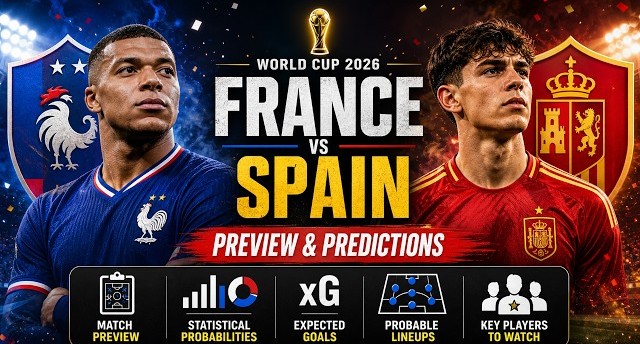
This is the kind of World Cup fixture that changes the temperature of an entire tournament. France vs Spain isn’t just “two favourites colliding” — it’s a game where one team gets to turn authority into inevitability, and the other has to prove their control-heavy identity still works when the opponent can punish mistakes in a single sprint.
At this stage of a World Cup, the psychological load is different. There’s less room for “we’ll fix it next match” — especially for Spain, whose possession dominance often invites the same question: what happens when the opponent refuses to chase and simply waits to strike? France, meanwhile, live comfortably in that problem-solving space. They don’t need to win territory every minute. They need to win the moments.
Schedule-wise, the stress point is recovery and repeatability. Both sides typically arrive with heavy minutes in the core: centre-backs, controlling midfielders, and the forward who ties the attack together. Late-tournament football is about concentration and legs. Lose either, and your structure leaks.
2️⃣ Form & Advanced Metrics
If we look deeper than the headline results, the profiles are familiar — and that’s exactly why this matchup is so clean to read.
France’s underlying numbers usually skew toward shot quality over shot volume. They don’t always top the shot count, but their better attacks end with high-value looks: cutbacks, central zone entries, and quick strikes after forcing a bad rest-defense shape. In xG terms, that typically translates into fewer “cheap” shots and more chances you actually fear.
Defensively, France can look calm without being passive. Their best versions defend space rather than chase the ball: compact midfield spacing, centre-backs protected from wide isolation, and a willingness to let you have sterile possession in front of them. The volatility comes when their fullbacks get drawn high and the counterpress doesn’t land — then transitions become footraces, and those are never fully controllable.
Spain, by contrast, are built on territorial control. Their xG usually comes from accumulation: a lot of entries, a lot of second balls, a lot of shots from decent but not elite zones. The key metric lens with Spain is shot quality distribution. If their attack is reduced to outside-the-box strikes and crowded half-space shots, they can look dominant while barely threatening.
Pressing is where Spain often try to win this game. Their PPDA profile tends to be aggressive — not just “high press,” but immediate counterpressure after losing the ball to keep the opponent locked in. Against France, that’s a double-edged sword: it can suffocate buildup, but if the first wave is beaten, there’s a lot of grass behind it.
Tempo patterns matter here. Spain want long spells, low chaos, repeatable sequences. France want controlled suffering, then a burst. That clash is why the game state is so sensitive to the first goal.
3️⃣ League Table Snapshot
World Cup football doesn’t give you a league table in the traditional sense, but the tournament snapshot still matters: who’s been stable, who’s been swinging between extremes, and who’s carrying finishing noise.
| Team | Tournament Status | Performance Signal | Style Baseline |
|---|---|---|---|
| France | Knockout-stage contender | High chance quality, transition bite | Compact + direct accelerations |
| Spain | Knockout-stage contender | Territory control, pressing volume | Possession + counterpress |
Takeaway: these positions reflect two reliable structures rather than hot finishing streaks. The difference is where their “control” lives: Spain control the ball; France control the high-value moments.
4️⃣ Head-to-Head Analysis
Head-to-head history between top nations is often misused — people remember the scoreline, not the pattern. The pattern here is consistent: Spain tend to own possession and territory; France tend to own the penalty-box danger.
When Spain have looked comfortable, it’s usually because they’ve been able to keep France’s wide threats facing their own goal, not running at them. When France have looked dangerous, it’s typically been through two repeatable mechanisms: quick outlets into the channel behind Spain’s advanced fullbacks, and central runners arriving late when Spain’s midfield line is attracted toward the ball.
Importantly, past results often align with the underlying mechanics. If Spain can’t produce central-box shots, possession becomes cosmetic. If France can’t exit pressure cleanly, they spend too long defending and their transition edge disappears.
5️⃣ Tactical Breakdown (Core Section)
Who dictates tempo?
Spain will attempt to dictate tempo with ball retention and positioning. But France’s best tournaments are built on refusing to be emotionally dragged into the opponent’s rhythm. Expect France to accept periods without the ball — not as surrender, but as strategy — and to choose the moments they accelerate.
Where is the overload zone?
Spain’s overload usually lives in the half-spaces. They want triangles that pull a midfielder out, then a third-man run behind. France will try to keep the half-space compact, even if it means conceding wider circulation. If Spain can pin France’s wide defenders and still access the half-space, France’s block starts to bend.
France’s overload is more direct: isolate a defender, then attack the space behind. Their most dangerous sequences often start with an escape pass through midfield pressure, then an immediate vertical ball into the channel. Spain’s rest defense — the structure they keep behind the ball — becomes the test.
Which flanks are exposed?
Spain’s fullbacks are essential to their width. That width creates the passing lanes — but also the vulnerability. If Spain lose the ball with both fullbacks high and the midfield stretched, France’s first pass forward becomes a chance creator.
France’s flank exposure is different. When their wide defenders step to engage, they can leave pockets behind them, especially if the winger doesn’t track the underlap. Spain will try to manufacture those underlaps repeatedly until one lands.
Midfield control battle
This game is won or lost in the second line. Spain want their pivot to receive freely and turn; France want that pivot forced sideways. Pressing triggers will likely be clear: a back-pass into a centre-back, a heavy first touch, or a pass into a player receiving with closed body shape.
If France can win even a small share of second balls, the match flips. Spain’s structure is excellent when they can reset after losing it. It’s less comfortable when they have to chase a broken phase with runners already in motion.
Transition vulnerability
Spain’s transition defense is usually proactive — counterpress first, foul if needed, reset. But elite transition teams don’t need many escapes. France only need two or three clean breakaways to generate a match-winning xG total.
France’s transition risk comes if they sit too deep for too long. Then even low-quality Spanish shots start to pile up, and deflections, set pieces, and rebounds become the chaos tax of defending your box for 60 minutes.
Set-piece dynamics
In tight knockout games, set pieces are not a side note; they’re a pricing factor. France typically carry more aerial threat and more variety in delivery targets. Spain often defend set pieces well structurally, but a single lapse in blocking assignments can decide a match that otherwise feels like a chessboard.
6️⃣ Odds & Market Evaluation
| Market | Odds | Implied Probability |
|---|---|---|
| France win | 2.75 | 36.4% |
| Draw | 3.10 | 32.3% |
| Spain win | 2.70 | 37.0% |
Those implied probabilities sum above 100% due to bookmaker margin, but the shape is clear: the market is calling it near-equal, with Spain a marginal “control premium.”
According to our calculations at betlabel.games, the fair line is slightly closer to France than the market suggests. Not a dramatic misprice — more like a small inefficiency created by how heavily people weight possession dominance in big-name matchups.
7️⃣ The Hidden Edge (Mandatory Section)
There’s a structural nuance here the market can be slow to price: Spain’s territory doesn’t always convert into high-grade shots against low-block teams with elite transition threat. In group-stage or mismatched knockout ties, Spain’s pressure becomes goals because the opponent collapses, panics, and concedes penalties, tap-ins, or open-net cutbacks.
France are different. They’re comfortable defending without chasing, and they’re comfortable conceding “volume” as long as it’s the wrong kind of volume. That creates a quiet form of xG suppression: Spain can rack up attempts, but the average shot quality stays capped unless they break the block with a perfectly timed run.
The other hidden edge is game-state resilience. If Spain lead, they can starve the match. If France lead, Spain have to increase risk — and that is exactly when France become most dangerous. That asymmetry matters for pricing, because it increases the value of France positions that protect the draw.
8️⃣ Final Prediction
Main Pick: France — Draw No Bet
Alternative: Under 2.5 Goals
Risk Level: Medium
Why this is the most logical angle:
1) Chance quality edge. Even in matches where Spain control territory, France are more likely to create the clearest chances through transitions and cutback zones.
2) Tactical matchup pricing. The market often prices Spain’s control as safety. Against France, that control can become sterile, while one broken counterpress can decide the game.
3) Draw protection fits knockout reality. These games frequently live in narrow margins, and DNB aligns with a match that can spend long periods level while still offering France the higher “moment value.”
No guarantees — but on probability logic, France with protection is the cleaner value side of a near-coinflip.





Leave a Reply