




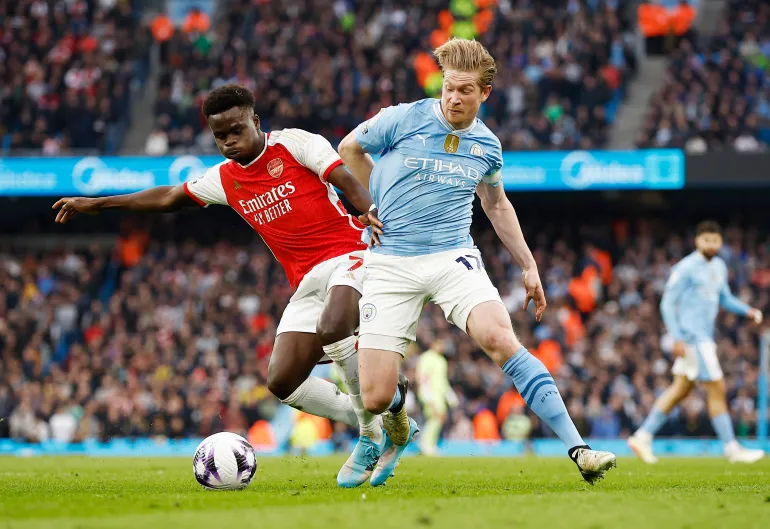


1️⃣ Match Context
Manchester City vs Arsenal in April rarely needs extra framing, but this one has it anyway: it’s late-season, it’s elite-vs-elite, and it’s the kind of fixture that can swing the title race or lock in Champions League seeding. The stakes aren’t just points — they’re leverage. Whoever controls this 90 minutes controls the narrative for the final month.
City at home comes with a different kind of pressure: expectation pressure. They’re built to dominate territory at the Etihad, and anything that looks like “a cautious draw” often feels like dropped points. Arsenal arrive with a more complex psychological load — the mixture of belief and scar tissue that comes with repeated title challenges. One bad half here can reverberate.
Schedule context matters too. April is where legs go quietly. Even if the teams rotate, the intensity cost of high-level games accumulates: repeated accelerations, repeated defensive sprints, and repeated decision-making under fatigue. This is the month where small structural weaknesses become goals conceded.
2️⃣ Form & Advanced Metrics
City’s recent profile is familiar: high territory control, sustained pressure, and an ability to keep opponents pinned long enough that chances eventually arrive. The key isn’t just volume — it’s shot quality created through central occupation. City’s best phases come when their “five-lane attack” actually becomes three lanes in the final third: two half-spaces plus the central lane. That’s when cutbacks and high-value shots appear rather than hopeful edges-of-the-box attempts.
Defensively, City’s numbers tend to look clean, but the risk is specific: the first pass after they lose the ball. When City commit both fullbacks high and the midfield line is stretched, opponents don’t need many shots to post meaningful xG. They need the right shot. That’s why City matches can feel controlled and then suddenly swing on two transitions.
Arsenal’s recent metrics often show a slightly different balance. Their chance creation is frequently less about endless siege and more about sequence efficiency: winning the ball, hitting the next line quickly, and arriving in the box with numbers. When Arsenal are flowing, their shot volume doesn’t have to be extreme because the locations are strong — close-range looks, cutbacks, and second-phase shots from the penalty spot zone.
Out of possession, the pressing intensity is usually the story. PPDA (passes allowed per defensive action) is the best shorthand: lower PPDA means you press earlier and more often. City’s press is about locking you in and recycling possession immediately; Arsenal’s is more trigger-based, aimed at forcing predictable exits before pouncing. Over 90 minutes, the team that sustains their pressing behavior deeper into the second half typically wins the territory war — and territory becomes xG.
Home/away dynamics also matter. At the Etihad, City’s field tilt (share of final-third play) tends to be extreme because opponents naturally sink. Arsenal, however, are one of the few sides comfortable defending higher and refusing the automatic low block. That alone changes the game: if Arsenal can keep City from living on the edge of their box, the match becomes more open — and more volatile.
3️⃣ League Table Snapshot
| Team | Position | Points | GP | GD |
|---|---|---|---|---|
| Manchester City | 2 | — | — | — |
| Arsenal | 1 | — | — | — |
Takeaway: this is the classic “top-two stress test.” At this stage, positions usually reflect process more than luck — but not entirely. Small swings in finishing and set-piece conversion can still distort the table. What matters here is not who has the better season; it’s whose game model breaks less under elite opposition.
4️⃣ Head-to-Head Analysis
Recent City–Arsenal meetings have increasingly become chess, not chaos. The tactical repetition is clear: City attempt to overload the half-spaces and force Arsenal’s midfield to choose between protecting central lanes or closing the wide-to-inside rotations. Arsenal, meanwhile, often aim to keep the game in front of them and then hurt City with fast, clean transitions into the channels.
The psychological layer is subtle but real. City are comfortable in “long domination” games — 70% possession, constant territory, patient shot selection. Arsenal have grown into that environment, but the decisive moments tend to come when Arsenal’s defensive line has to defend 10–15 consecutive box entries. That’s where concentration costs appear: a missed runner, a half-second late to a cutback zone, a second ball not cleared.
The big question: do previous results align with the underlying dynamics? Often, yes — but with caveats. These games can be decided by one transition or one set piece even when one side “wins the match” on territory. H2H is useful here only insofar as it confirms the structural themes: City’s sustained pressure vs Arsenal’s controlled threat.
5️⃣ Tactical Breakdown (Core Section)
Who dictates tempo?
City will try to slow the game into a constant squeeze: long possession chains, repeated entries, and immediate counterpressing to prevent Arsenal from running. Arsenal’s best path is the opposite: break City’s rhythm with verticality. If Arsenal can turn this into a game of episodes — short City spells, then Arsenal counters — it becomes closer to 50/50 than the possession suggests.
The overload zone: half-spaces and the “cutback corridor”
City’s most consistent high-quality chances come from the cutback corridor: the area between the penalty spot and the six-yard line, delivered from wide or half-space. Arsenal’s defensive structure must protect that zone first. If Arsenal’s wingers defend too deep, City’s fullbacks can step into crossing angles; if the wingers stay high, City can play through the half-space and arrive at the byline.
Arsenal’s response is usually a compact 4-4-2/4-5-1 shell with aggressive stepping from a midfielder into the half-space. The risk is obvious: step late, and City receive between lines; step early, and you open a lane behind the stepping midfielder.
Which flanks are exposed?
Arsenal’s best transitional threat is typically into the channels behind City’s advanced fullbacks. City’s rest defense (the players positioned to stop counters) is usually strong, but when their center-backs are forced wider, the middle can open for a second runner. Watch for Arsenal’s wide forward dragging City’s fullback inside, then releasing the runner outside. It’s not about one sprint; it’s about repeated sprints until one is missed.
Midfield control: duels, not just possession
This match is decided by second balls and pressure resistance. City want Arsenal’s midfield receiving with their back to goal under pressure; Arsenal want City’s midfield turning to chase. The team that wins the “next action” after a duel — the second pass, the second clearance, the second tackle — will tilt the xG battle without it looking dramatic.
Pressing triggers and buildup resistance
Arsenal’s pressing triggers often come on predictable passes into fullbacks or a back pass under pressure. City, however, are among the best in the world at baiting that press and playing through it. The key is Arsenal’s spacing: if the press arrives without compactness, City will play through the first line and immediately attack the back line. If Arsenal stay compact, City may accept sterile possession and wait for a better opening.
Transition vulnerability
This is the tactical hinge. City can concede high-quality chances with very low volume if Arsenal execute two passes after the turnover. Arsenal can also be punished if their counter fails and City counterpress into an exposed midfield. Expect phases where both sides look cautious — not because they lack ambition, but because one mistake can become 0.4 xG.
Set pieces
In a match this balanced, set pieces are not a side note. Arsenal have been consistently strong in dead-ball routines, especially in creating first-contact headers and second-ball shots. City, meanwhile, are structurally sound but can be vulnerable if forced into repeated clearances. If Arsenal win corners early, that’s not just pressure — it’s probability.
6️⃣ Odds & Market Evaluation
| Market | Odds | Implied Probability |
|---|---|---|
| Manchester City | 2.05 | 48.8% |
| Draw | 3.60 | 27.8% |
| Arsenal | 3.55 | 28.2% |
Market read: pricing leans City because of home dominance and their ability to trap top teams in long defensive phases. According to our calculations at betlabel.games, the fair line is closer to City 46% / Draw 27% / Arsenal 27%. That suggests the current City price is slightly short, while Arsenal and the draw carry marginally better value depending on your angle.
This is not a massive misprice. It’s a “thin-edge” game — the kind where you either pick a specific derivative market (like Asian lines or totals) or you pass. Discipline matters.
7️⃣ The Hidden Edge (Mandatory Section)
There’s a structural nuance here the market can be slow to price: late-season control games aren’t always lower-variance — they can be higher-variance. Why? Because fatigue doesn’t usually reduce possession; it reduces recovery speed and sprint repeatability. That hits rest defense and transition coverage first.
City can still dominate the ball while becoming slightly more open to “two-pass” counters. Arsenal can still look compact while losing just enough sharpness in box defending to concede a cutback they normally block. Those are invisible changes unless you’re watching the spacing and the second-half distances.
That’s why derivative markets can outperform the 1X2: if one team’s control slips late, you often get a match state swing (0-0 to 1-0 to 1-1) that makes full-time outcomes messy but makes lines like Arsenal +0.5 or both teams to score more attractive depending on team news and game state expectations.
8️⃣ Final Prediction
Main Pick: Arsenal +0.5 (Asian Handicap)
Alternative: Under 3.25 (Asian Total)
Risk Level: Medium
Why: (1) Arsenal’s structure is one of the few that can defend City’s half-space occupation without collapsing into pure emergency defending, which keeps the game closer to even than City’s territory suggests. (2) City’s edge at home is real, but the market tends to charge a premium for it — and this matchup is specifically built to resist total domination. (3) Late-season fatigue increases transition volatility, which makes taking the goal start (+0.5) a cleaner value proposition than picking a straight winner.
No guarantees — but in a game this tight, the best bet is often the one that wins when the match looks exactly as expected: tense, tactical, and decided by moments rather than waves.







Leave a Reply