




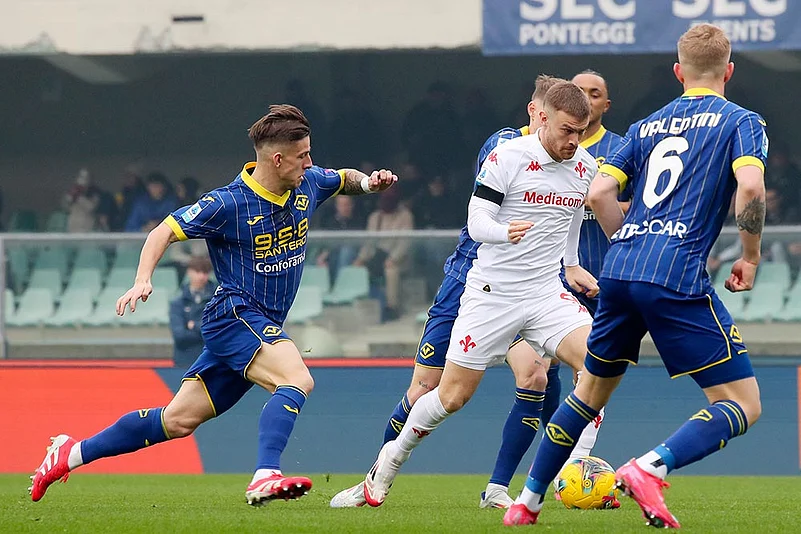


1️⃣ Match Context
This is the part of the Serie A calendar where matches stop being “three points” and start being leverage.
Verona are typically judged by survival math: every home game against a top-half opponent is a chance to buy margin for the run-in. Fiorentina, meanwhile, live in the pressure zone of expectations — the squad is built to compete for Europe, not to “see what happens.” That gap in objective shapes everything: Verona can accept long phases without the ball if the game stays level; Fiorentina can’t.
The timing matters. Early April brings accumulated fatigue, nagging muscle issues, and a tactical conservatism that creeps into teams protecting an outcome. Verona’s crowd and game-state management (slowing restarts, compressing space, drawing fouls) becomes more potent now. Fiorentina’s psychological pressure is different: drop points here and you force yourself to chase wins in higher-variance fixtures later.
2️⃣ Form & Advanced Metrics
Verona’s recent profile tends to be low-possession, medium-event football. They’re not trying to “win the shot count”; they’re trying to win the territory battle at the right moments. In xG terms, that usually shows up as a smaller volume of attempts but a reliance on a few higher-leverage sequences: fast breaks after a regain, second balls from direct play, and set-piece clusters.
The key is what they allow. Verona can look stable for long spells because they keep bodies behind the ball, but the concession pattern is often the same: opponents are steered wide, then eventually find a cutback or a central pocket at the top of the box. That’s why their defensive numbers can feel “fine” until they aren’t. It’s not constant leakage — it’s concentrated danger.
Fiorentina, by contrast, are usually a territory-first side. Their best games are built on field tilt (sustained attacks, recycling possession, pinning the opponent), and they tend to generate a healthy share of shots from advantageous zones when the press lands. The tell is in their shot quality: not just crosses and hopeful efforts, but more possessions that end with a final pass into the half-spaces and the cutback lane.
Pressing intensity is the swing factor. PPDA (passes per defensive action) is a proxy for how quickly you engage the opponent’s build-up. When Fiorentina are aggressive, their PPDA drops — meaning they’re forcing earlier decisions and creating short-field attacks. When they’re a step late, they can still have the ball, but they lose the easy recoveries that keep xG pressure constant. Verona will happily bait a press if they believe they can hit the second ball behind it.
Home/away dynamics also matter here. Verona at home are more willing to turn the match into a dueling contest: fewer clean possessions for the opponent, more stoppages, more collisions, more emotional momentum. Fiorentina away can sometimes drift into “control without incision” — high possession, but with the opponent’s box protected and transitions kept at arm’s length.
3️⃣ League Table Snapshot
| Team | Position | Points | GF | GA |
|---|---|---|---|---|
| Hellas Verona | 15th | 30 | 28 | 41 |
| Fiorentina | 7th | 48 | 45 | 34 |
Takeaway: This gap reflects two different seasons. Verona’s position is consistent with a team living on thin margins (one mistake swings the match). Fiorentina’s spot suggests a side with stable process but not always stable outcomes — capable of dominance, yet occasionally punished by variance when they don’t convert territory into goals.
4️⃣ Head-to-Head Analysis
These fixtures often follow a repeatable script: Fiorentina seeing more of the ball, Verona compressing the middle and trying to spring into space behind the fullbacks. The psychological dynamic is also familiar — if Fiorentina don’t score first, Verona grow into the game, and the crowd starts to influence tempo and referee thresholds.
The more important angle is structural: Fiorentina’s build-up and counter-press can suffocate Verona’s first pass, but if Verona escape that first wave, they can access the exact zones Fiorentina don’t love defending — wide channels with runners arriving at the far post, and second-phase balls where the defensive line is resetting.
5️⃣ Tactical Breakdown (Core Section)
Who dictates tempo?
Fiorentina will try to dictate with possession and field position. Verona will try to dictate with game state. That’s not a cliché — it’s a tactical plan. Verona’s ideal match is 0–0 deep into the second half, because every minute without Fiorentina scoring increases the value of Verona’s next transition and the crowd’s impact on rhythm.
Where is the overload zone?
Fiorentina’s best overloads usually arrive in the half-spaces: the channel between fullback and center-back, where the final pass can become a cutback. If they can pin Verona’s wide midfielder and isolate the fullback, they can create the “corner of the box” entry that Serie A defenses hate — it forces rotations and opens the penalty spot area.
Verona’s overload is different: they want the far side. The first ball goes long or into a duel, the second ball lands in a semi-organized zone, and suddenly Fiorentina are facing a cross or a low square pass with defenders running toward their own goal.
Which flanks are exposed?
The risk for Fiorentina is structural: pushing fullbacks high increases territory control, but it also increases the space behind them. Verona don’t need many chances; they need one or two clean releases into that channel. If Verona’s wide runners time it well, Fiorentina’s center-backs get pulled into uncomfortable wide defending, and the box protection suffers.
Midfield control battle
This match is won in the “second line.” Fiorentina want their midfield to receive on the half-turn and play forward early. Verona want those receptions to be back-to-goal, forcing safe passes and slowing the tempo. If Verona can keep Fiorentina’s central midfield facing their own goal, Fiorentina’s possession becomes sterile — lots of passes, few high-value touches.
Pressing triggers and buildup resistance
Expect Fiorentina to press hard on poor first touches and lateral passes across Verona’s back line. Verona’s response is rarely to outplay the press — it’s to skip it. The tactical nuance is what happens after the skip. If Fiorentina’s counter-press is connected (short distances, immediate pressure on the receiver), Verona’s long ball becomes a turnover. If it’s disconnected, Verona get a runway.
Transition vulnerability
Fiorentina’s transition defense is the hinge. Their attacking shape often commits numbers, and when that possession ends abruptly, they can be exposed in the first five seconds — precisely the window Verona target. Conversely, Verona’s own transitions can be messy when they over-commit to a counter and lose the second ball; Fiorentina can recycle instantly and keep them pinned.
Set-piece dynamics
This is a match where set pieces are not a side story. Verona’s path to points often runs through corners, long throws, and second-phase chaos. Fiorentina can defend these well when focused, but away fixtures in hostile atmospheres increase the probability of small errors: missed assignments, poor clearances, or a cheap foul that becomes a delivery.
6️⃣ Odds & Market Evaluation
| Outcome | Odds | Implied Probability |
|---|---|---|
| Hellas Verona Win | 3.40 | 29.4% |
| Draw | 3.15 | 31.7% |
| Fiorentina Win | 2.25 | 44.4% |
According to our calculations at betlabel.games, the fair pricing is tighter than the market suggests. Fiorentina are deserved favorites on territory and chance creation, but Verona’s home game-state control and set-piece threat keep the draw and narrow-home-win live.
Market read: the current away price implies a relatively clean Fiorentina edge. The matchup is not clean. It’s messy — and messiness inflates draw probability.
7️⃣ The Hidden Edge (Mandatory Section)
There’s a structural nuance here: Fiorentina’s “dominance” can be misleading if it doesn’t translate into penalty-box touches. Against compact, low-block opponents, they can rack up possession and even shots, but the shots skew toward lower-value angles unless they win the cutback lane.
Verona’s defensive scheme is built to concede the outside and protect the middle. That means Fiorentina may “look good” in live statistics — territory, pass count, corners — while still failing to create the kind of chances that separate variance from inevitability.
Add the April context: legs are heavier, rotations are imperfect, and away favorites often lose a half-step in counter-pressing. That half-step is exactly what Verona need to turn one clearance into a transition shot or a dangerous set piece. Markets can be slow to price that because it doesn’t show up as a stable trend in results; it shows up as a shift in the type of chances conceded.
8️⃣ Final Prediction
Main Pick: Under 2.75 Goals (Asian Total)
Alternative: Hellas Verona +0.75 (Asian Handicap)
Risk Level: Medium
Why these bets fit the matchup:
1) Game-state incentives point to a slower, tighter contest. Verona are structurally happy at 0–0 and will drag tempo down; Fiorentina can dominate without necessarily creating constant high-xG looks.
2) The matchup funnels Fiorentina wide. If Verona protect central lanes well, Fiorentina’s possession becomes more cross-dependent, which typically lowers shot quality and increases variance rather than goal volume.
3) Verona’s edge is episodic, not continuous. Their best moments come from transitions and set pieces — dangerous, but not usually producing a high number of clear chances. That profile supports a lower total and makes a goal-margin handicap attractive.
No guarantees here. But in a fixture where control doesn’t automatically equal clarity, backing reduced scoring and giving Verona a cushion is a logical way to align with the underlying mechanics.







Leave a Reply