




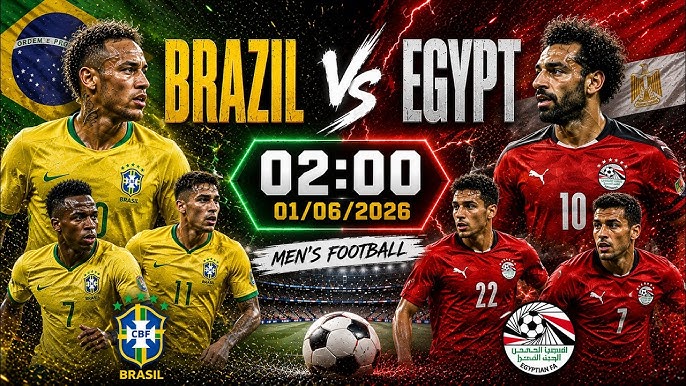


1️⃣ Match Context
Friendlies rarely feel like “must-win” games—until you look at what sits underneath them. Brazil vs Egypt lands in a window where national teams are stress-testing ideas, not chasing points. That doesn’t mean the stakes are low. The stakes are selection, hierarchy, and system clarity.
For Brazil, the pressure is structural. Every non-competitive match is a referendum on whether the current build can control elite-level transitions while still producing the attacking volume Brazil are expected to generate. The crowd, the shirt, the expectation: Brazil are judged on dominance, not just results. A friendly draw can still be a negative headline if the performance lacks grip.
For Egypt, the psychology is different: it’s a chance to play up a weight class with minimal downside. The incentive is to prove their low-block and counter mechanics can survive long spells without the ball, and that their progression routes can still create real chances rather than “moments.” If Egypt can stay structurally intact for 60–70 minutes, the game naturally becomes a test of Brazil’s patience and Egypt’s concentration—exactly the profile that can distort friendly outcomes.
Schedule and fatigue matter more than fans assume. In these windows, players arrive with mixed physical loads and club-season residue. That often creates a two-speed match: high-intensity bursts followed by long periods of managed tempo. Brazil generally handle that better because they can rotate quality without losing technical level; Egypt’s margin for error is thinner, especially if they chase for too long.
2️⃣ Form & Advanced Metrics
Instead of treating “form” as a last-five scoreline exercise, the betlabel.games team evaluates what tends to travel: shot quality, territory control, and how repeatable the chance creation is when the opponent refuses to open up.
Brazil typically operate with a strong territorial footprint—high field tilt, long spells in the attacking third, and a shot profile that leans toward central access when their wide rotations land. The numbers indicate their attack is less about raw shot volume and more about manufacturing high-value looks through cutbacks, half-space combinations, and second-ball pressure. That reduces randomness. You can miss a few and still be “in” the game because you’re repeatedly arriving in dangerous zones.
Defensively, Brazil’s volatility usually isn’t about being peppered with shots. It’s about where the opponent’s few shots come from. If Brazil’s counter-press is late—often after aggressive fullback positioning—opponents can reach central lanes with minimal resistance. That’s how you get a low shot count but high stress moments. In friendly contexts, where intensity can dip, that’s the key risk.
Egypt’s profile is generally more reactive: lower territory share, more time without the ball, and an attacking plan that relies on transitions, set-piece pressure, and exploiting the space behind fullbacks. Their shot quality can spike when counters are clean, but their shot volume is usually dependent on how often they can escape pressure rather than how well they can build. That creates a narrower path to goal.
Pressing intensity is the fork in the road. PPDA (passes allowed per defensive action) isn’t about “running more”—it’s about where and when you choose to engage. Brazil tend to press with triggers: a poor touch, a backward pass, a receiver facing their own goal. Egypt, against top-tier opponents, often defend in phases—contain first, then press once the ball moves wide or the opponent’s pivot is isolated. That’s sensible, but it invites long Brazil possessions. Over 90 minutes, that’s a lot of defending decisions.
Home/away splits matter too, even in friendlies. Brazil’s rhythm improves when they can play on the front foot with the crowd feeding the tempo, while Egypt’s best work often comes when the game is emotionally flat and the opponent is slightly casual. If this match starts at a high pace, it favors Brazil. If it starts slow and stays slow, the draw becomes more live than the brand names imply.
3️⃣ League Table Snapshot
This is an international friendly, so there is no league table in the classic sense. The closest “table” is the ranking context and performance expectations.
| Team | Competitive Context | Primary Objective | Main Performance Pressure |
|---|---|---|---|
| Brazil | Top-tier global contender | Dominant control + chance quality | Convincing performance, not just result |
| Egypt | Elite within CAF, underdog vs top 5 nations | Structural resilience + transition threat | Stay compact, avoid early collapse |
Takeaway: the “positions” here reflect expectation asymmetry. Brazil are priced and judged as a control team; Egypt are priced and judged as a resistance team. That gap is where betting markets can overreach—especially if the match state stays level deep into the second half.
4️⃣ Head-to-Head Analysis
In cross-confederation friendlies, head-to-head history can be noisy: different coaches, different squad priorities, and different incentives. The more useful angle is tactical repetition.
The structural pattern tends to be consistent when Brazil play a compact underdog: Brazil dominate territory, Egypt defend in layers, and the game hinges on two details—Brazil’s ability to access the box with quality, and Egypt’s ability to turn defensive regains into forward meters rather than instant turnovers.
If we look deeper, past meetings of similar profiles often show the same underlying truth: Brazil can create enough to win, but the match can feel “closer” than it is on the scoreboard because Egypt’s plan is to reduce the number of high-leverage events. That’s why totals and handicap markets often matter more than pure 1X2.
5️⃣ Tactical Breakdown (Core Section)
Who dictates tempo?
Brazil want a game of controlled acceleration: slow circulation, then sudden verticality once the opponent’s midfield line is pinned. The key is their ability to keep the ball in advanced zones after the first attack ends. If Brazil sustain pressure with strong rest-defense (enough players behind the ball to stop counters), Egypt get trapped in a repeating cycle of clearance and re-clearance.
Egypt want the opposite: a broken rhythm. Longer gaps between Brazil’s big chances, more stoppages, more set-pieces, more moments where Brazil’s structure looks slightly disconnected.
Where is the overload zone?
Expect Brazil to overload the half-spaces—especially the channel between Egypt’s fullback and nearest center-back. That’s where cutbacks and late box arrivals become available. If Egypt’s wide midfielder drops too deep, Brazil gain time to pick passes. If Egypt hold the wide midfielder higher, Brazil can isolate the fullback 1v1.
Egypt’s overload zone is transitional: the space behind Brazil’s advanced fullback. They don’t need sustained possession to threaten—just one clean release pass and a runner arriving into the channel.
Midfield control battle
The game is decided by Egypt’s ability to deny Brazil’s central progression. If Brazil’s pivot can receive under light pressure and turn, Brazil will enter the final third with structure. If Egypt can screen the pivot and force Brazil wide early, Brazil will still cross and combine—but the shot quality drops. That’s the difference between “dominant” and “frustrated dominance.”
Pressing triggers and buildup resistance
Brazil’s pressing triggers are likely to be aggressive on Egypt’s first pass out of the back. The goal isn’t to win the ball every time—it’s to stop Egypt from exiting cleanly. If Egypt can’t connect the second pass, they lose the ability to push their block up, and the defending becomes deeper and deeper.
Egypt’s buildup resistance will be pragmatic: avoid central turnovers, use longer releases, and try to win second balls in midfield rather than constructing 10-pass sequences. That’s sensible against Brazil’s athletes and counter-press.
Transition vulnerability
This is the one area Egypt can genuinely swing the match. Brazil’s attacking shape often commits bodies forward. If the counter-press is mistimed, Egypt can create a shot from a high-value transition even with minimal total possession. That’s why markets on “Brazil win to nil” are often fragile in these matchups.
Set-pieces
Set-pieces are Egypt’s leverage point. Even if open-play threat is limited, corners and wide free-kicks compress variance into a few deliverables: first contact, second ball, and chaos in the six-yard box. Brazil typically have the aerial tools to manage this, but friendly intensity can make set-piece defending softer than in tournaments.
6️⃣ Odds & Market Evaluation
| Market | Odds | Implied Probability | betlabel.games View |
|---|---|---|---|
| Brazil | 1.33 | 75.2% | Slightly short but playable in derivatives |
| Draw | 5.00 | 20.0% | Live if Brazil’s tempo is managed, not frantic |
| Egypt | 9.50 | 10.5% | Needs a very specific game state; thin value |
Implied probability note: these three add up to more than 100% due to bookmaker margin. According to our calculations, the market is pricing Brazil as a heavy favorite—reasonable on talent and territory expectation—but it can be slightly unforgiving if Brazil rotate heavily or treat the second half as a managed exercise.
The cleaner angle is often not “can Brazil win?” but “how does the match scoreline distribute given Egypt’s low-event plan?” That’s where totals and handicaps offer more stable logic than the 1X2 price.
7️⃣ The Hidden Edge (Mandatory Section)
There’s a structural nuance here: friendly game states can undercut pressing teams. Brazil’s edge is magnified when they sustain counter-press intensity—win the ball back quickly, pin the opponent, repeat. In competitive matches, that loop is ruthless. In friendlies, the loop can break because players manage collisions, manage sprints, and avoid needless risk.
That matters against Egypt because Egypt’s entire plan is to survive the first wave and then grow into the spaces the favorite leaves behind. If Brazil’s rest-defense spacing is even slightly sloppy, Egypt don’t need 10 attacks—two or three high-quality transitions can be enough to land a goal, and suddenly the handicap market becomes uncomfortable for Brazil backers.
The market can be slow to adjust to that because it prices “Brazil superiority” correctly in the abstract, but doesn’t always price the intensity tax correctly in friendlies. The result: Brazil can still win, but the margin is less reliable than the raw odds imply.
8️⃣ Final Prediction
Main Pick: Brazil -1.25 (Asian Handicap)
Alternative: Under 3.25 Goals (Asian Total)
Risk Level: Medium
Why:
1) Territory and chance quality should be one-way. Brazil’s ability to camp in the final third and generate repeat entries usually forces the underdog into a long defensive game.
2) Egypt’s threat is real but narrow. They can bite in transition and set-pieces, yet sustaining open-play chance creation across 90 minutes is difficult if Brazil’s counter-press is even average.
3) The market likely overprices the clean-sheet narrative. Brazil can win without shutting Egypt out. That’s why the handicap is preferred to “win to nil,” and why the under is a logical hedge if the match tempo stays managed.






Leave a Reply