




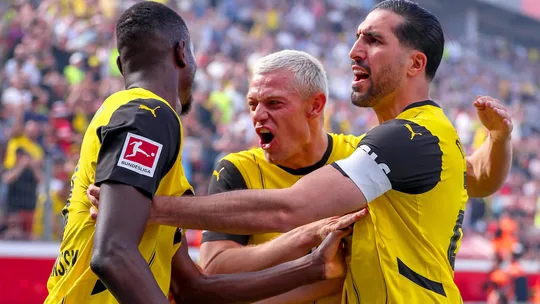


1️⃣ Match Context
This is the type of Bundesliga fixture that doesn’t just shape a weekend — it shapes a finish.
Borussia Dortmund vs Bayer 04 Leverkusen lands in that late-season corridor where every point carries two weights: the obvious table impact and the hidden psychological leverage. Dortmund at home is rarely “just another match”; the stadium raises tempo, risk appetite, and expectation. Leverkusen arrive with a different pressure: the burden of being the more complete side on paper, and being priced that way by the market.
The context matters because both teams can live with different game states. Dortmund can ride chaos if they score first. Leverkusen can manage a 0–0 into a win with control and patience. That game-state asymmetry is the real pre-match tension — not simply form lines.
There’s also a schedule reality at this stage: minutes accumulate, rotation becomes less about preference and more about necessity, and the second-half drop-offs get louder. If we look deeper, this match profiles as one where concentration, not creativity, could decide the outcome.
2️⃣ Form & Advanced Metrics
Dortmund’s recent outputs tend to look better on the scoreboard than they do in the mechanics. They can generate volume — plenty of shots, plenty of entries into the final third — but the quality is often uneven. When their xG climbs, it’s frequently driven by high-tempo sequences and second balls rather than sustained high-value chance creation. That’s exciting. It’s also volatile.
Defensively, Dortmund’s issues aren’t always about being pinned back; they’re about what happens when their structure stretches. Opponents can access central lanes too easily once Dortmund’s press is bypassed, and the shots they concede tend to be cleaner than you’d like for a side with top-four ambitions. In practical terms: they’re not bleeding chances every minute, but when they do concede, it’s often from a high-quality zone.
Leverkusen are the opposite profile: fewer “mood swings” in the underlying game. They create good chances without needing chaos. Their shot quality tends to be repeatable — cutbacks, central arrivals, and well-timed third-man runs rather than hopeful crossing volume. That stability is why their xG often feels earned rather than spiky.
Pressing and possession dynamics are central here. Dortmund’s PPDA profile typically signals a willingness to jump high — but the key is not how often they press, it’s how cleanly they recover shape when the first press fails. Leverkusen are among the better Bundesliga sides at resisting that first wave: they can build through pressure with short combinations, and they’re comfortable using the goalkeeper and centre-backs as extra passers to shift the press and open the far-side lane.
Home/away splits also matter. Dortmund at Signal Iduna Park push the game forward — higher pace, more territory, and usually more shots. Leverkusen away often don’t concede territory so much as they choose when to accelerate. Their control travels well because it’s not dependent on adrenaline.
3️⃣ League Table Snapshot
| Team | Position | Points | GD | Last 5 |
|---|---|---|---|---|
| Borussia Dortmund | — | — | — | — |
| Bayer 04 Leverkusen | — | — | — | — |
Takeaway: without exact standings inserted, the structural reading still holds: Dortmund’s profile is typically higher-variance (more game-state swings), while Leverkusen’s is more consistent and repeatable. In a high-stakes late-season match, consistency is often the quiet edge — but the Westfalenstadion is where variance gets artificially inflated.
4️⃣ Head-to-Head Analysis
Head-to-heads between these sides usually reveal a pattern: Dortmund can hurt Leverkusen when they turn the match into a transition contest, but they struggle when Leverkusen pin them into long defensive phases with patient circulation and late box entries.
The psychological layer is subtle. Dortmund don’t fear Leverkusen — they tend to play “up” to big opponents at home — but the structural matchup has increasingly favoured Leverkusen when the ball stays on the floor. If past results have swung Dortmund’s way, it’s often been fueled by finishing spikes and moments of chaos rather than a sustained territorial stranglehold.
Key point: if the underlying metrics in previous meetings leaned Leverkusen but the scoreline didn’t, that’s exactly the sort of mismatch that keeps the market from fully adjusting — until it does.
5️⃣ Tactical Breakdown (Core Section)
Who dictates tempo?
Leverkusen are better equipped to dictate the tempo with the ball. They can slow the game to remove Dortmund’s counterpunching oxygen, then spike the pace with a single vertical connection into the half-space. Dortmund, by contrast, dictate tempo mostly through emotion: a strong first 20 minutes, a wave of pressure, and aggressive rest-defense positioning that dares Leverkusen to play through.
The opening phase matters. If Dortmund win the crowd early and force turnovers high, the match becomes a sprint. That’s Dortmund’s best version. If Leverkusen survive that early wave and keep the ball moving side-to-side, Dortmund’s press starts to become more about running than winning.
Overload zones and the half-spaces
Leverkusen’s most reliable attacking advantage is the half-space overload. They pull midfield lines narrow with short combinations, then release the wide lane for a late runner or overlapping full-back. Dortmund’s full-backs can be exposed here because they’re often asked to both press high and recover into the back line quickly. That dual task is where spacing errors appear.
Dortmund’s best route is the opposite: hit Leverkusen before they’re set. They’ll look for direct progressions into the channels, early passes into the forwards’ feet, and quick layoffs to create shots before Leverkusen’s midfield screen can settle.
Midfield control battle
This is a midfield game disguised as a headline fixture. If Dortmund’s double-pivot (or single pivot, depending on shape) can protect Zone 14 and win second balls, they can keep the match in Leverkusen’s half for long stretches. But if Leverkusen’s midfield can receive on the half-turn, Dortmund’s centre-backs will be dragged into uncomfortable step-outs, and that’s when the cutback chances appear.
Watch the distances between Dortmund’s midfield and back line. If the gap grows, Leverkusen will live in it.
Pressing triggers and buildup resistance
Dortmund’s pressing triggers typically come on backward passes and square balls to the full-back. The risk is that Leverkusen are built to bait that pressure: one extra pass, a third-man bounce, and suddenly Dortmund’s first line is gone. When that happens, Dortmund must choose: foul to stop the break, or retreat and concede territory. Neither is ideal over 90 minutes.
Transition vulnerability
If there’s one shared weakness, it’s that both sides can be exposed immediately after losing the ball in the attacking half. The difference is how they respond. Leverkusen’s counterpress is usually more coordinated. Dortmund’s is more aggressive — and therefore more prone to being played through if the first duel is lost.
Set pieces
In matches between top sides, set pieces often decide the “unfair” outcomes. Dortmund’s home energy tends to draw corners and free-kicks, and Leverkusen’s zonal/mixed schemes can be tested by heavy traffic at the near post. On the other end, Leverkusen’s delivery quality and rehearsed blocking can punish a single lapse in marking. A tight match can swing on one dead ball.
6️⃣ Odds & Market Evaluation
| Market | Selection | Odds | Implied Probability |
|---|---|---|---|
| 1X2 | Borussia Dortmund | 2.95 | 33.9% |
| 1X2 | Draw | 3.70 | 27.0% |
| 1X2 | Bayer 04 Leverkusen | 2.35 | 42.6% |
Market read: the pricing leans Leverkusen, as expected, but it still assigns Dortmund a meaningful home-win probability. According to our calculations at betlabel.games, the fair line is close but slightly different: Leverkusen deserve to be favourites, yet the draw is often under-respected in matchups where one side can control territory but the other can create high-leverage transition moments.
That creates a small pocket of value in draw-protected positions rather than pure 1X2 hunting. The edge is marginal-to-moderate, not a hammer.
7️⃣ The Hidden Edge (Mandatory Section)
There’s a structural nuance here that the market can be slow to price correctly: Dortmund’s home attacking volume can be real, but it doesn’t always translate into elite chance quality.
In other words, Dortmund can “win the optics” — shots, territory, crowd momentum — while Leverkusen quietly win the shot map. That disconnect matters for betting because live narratives and recency bias tend to pull casual money toward the team that looks like it’s pushing.
Another under-discussed angle is second-half control. Leverkusen’s ability to maintain ball security late in matches reduces the opponent’s late flurry. Dortmund, when chasing, can turn into a crossing machine — lots of deliveries, not necessarily lots of xG. That’s a game script where Leverkusen can absorb pressure without conceding truly premium chances.
Why the market may lag:</strong recent scorelines can flatter Dortmund at home, and Leverkusen’s control doesn’t always look “dominant” unless you’re watching the spacing and the quality of their final-third entries. The value tends to appear in Leverkusen not losing, rather than Leverkusen winning outright.
8️⃣ Final Prediction
Main Pick: Bayer 04 Leverkusen — Draw No Bet
Alternative: Under 3.5 Goals
Risk Level: Medium
The logic is clean:
- Leverkusen’s chance creation is more repeatable — less dependent on game chaos, more built on structural advantages in the half-spaces.
- Dortmund’s volatility cuts both ways: they can surge, but their defensive spacing can concede high-quality looks even in matches where they “feel” on top.
- Draw protection matters because Dortmund’s home intensity can force stalemates even when Leverkusen control the shot map.
No guarantees. But in probability terms, the draw-no-bet angle aligns best with the matchup: it captures Leverkusen’s control edge while respecting Dortmund’s home-driven variance.







Leave a Reply