




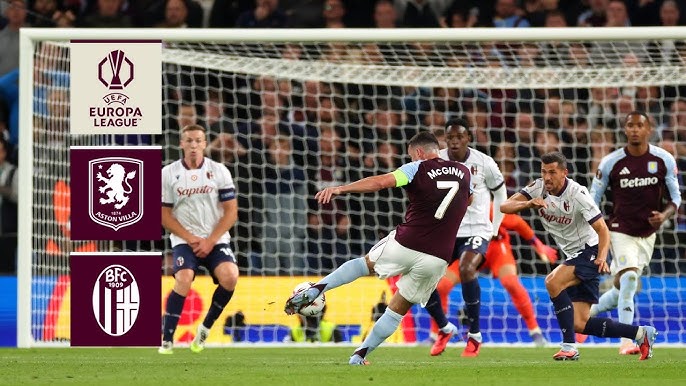


1️⃣ Match Context
Europa League nights distort normal logic. League form matters, but not as much as game state, emotion, and the fine margins of knockout pressure. Aston Villa host Bologna 1909 knowing that home legs in Europe are where ties are built — not necessarily won, but shaped. Villa Park under lights tends to compress opponents: faster restarts, higher volume of second balls, and a crowd that rewards aggression.
For Bologna, this is the kind of away trip that tests identity. Italian sides can manage European away legs well when they control tempo. The danger is being forced into a track meet. The psychological hinge is simple: Villa will want to turn the match into repeated waves; Bologna will want to turn it into a sequence of stoppages, long possessions, and selective counterpunches.
There’s also the schedule factor. Mid-April is the fatigue window: league run-ins, rotation dilemmas, and the subtle drop in pressing consistency that doesn’t show up in highlights but absolutely shows up in chance quality allowed late in halves. This is a tie where “who suffers better” matters as much as “who plays better.”
2️⃣ Form & Advanced Metrics
Aston Villa’s recent profile is built on territorial control and controlled chaos. They tend to generate a strong shot count at home, but the key isn’t volume — it’s where those shots come from. The numbers indicate Villa’s best sequences are produced when their attacking midfield line pins the opponent’s double pivot, letting runners arrive into the box rather than receiving with back to goal. That typically lifts shot quality, not just shot quantity.
Defensively, Villa’s volatility often comes from transitions rather than set defending. When their full-backs commit high and the counter-press misses its first tackle, opponents can access central lanes quickly. In xG terms, that creates “spiky” matches: long periods of control, interrupted by two or three high-leverage moments conceded. It’s also where PPDA (passes per defensive action) becomes meaningful. Villa can press intensely in bursts, but if the press isn’t sustained, they can leave the midfield line stretched.
Bologna’s underlying story is more about structure than star power. They typically allow fewer clean central entries because their compactness forces opponents wide, then asks them to cross under pressure. That lowers average shot quality conceded — but it carries a trade-off. If the wide pressure is late, they can allow cutbacks, which are the most valuable chance type in modern football.
In possession, Bologna are often more patient than they appear. Their pace of play can be deceptive: slower circulation, then one sharp vertical to break a line. Against teams that over-commit to a high press, that can be a release valve. Against teams that press with control and keep rest-defense (the shape behind the ball) intact, Bologna can be made to play in front of the block.
The form lens here is not “who is scoring,” but “who is consistently creating high-value shots.” Villa’s home process tends to be more repeatable. Bologna’s away process tends to be more conditional — it depends on whether the opponent gives them transition access.
3️⃣ League Table Snapshot
| Team | League Position | Points | GF | GA |
|---|---|---|---|---|
| Aston Villa | — | — | — | — |
| Bologna 1909 | — | — | — | — |
Takeaway: league position can lie in April because fixture difficulty and finishing variance start to separate “process” from “points.” In this matchup, Villa’s home identity typically travels better than Bologna’s away attacking output — but Bologna’s defensive structure is exactly the type that can keep a tie alive even when out-possessed.
4️⃣ Head-to-Head Analysis
In European ties like this, head-to-head history matters less than style-to-style repetition. The key question is whether Villa can consistently access the half-spaces behind Bologna’s midfield screen, or whether Bologna can force Villa into predictable wide deliveries.
If we look deeper, the matchup pattern tends to hinge on one detail: can Bologna’s wide midfielders track Villa’s full-backs without collapsing their own counter threat? When they fully commit to tracking, Bologna become safer but toothless. When they hold higher for transitions, they can create counters — but concede overloads and cutbacks.
5️⃣ Tactical Breakdown (Core Section)
Who dictates tempo?
Villa will try to dictate through territory, not possession for its own sake. Expect them to push their line higher, play more in the opponent half, and force Bologna to defend sequences of 30–60 seconds. Bologna’s preference is to dictate through tempo control: slow the match with longer possessions, draw Villa out, and then break the first press line with a vertical pass into the striker or attacking midfielder.
If Villa win the “restart battle” — throw-ins, second balls, immediate counter-press — the game tilts toward them quickly.
Overload zones and where the match breaks
Villa’s best attacking zone is typically the left half-space into the box, where a runner can arrive onto a cutback. Bologna’s defensive scheme usually tries to deny that by shifting early and asking the winger to double up, forcing play wide and away from the penalty spot.
The structural nuance here: Bologna can be stretched when the ball is switched quickly. If Villa circulate with purpose — not sterile U-shapes, but fast switches after drawing pressure — Bologna’s far-side full-back can end up defending two threats: the overlapping runner and the inside receiver.
Midfield control battle
Bologna’s midfield compactness is designed to make opponents play around them. Villa’s challenge is to play through them without turning the match into forced, low-probability shots. Expect Villa to use third-man runs and quick one-touch combinations at the edge of the block, trying to create that one half-second where Bologna’s screen is broken.
On the other side, Bologna’s best moments may come when Villa’s midfield steps too aggressively to press. If Bologna can bait pressure and then find the first forward pass into the channel, Villa’s center-backs can be pulled wide — and that’s where transition xG spikes.
Pressing triggers and buildup resistance
Villa’s pressing tends to be most effective when the opponent’s full-back receives facing their own goal. That’s the trigger: lock to the touchline, trap, win a throw-in, and start again higher up. Bologna will likely try to avoid that by using inside outlets and occasional longer diagonals. If Bologna go long, the second-ball duel becomes critical — and Villa at home typically lean into that chaos.
Set-piece dynamics
Knockout legs often swing on dead balls. Villa’s home set pieces are a constant source of “hidden” xG — not always immediate shots, but second phases where the opponent’s line loses shape. Bologna’s discipline is usually strong, but away legs create small timing errors: a half-step late on the near-post run, a clearance that drops central. Even if open play stays tight, set pieces can create the separator.
6️⃣ Odds & Market Evaluation
| Market | Selection | Odds | Implied Probability |
|---|---|---|---|
| 1X2 | Aston Villa | 1.80 | 55.6% |
| 1X2 | Draw | 3.60 | 27.8% |
| 1X2 | Bologna 1909 | 4.75 | 21.1% |
Those implied probabilities are raw (they don’t remove bookmaker margin), but they frame the market stance: Villa are a clear home favorite, the draw is respected, and Bologna are priced as a “win only if the game stays low event” side.
The betlabel.games team evaluates this closer to Villa 52% / Draw 27% / Bologna 21%. That suggests the straight home win is priced slightly short, but not wildly wrong. The more interesting value typically sits in handicap protection or low-to-mid total ranges depending on match state expectations.
7️⃣ The Hidden Edge (Mandatory Section)
Markets often overreact to surface results in Europe — especially when one team “looked comfortable” in a previous round. The hidden edge here is about event control.
Bologna’s defensive structure is designed to reduce shot quality, not necessarily shot count. That means Villa may have long spells of pressure that feel dominant, but the shots can be slightly worse than the crowd expects: wider angles, more bodies in line, fewer clean cutbacks. If Villa don’t score early, the match can drift into a state where the favorite is controlling territory without converting it into top-tier chances.
On the flip side, Bologna’s counter threat is often undervalued when priced as a big away dog, because their best chances are few but high quality. One broken press, one channel run, one cutback. That’s how away legs flip. The market is efficient on overall strength, but slower on how “few chances” can still mean “real danger.”
8️⃣ Final Prediction
Main Pick: Aston Villa -0.25 (Asian Handicap)
Alternative: Under 3.0 Goals (Asian Total)
Risk Level: Medium
Why these angles fit:
1) Villa’s home territorial control is the most repeatable edge in the matchup — even if Bologna defend well, Villa should spend more time in the attacking third and win more set-piece and second-ball sequences.
2) Bologna’s structure can keep chance quality down, which makes a goal-fest less likely unless Villa score very early and force the game open.
3) The -0.25 line protects against the draw in a matchup where Bologna are very capable of “surviving” without being the better side for 90 minutes.
No guarantees, just probability. Villa are likelier winners — but the cleanest betting logic is to respect Bologna’s ability to control damage while still acknowledging the home side’s territorial ceiling.







Leave a Reply