




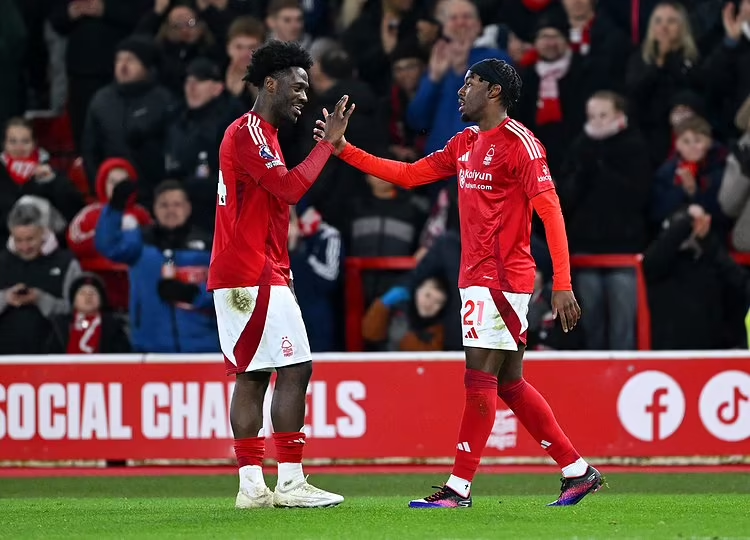


1️⃣ Match Context
This is the type of Europa League night where the crowd doesn’t need a goal to feel the tension. Nottingham Forest are hosting a side with deeper European muscle, but also one that will feel the weight of expectation: Aston Villa didn’t come into this competition to “compete” — they came to win it.
Forest’s incentive is different and, psychologically, often more dangerous for the favorite. For them, this is a chance to turn a season-defining narrative into something tangible: a home European scalp, proof that their structure holds against elite pressing and elite pace. Villa, meanwhile, carry the burden of being the better team on paper. That brings game-state pressure: if they don’t control territory early, anxiety creeps in — and Europa League ties punish impatience.
Schedule context matters too. Late April is where legs go and decision-making follows. The intensity isn’t constant; it comes in waves. Teams that manage tempo — not just “dominate” it — tend to survive these nights. Forest at home will want chaos in the right moments. Villa will want order for as long as possible.
2️⃣ Form & Advanced Metrics
Forest’s recent profile is typically defined by pragmatic football mechanics: they’re comfortable without the ball, but they don’t simply “sit in.” The numbers indicate a willingness to compress central zones and force opponents wide, even if that means conceding harmless volume. Their shot profile often reflects it: fewer shots conceded from prime central areas, but a steady diet of crosses and second-phase scrambles. That’s not pretty, but it’s controllable — until set-pieces and rebounds enter the equation.
In attack, Forest’s best work tends to come from transition sequencing rather than sustained possession. When they win the ball, they try to get to goal quickly, and their shot quality spikes when they can attack an unset back line. The issue is volatility: if the transition windows don’t appear, they can go long stretches generating low-value shots from the edges of the box. That’s how you end up “looking active” without actually threatening.
Villa’s underlying data usually tells a clearer story: they want territorial control and repeatable chance creation. Their xG tends to be built on structure — third-man runs, half-space access, and cutback zones — not just individual magic. They also press in a way that’s more intelligent than manic: PPDA (passes per defensive action) typically sits in the “high engagement” range, but the real value is in their triggers. They don’t chase everything. They hunt specific passes into the pivot and jump aggressively on negative touches.
There’s a trade-off, though. Villa’s buildup and positional play can leave them exposed to the exact type of attack Forest prefer: quick, direct transitions into the channels. If Villa’s fullbacks are high and the nearest midfielder is a step late, opponents don’t need five passes — they need one good one.
Home/away nuance is important here. Forest’s defensive concentration usually improves at the City Ground — crowd energy helps them sustain compactness — while Villa’s away European games can swing more by game state. If Villa score first, their control looks inevitable. If they don’t, they can drift into a “possession without incision” mode where shot volume rises but shot quality dips. That’s where ties become uncomfortable.
3️⃣ League Table Snapshot
| Team | Position | Points | GF | GA | GD |
|---|---|---|---|---|---|
| Nottingham Forest | 10 | 47 | 43 | 45 | -2 |
| Aston Villa | 5 | 61 | 58 | 44 | +14 |
Takeaway: This gap isn’t just talent — it’s repeatability. Villa’s position typically reflects more consistent territory and chance quality over time, while Forest’s mid-table profile hints at higher variance: they can be excellent in specific matchups, but less reliable when forced to dictate.
4️⃣ Head-to-Head Analysis
The Forest–Villa matchup tends to revolve around the same structural question: can Forest disrupt Villa’s access into the half-spaces without conceding the wide overloads that lead to cutbacks? When Forest defend well against Villa, it’s because their midfield line stays connected and their wide players track runners rather than just closing the ball.
Psychologically, Villa often arrive as the “should win” team. Forest benefit from that imbalance — not because it changes quality, but because it changes decision-making. The first 20 minutes matter: if Villa don’t create a high-quality chance early, Forest’s belief grows and the game drifts toward the lower-scoring, margin-thin territory that underdogs love.
If we look deeper, past results in this kind of matchup can be misleading. Villa may outshoot and out-possess, but the underlying question is always shot quality: are those shots coming from central cutbacks and penalty spot zones, or from outside-the-box volume? Forest can live with the latter.
5️⃣ Tactical Breakdown (Core Section)
Who dictates tempo?
Villa will try to dictate the rhythm through controlled possession and rest-defense structure — keeping enough players behind the ball to kill transitions before they start. Forest will accept being pinned back in spells, but they’ll look to spike tempo after recoveries. This becomes a game of “waves”: Villa’s sustained pressure versus Forest’s sudden breaks.
The overload zone: Villa’s left half-space vs Forest’s right corridor
Villa’s most repeatable route is often the left-sided half-space: combinations that pull the opposing right-back inside, then release wide for a cross/cutback. Forest’s right side can be a pressure point here. If their right winger collapses too deep, they concede the wide delivery. If he stays high to threaten transition, their fullback gets isolated 1v2. That is where Villa can manufacture high-quality chances without needing a pure target man.
Forest’s transition punch: channels, not central dribbles
Forest’s best transitional chances typically come when they attack the space outside Villa’s center-backs. The aim isn’t to dribble through midfield; it’s to bypass it. One vertical pass, one carry into the channel, and suddenly Villa’s high line has to turn. If Forest can force Villa’s midfielders into recovery sprints, the game becomes less about technical superiority and more about timing and duels.
Midfield control battle: the pivot screen
The central duel is about screening, not tackling. Forest’s midfielders must block the passing lane into Villa’s most advanced interior players. If they step out too aggressively, Villa can play around them and attack the back line at speed. If they stay too passive, Villa settle into the final third and cycle until the cutback appears. Forest need controlled aggression: press on triggers, not on emotion.
Pressing triggers and buildup resistance
Villa’s press is designed to force predictable exits. Forest will likely respond with more direct buildup: earlier balls into wide targets and second-ball fights. That reduces Villa’s ability to win the ball high, but it also invites territory loss. The tie can swing on second balls: if Forest can win enough of them, they prevent Villa from setting up repeat attacks. If they can’t, Villa’s field tilt (share of final-third possession) will climb and Forest will spend too long defending.
Set-pieces: the equalizer that keeps Forest alive
In these matchups, set-pieces are often where the underdog can “buy” expected goals without dominating open play. Forest will look for corners and wide free-kicks as a deliberate strategy, not a bonus. Villa’s defensive structure on dead balls has generally been solid, but late-season fatigue shows up here first: slow reactions, late picks, and second-phase clearances that don’t travel.
6️⃣ Odds & Market Evaluation
| Market | Selection | Odds | Implied Probability |
|---|---|---|---|
| 1X2 | Nottingham Forest | 3.45 | 28.99% |
| 1X2 | Draw | 3.30 | 30.30% |
| 1X2 | Aston Villa | 2.15 | 46.51% |
Those implied probabilities are raw and include margin, but the shape is clear: the market prices Villa as the most likely winner, with a meaningful draw chance and Forest as a live underdog.
The betlabel.games team evaluates this closer to a tight away-favorite scenario rather than a comfortable one. According to our calculations, Villa’s win probability is a touch lower than the market suggests, while the draw is slightly underpriced — a typical Europa League dynamic when the better side controls territory but struggles to turn it into separation.
Edge assessment: marginal-to-moderate. Not a “slam dunk” misprice, but there’s room if you target the right market type (handicaps/totals) rather than pure 1X2.
7️⃣ The Hidden Edge (Mandatory Section)
There’s a structural nuance here that markets often underweight: Villa’s control can inflate shot volume while quietly lowering shot quality when opponents refuse to open the middle. Against compact mid-blocks, Villa can rack up entries and half-chances, and the optics look dominant — but the actual xG per shot drops if the main output becomes outside-the-box attempts and blocked crosses.
Forest are built to invite that exact pattern. They’ll concede territory, but they’ll try to keep the “gold zone” protected. That creates a match script where Villa feel on top, yet the scoreboard stays tight longer than expected. And once that happens, the game becomes a psychological test: do Villa keep their structure, or do they over-commit and hand Forest the transition they’ve been waiting for?
Add the late-season fatigue factor: defensive concentration on second phases (especially after set-pieces and blocked shots) is where European ties get decided. The market prices team quality; it’s slower to price decision fatigue. That’s where the draw and low-scoring derivatives often find value.
8️⃣ Final Prediction
Main Pick: Draw or Aston Villa (X2) + Under 3.5 Goals (same-game angle)
Alternative: Draw (straight 1X2) at current prices
Risk Level: Medium
The logic is straightforward and rooted in mechanics:
1) Game state points to control without separation. Villa should own more territory, but Forest’s compactness can push Villa toward lower-quality volume.
2) Forest’s threat is real, but intermittent. They can land transitions, yet sustained chance creation is harder against a structured away side that manages rest-defense well.
3) Europa League pressure amplifies the draw. If the game stays level into the final half-hour, both teams become more risk-aware — and the draw probability rises faster than the market often assumes.
No guarantees — but in a matchup where Villa are likelier to be “better” than “clear,” the value lives in coverage and totals rather than calling a clean away win.







Leave a Reply