




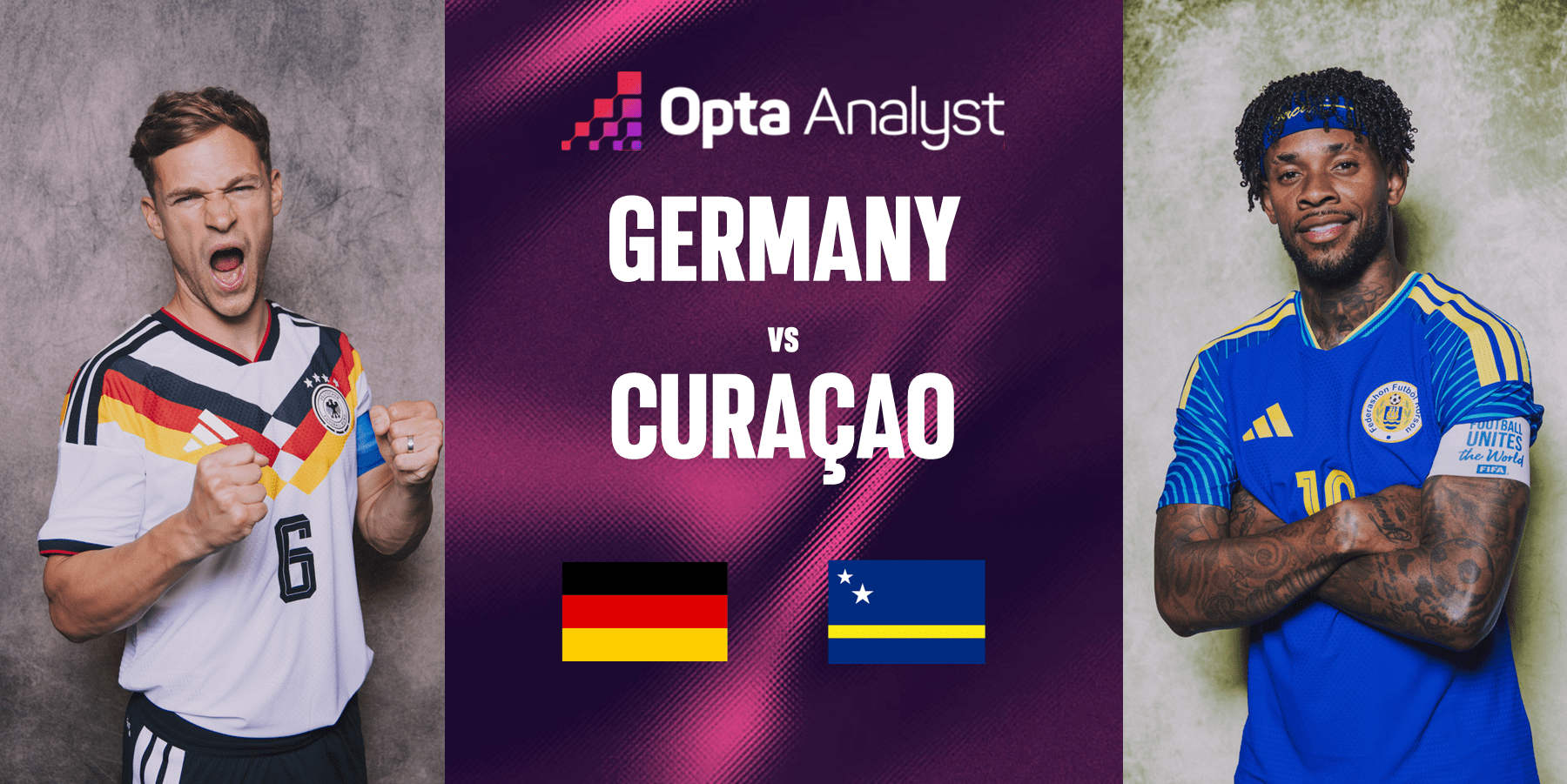


1️⃣ Match Context
This is the kind of World Cup qualifier that looks routine on the surface, but carries a very specific type of pressure: Germany are expected to win cleanly, control the narrative, and avoid any wobble. In a group format where goal difference can quietly become a tie-breaker, “just three points” often isn’t the full job. It’s three points plus authority.
Curacao arrive with a different psychology. For them, the match is not about possession shares or aesthetics; it’s about survival. Every minute at 0–0 is a win, every defended set-piece is a small psychological reset, and every Germany transition stopped is proof they belong at this level.
Schedule-wise, Germany’s biggest enemy is complacency and minutes management. Qualifier windows create a strange rhythm: heavy legs, limited training time, and a temptation to treat “smaller” opponents as a rehearsal rather than a competitive test. Curacao’s incentive is to turn it into exactly that kind of awkward rehearsal — low tempo, broken flow, and frustration.
2️⃣ Form & Advanced Metrics
Germany’s recent profile is built around territory and repeatable chance creation. The numbers indicate a team that can pin opponents in with high field tilt, generate a steady stream of shots, and create high-value looks from central zones when their attacking midfielders receive between the lines.
But the more interesting layer is shot quality versus shot volume. Germany can produce volume against low blocks, yet the match state matters: when early goals don’t arrive, shot maps can drift wider and lower in value. You’ll often see more cut-backs and second-phase shots rather than clean first-wave chances. That’s not “bad” — it’s simply the reality of facing a deep 5-4-1 or 4-5-1 with extreme box density.
Out of possession, Germany’s pressing intensity (PPDA as a proxy for how quickly they engage) tends to be aggressive against teams that try to build. The key nuance: Curacao may not build. If their plan is direct play and immediate second-ball contests, Germany’s press becomes less about winning it high and more about rest-defense structure — keeping enough numbers behind the ball to kill transitions.
Curacao’s underlying metrics in these matchups typically skew toward low possession, low shot volume, and defensive-box frequency. That can look “resilient” in raw goals conceded, but it’s fragile: concede first, and the game becomes a sequence of Germany attacks against a tiring block. The longer you defend, the more your clearances turn into re-attacks — and the expected goals against climb even if the scoreline doesn’t immediately reflect it.
Home/away dynamics also matter. Germany at home (or in a dominant venue setting) usually means higher tempo in the first 20 minutes, more corners, more touches in the penalty area, and a more ruthless ability to lock the opponent’s fullbacks deep. Curacao’s route to competitiveness is to slow that first wave, then hope Germany’s rhythm becomes predictable.
3️⃣ League Table Snapshot
| Team | Played | W | D | L | GF | GA | Pts |
|---|---|---|---|---|---|---|---|
| Germany | — | — | — | — | — | — | — |
| Curacao | — | — | — | — | — | — | — |
Takeaway: Without confirmed group data in this preview, the meaningful “table” angle is conceptual: qualifiers reward consistency, and heavy favorites are judged not only by results but by control. For Germany, anything short of a comfortable win creates noise. For Curacao, even a narrow defeat can be a functional outcome if it preserves confidence and goal difference.
4️⃣ Head-to-Head Analysis
There isn’t a rich competitive history here that reliably predicts outcomes, and that’s actually useful. When head-to-head is thin, the market leans more heavily on brand power and generic strength gaps — sometimes correctly, sometimes with a tax.
The structural matchup is the story: a possession-heavy elite side versus a deep-defending, transition-limited underdog. In these pairings, past results usually align with the same pattern: Germany dominate territory, the opponent has a handful of counters at most, and the key question becomes whether Germany’s finishing converts pressure into a scoreline that matches the control.
5️⃣ Tactical Breakdown (Core Section)
Who dictates tempo?
Germany will dictate the tempo by default through possession and field position. Curacao’s only real lever is disruption: slowing restarts, collapsing into a compact mid/low block, and forcing Germany into circulation rather than penetration. If Curacao can keep Germany’s attacking actions outside the box — crosses without targets, shots from 18–22 meters — they can keep the game “alive” longer than the talent gap suggests.
Where is the overload zone?
Expect Germany to create overloads in the half-spaces, not just on the wings. The most damaging pattern against a low block is: switch the ball quickly, pull the wide midfielder/fullback out, then hit the half-space runner for a cut-back. If Curacao’s midfield line sinks too deep, Germany’s No.10/advanced 8s receive facing goal — and that’s when shot quality spikes.
Which flanks are exposed?
Curacao’s flanks are exposed in a specific way: not because they lack work rate, but because a deep block forces the wide midfielder to become a second fullback. That creates a dilemma: track the German fullback overlapping, or protect the inside lane. Germany can stress that choice repeatedly, especially with quick switches and underlaps.
Midfield control battle
This isn’t a 50/50 midfield duel; it’s about Germany preventing the only thing that can hurt them: the second ball after a clearance. If Germany’s defensive midfielder and center-backs win those contests and immediately re-cycle possession, Curacao will defend wave after wave. If Curacao can win just a few second balls and force Germany to turn, they buy oxygen and reset their block higher up the pitch.
Pressing triggers and buildup resistance
Germany’s press is most effective when the opponent insists on building short. Curacao may bypass it, which shifts Germany’s focus: keep distances tight, win aerial duels, and be positioned for the rebound. That’s classic rest-defense — it doesn’t look glamorous, but it prevents the only scenario where underdogs become dangerous: open-field counters after a cheap turnover.
Transition vulnerability
The structural risk for Germany is the fullback height. If both fullbacks push and the ball is lost centrally, there’s temporary space behind them. Curacao’s challenge is turning that theoretical space into actual shots. That requires: (1) an outlet who can hold the ball, and (2) runners arriving with timing. Without both, transitions become hopeful clearances — and Germany recover.
Set-piece dynamics
This is where underdogs can stay relevant. Even with low open-play xG, a few corners and wide free-kicks can create a high-leverage moment. Germany’s advantage is repetition and delivery quality at the other end: sustained pressure typically drives corner counts up. Curacao’s defensive set-piece structure will be tested not once, but repeatedly — and fatigue is the silent opponent.
6️⃣ Odds & Market Evaluation
| Market | Selection | Odds | Implied Probability |
|---|---|---|---|
| 1X2 | Germany | 1.05 | 95.24% |
| 1X2 | Draw | 13.00 | 7.69% |
| 1X2 | Curacao | 41.00 | 2.44% |
Those implied probabilities sum well above 100% due to bookmaker margin. According to our calculations at betlabel.games, a more realistic “fair” view is closer to Germany ~92%, draw ~6%, Curacao ~2%. That suggests the 1X2 home price is heavily taxed — not surprising — and the value hunt shifts to derivative markets where game state and tactical shape matter more than brand.
Edge assessment: marginal on 1X2, potentially better on handicaps/totals depending on line placement.
7️⃣ The Hidden Edge (Mandatory Section)
There’s a structural nuance here: markets often price matches like this as if dominance automatically converts into a big scoreline. But against a committed low block, the first goal is everything. If it comes early, the game can avalanche. If it arrives late, the match can look “underwhelming” despite control.
The hidden edge is to think in sequences, not reputation. Curacao’s most plausible success condition is a first-half resistance script: concede few big chances early, keep the crowd quiet, slow tempo, and force Germany into lower-quality perimeter shooting. That doesn’t mean Curacao are likely to avoid defeat — it means certain totals/handicap shapes can be mispriced if the market assumes an immediate blowout.
On the other side, Germany’s edge is fatigue economics. A deep block requires constant concentration and repeated sprinting in short bursts. Defensive “success” in minute 20 can turn into set-piece chaos by minute 70. Markets sometimes underweight that late-game tilt: not just more Germany shots, but better shots — closer, more central, more cut-backs after the block’s spacing deteriorates.
8️⃣ Final Prediction
Main Pick: Germany -2.5 (Asian Handicap)
Alternative: Germany to win & Under 4.5 goals
Risk Level: Medium
Why: (1) Germany’s territory control should translate into sustained box pressure, and sustained pressure is how low blocks crack — often via second phases and set-pieces. (2) Curacao’s pathway to goal is narrow: limited buildup, few transition repetitions, and reliance on rare dead-ball moments. (3) The market’s 1X2 is too expensive to touch; the handicap/totals allow you to express the expected control-to-scoreline conversion with better payoff, even if the first half is sticky.






Leave a Reply