



1️⃣ Match Context
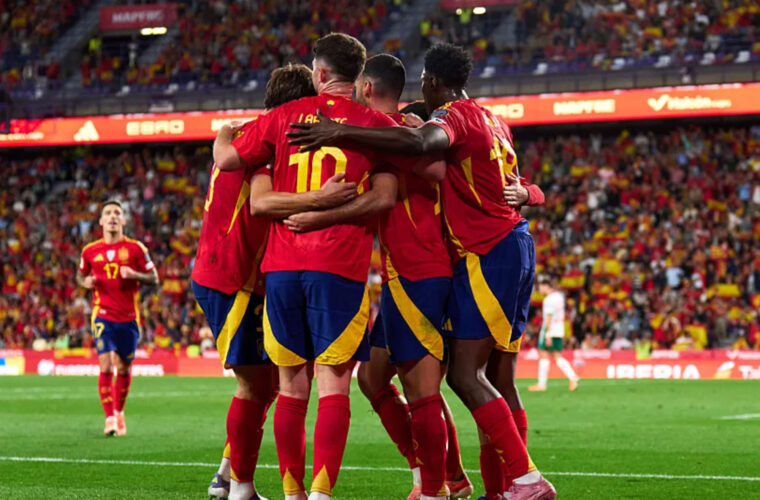
A late-March friendly rarely carries “trophy pressure,” but it does carry something modern national teams value almost as much: hierarchy. Spain are in the phase where selection depth is a weapon and a problem—there are more good players than minutes, and every window becomes a referendum on who can execute the game model at international speed.
Egypt arrive with a different tension. Their margin for error against elite possession teams is thin, and these fixtures often function as an exam: can they defend for long spells without losing their transition threat, or do they get pinned into a low block that becomes a slow surrender?
There’s also the calendar reality. March windows compress training time. That favors teams with a stable, automated structure. Spain’s positional play is built for that. Egypt’s success tends to be more opponent-specific—shape discipline, moments in wide transitions, set-piece leverage—elements that can be disrupted by fatigue and travel logistics.
Momentum matters too, but in friendlies it’s less about streaks and more about clarity. Spain’s best games look inevitable: territorial control, rapid counterpressing, and a steady drip of high-quality shots. Egypt’s best games look opportunistic: survive, then strike on the run. This match is about whose identity asserts itself first.
2️⃣ Form & Advanced Metrics
Spain’s recent pattern is consistent across opponents: **high territory share, high final-third entries, and a shot profile that tilts toward cutbacks and central-zone finishes** rather than low-percentage crossing. When Spain are functioning, they don’t need a flood of shots; they need repeatable access to the “golden corridor” between the penalty spot and the six-yard box. That’s where their expected-goals value typically comes from.
Defensively, Spain’s numbers usually reflect two things: strong counterpressing that prevents counters from becoming shots, and compact rest defense that keeps opponents wide. The risk is not volume—it’s event quality. When Spain get caught, it’s often in the exact type of moment Egypt hunt: a broken structure, a fullback high, and a direct ball into space that turns one pass into a chance.
Egypt’s underlying profile against top-tier opposition often looks like this in football terms: **shot suppression through block density, but a concession of territory that invites sustained waves**. That can keep the xGA respectable for long stretches—until it doesn’t. The danger is cumulative. If you spend too much time defending your box, the eventual concession tends to be higher quality: second balls, rebounds, and short-range finishes after the line is forced deeper.
Pressing intensity is a key separator. Spain’s PPDA-style approach—allowing fewer passes before engaging—typically creates predictable opponent behavior: rushed clearances and long balls. Egypt’s press is more situational; they often prefer to drop into a medium/low block and select triggers (back passes, wide traps). That can work, but only if the distances between lines stay tight. If those distances stretch, Spain’s interior combinations become a problem fast.
Tempo is the other hidden lever. Spain can play slow and still be dangerous because their “slow” is still structured: constant re-occupation of zones, fullback underlaps, third-man runs. Egypt, when forced to defend deep, can become passive in their first pass out. That reduces transition volume and turns the match into a siege—exactly what Spain want in a friendly where they can rotate without losing control.
3️⃣ League Table Snapshot
Friendlies don’t come with a league table, but markets still price them like competitive fixtures—because performance indicators carry over.
| Category | Spain | Egypt |
|---|---|---|
| Status | Elite possession nation | Transition-focused contender |
| Typical game state | Controls territory & tempo | Defends deep, breaks wide |
| Primary win path | Sustained pressure → high-quality chances | Low-block survival → counters / set pieces |
| Primary risk | One transition chance conceded | Box defending fatigue, second balls |
Takeaway: this matchup isn’t “form vs form.” It’s **structure vs structure**. Spain’s baseline usually travels. Egypt’s baseline depends more heavily on game script and scoreline.
4️⃣ Head-to-Head Analysis
Head-to-head history is limited and often misleading in national-team friendlies because personnel cycles move quickly. The useful part isn’t the past scorelines—it’s the recurring matchup logic: Spain tend to dominate territory against teams who sit in, and those teams typically need either (a) an elite outlet to hold the first ball under pressure, or (b) set-piece superiority to keep the game alive.
Against Spain, teams that merely “survive” without an outlet eventually concede the same type of chance: a cutback after the block collapses inward. If Egypt can’t connect their first two passes after regaining the ball, the match becomes one-way traffic, regardless of how disciplined the block looks on broadcast.
5️⃣ Tactical Breakdown (Core Section)
Who dictates tempo?
Spain should. They don’t just keep the ball; they keep it in the opponent’s half with intention. Expect long spells of circulation that aren’t sterile—Spain will probe for the moment the Egyptian midfield line shifts a half-step too far, then play through the inside channel.
Where is the overload zone?
The key zone is the half-space between Egypt’s wide midfielder and fullback. Spain will try to create a 2v1 there via an interior midfielder plus an underlapping fullback, forcing Egypt’s winger to choose: track the runner or protect the fullback. Either choice creates a second-order opening—either a cutback lane or a switch to the far side.
Which flanks are exposed?
Egypt’s danger flank is often the side where their winger is tasked with too much defending. If that winger drops into the back line, Egypt lose their primary counter outlet. If he stays high, Spain get free access to progression down that wing. It’s a trade-off, and Spain’s patience tends to punish it.
Midfield control battle
Egypt’s best hope is to deny central progression and force Spain wide into lower-quality crossing. That requires midfielders to hold their positions, not chase. But Spain’s rotations are designed to tempt exactly that chase—dragging a midfielder out, then exploiting the gap with a third-man run. If Egypt’s midfield line loses its spacing, the box starts receiving passes rather than crosses. That’s when shot quality spikes.
Pressing triggers and buildup resistance
Spain’s counterpress is the main defensive mechanism here. When Egypt win the ball, Spain will swarm the first receiver to stop the release pass. If Egypt can bypass that with a direct ball into the channel early, they can create their best moments of the match. If they can’t, transitions die on contact, and Spain restart another attack wave.
Transition vulnerability
Spain’s risk is structural, not random: fullbacks high, center-backs in wide coverage, and one mistimed counterpress duel can open space. Egypt should target the first pass into the wide lane, then a diagonal into the striker’s run. They won’t get many of these chances, which makes conversion variance a real factor.
Set pieces
Friendlies can become set-piece games because rhythm is broken by substitutions. Egypt’s clearest equalizer is dead balls—corners and wide free kicks—especially if Spain rotate personnel and lose a bit of aerial continuity. Spain, meanwhile, generate set pieces through territorial dominance, and second phases can mimic open-play xG because the defending shape is disorganized.
6️⃣ Odds & Market Evaluation
| Market | Odds | Implied Probability |
|---|---|---|
| Spain win | 1.35 | 74.1% |
| Draw | 4.80 | 20.8% |
| Egypt win | 9.50 | 10.5% |
Note: implied probabilities above include bookmaker margin and won’t sum to 100%.
The betlabel.games team evaluates this closer to a **Spain win probability in the low 70s**, with the draw sitting in the low 20s and Egypt in the single digits. That means the 1X2 home price is not screaming value by itself—Spain are supposed to win, and the market knows it.
Where pricing can still move is in derivatives: handicap lines and totals, especially if rotation news drops late. The key question: does the market price this like a calm Spain control win, or a friendly with loose structure and higher variance?
7️⃣ The Hidden Edge (Mandatory Section)
There’s a structural nuance here that friendlies often hide: **second-half control tends to drop when the favorite rotates more aggressively**, and Spain are one of the most rotation-heavy nations because of depth. That can create a strange two-phase match—elite pressure early, then a less synchronized press after multiple changes.
Markets often price Spain as “Spain” for 90 minutes. But the game model’s sharpest edge—counterpressing and coordinated rest defense—requires automation and relationships. Swap three or four pieces, and the press becomes a step slower. That’s when Egypt’s most valuable moments can appear, not because Egypt improve, but because the favorite’s structure softens.
So the hidden edge isn’t simply “Egypt might score.” It’s that **the distribution of Egypt’s chances may be lumpy and late**, which affects totals and handicap timing. If Spain don’t convert early dominance into a two-goal cushion, the match can drift into a one-goal game where a single transition or set piece flips the betting narrative.
8️⃣ Final Prediction
Main Pick: Spain -1.25 Asian Handicap
Alternative: Under 3.25 Goals
Risk Level: Medium
Why: (1) Spain’s territorial control and shot-quality generation should be consistent against a deep block, and Egypt’s attack volume may be limited by Spain’s counterpress. (2) Egypt’s best path—transitions and set pieces—typically produces fewer total shots, meaning they can be competitive without creating sustained chance volume. (3) Friendlies introduce late-game variance through rotations, which makes a pure “Spain win to nil” angle fragile; the handicap and a slightly higher under line balance that risk.
Most likely script: Spain dominate territory, create the clearer chances, and win by one or two. The value question is whether the market has fully priced the possibility that Egypt’s best moments arrive late—after Spain’s rhythm changes.



Leave a Reply