




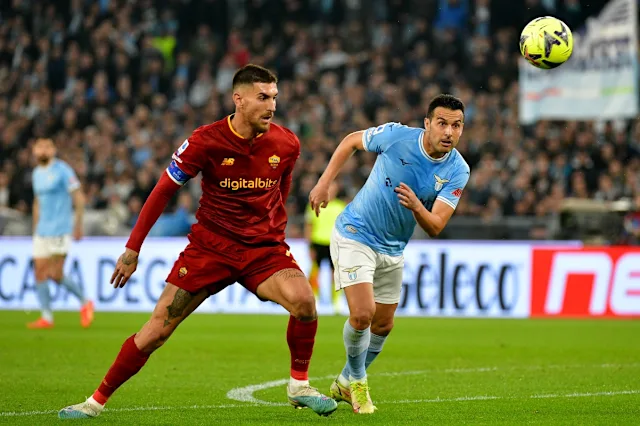


1️⃣ Match Context
Derby della Capitale rarely needs extra narrative fuel, but this one comes with real table gravity. With the season at its sharp end, Roma and Lazio are not just playing for pride — they’re playing for access: European positioning, financial upside, and the psychological stamp that can define a summer.
The pressure here is asymmetric. Roma at home carries the weight of expectation and the idea that “a derby win can rescue a season.” Lazio, traditionally more comfortable in chaos, can treat this as a game to disrupt rhythm, steal territory in bursts, and let the occasion squeeze the hosts. That dynamic matters because derby games often swing on emotional control more than pure quality.
There’s also the calendar angle. Mid-to-late May fixtures tend to carry accumulated fatigue: heavy legs, small injuries, and reduced training intensity. That typically lowers press cohesion and increases transition errors. In a derby, those errors become chances — and chances become narratives.
2️⃣ Form & Advanced Metrics
Roma’s recent profile has leaned toward territorial control rather than pure chance dominance. They tend to spend longer spells in the opponent’s half, but the key question is shot quality: are they turning possession into central, high-value looks, or settling for volume from the edges? In their better performances, Roma’s chance creation comes from forcing the opponent’s block to collapse — then attacking the space just inside the fullback channels. When that timing is off, the same possession becomes sterile.
Lazio’s form, meanwhile, typically reads as more volatile. They can look passive for 20 minutes, then create two high-quality transitions in five. The numbers indicate a team that’s comfortable trading rhythm for moments: fewer long spells of pressure, but a steady ability to generate shots that matter — especially when they win the ball with the opponent’s shape stretched. That’s where shot quality spikes.
Pressing intensity is the matchup hinge. PPDA (passes allowed per defensive action) isn’t just a number — it tells you whether a team pressures high or waits. Roma’s pressing tends to be more organized at home, but it can soften late in games when legs go. Lazio are often selective pressers: they trigger pressure on specific cues (bad body shape, backwards pass, isolated fullback), then attack quickly. In a derby, that selective aggression can be more efficient than constant pressing, because it reduces the “emotional sprinting” that drains teams.
Tempo patterns matter too. Roma usually prefer a controlled pace with long attacking phases, while Lazio like the game to fragment. If this match becomes stop-start — fouls, set-pieces, heated duels — it generally benefits the side more comfortable without rhythm. Lazio often are.
3️⃣ League Table Snapshot
| Team | Position | Points | GD | Last 5 |
|---|---|---|---|---|
| Roma | TBD | TBD | TBD | TBD |
| Lazio | TBD | TBD | TBD | TBD |
Analytical takeaway: even without exact table inputs here, the late-season derby dynamic typically compresses the incentive structure. If both are within reach of European places, the game becomes a risk-management puzzle. If one side is chasing while the other is protecting, you’ll see it in game state: earlier long shots, more direct play, and wider attacking shapes from the team that needs a win.
4️⃣ Head-to-Head Analysis
Head-to-heads in derbies are often misunderstood because the emotional layer hides structural repetition. What tends to repeat in Roma–Lazio is not a specific scoreline, but the question of who controls the central corridor without overcommitting. When Roma have enjoyed the better derby stretches, it’s typically because their midfield spacing has prevented Lazio from launching clean counters through the inside channels.
Lazio’s better derby outcomes often come when they can bait Roma into aggressive fullback positioning, then hit the space behind with early vertical balls. The past meetings frequently show this pattern: Lazio don’t need sustained possession to hurt Roma — they need Roma to lose rest-defense discipline for one moment.
If we look deeper, derby results can diverge from underlying chance quality because finishing volatility spikes in emotionally charged matches. That’s why it’s more useful to focus on repeatable access to high-value zones rather than one-off goals.
5️⃣ Tactical Breakdown (Core Section)
Who dictates tempo?
Roma will try to dictate through possession and territory, especially early. Expect them to build with patience, inviting Lazio’s first line to step — then playing into the half-spaces. Lazio’s preferred response is to refuse the “possession trap,” keep their midfield line compact, and turn the match into episodes: defend, win, break.
The first 25 minutes are huge. If Roma score first, their controlled tempo becomes a weapon. If Lazio keep it level and frustrate, the game naturally becomes chaotic — and that’s where Lazio’s transition profile can bite.
Overload zones and exposed flanks
Roma’s most reliable attacking patterns usually come from overloads around the left half-space, pulling defenders inward and then switching to the weak side. Lazio will try to deny the inside lane and force Roma wide. That can lower shot quality: crosses instead of cutbacks, second balls instead of clean finishes.
Lazio’s threat often lives in the channels behind Roma’s fullbacks. When Roma push both fullbacks high, their rest-defense can become a thin back line with big lateral distances. That’s a structural nuance here: Roma can look dominant and still be one bad turnover away from conceding a high-xG chance.
Midfield control battle
This derby tends to be decided by midfield spacing, not individual flair. Roma need their central midfielders to screen counters while still supporting attacks — a difficult balancing act. Lazio will try to pin those midfielders with quick forward runs, forcing them to choose: step and leave space behind, or hold and allow Lazio time on the ball.
If Roma’s midfield gets stretched, Lazio’s counters become cleaner and more frequent. If Roma keep distances tight, Lazio are forced into lower-quality wide entries and set-pieces.
Pressing triggers and buildup resistance
Roma’s buildup can be pressured if Lazio time their press on the first pass into midfield. Lazio don’t need to press constantly — they just need to press accurately. A couple of forced long balls can change the entire territorial story, because Roma’s attacks become shorter and more frantic.
Conversely, Roma can target Lazio’s buildup by locking onto the fullbacks and forcing play inside, where turnovers are most damaging. The derby is often decided by who wins the “second ball” battles after those forced long passes.
Transitions and set-pieces
Late-season legs plus derby emotion typically increases transition volume. That points toward both teams having chances, but not necessarily a high total of clean, structured shots. Set-pieces can be a swing factor: corners and wide free-kicks become pseudo-open-play chances in matches where the box is constantly crowded and duels are intense.
6️⃣ Odds & Market Evaluation
| Market | Selection | Odds | Implied Probability |
|---|---|---|---|
| 1X2 | Roma | 2.35 | 42.6% |
| 1X2 | Draw | 3.25 | 30.8% |
| 1X2 | Lazio | 3.10 | 32.3% |
The implied probabilities above include bookmaker margin, so they won’t sum to 100%. According to our calculations at betlabel.games, the fair line is slightly tighter between Roma and the draw than the market typically prices in derby spots. The derby tax often inflates the “anything can happen” narrative, but the real inefficiency usually sits in totals and handicaps rather than the raw 1X2.
If Roma are priced as a clear favorite without accounting for Lazio’s transition leverage, that’s where value can appear on Lazio-protected positions (double chance, Asian handicap) or on a game-state market like under/over depending on tempo expectations.
7️⃣ The Hidden Edge (Mandatory Section)
The market is often slow to price one specific derby reality: possession dominance can be misleading when the opponent’s best weapon is transition shot quality. Roma can “win” field tilt — more touches in the final third, more corners, more territory — while Lazio quietly generate the better chances because their attacks start closer to goal after turnovers.
That’s especially true late season, when pressing structure decays. Teams don’t recover into perfect rest-defense shapes as quickly. If Roma’s attacking shape becomes too aggressive — both fullbacks high, midfielders ahead of the ball — Lazio’s direct counters produce high-value shots with fewer passes. Those chances are often underrepresented in casual previews because they don’t require sustained pressure.
There’s also a second-half nuance: derby intensity can cause teams to drop their line 5–10 meters after the hour mark. That reduces the quality of high presses and increases the value of set-pieces and half-chances. If the market expects a “classic derby fireworks” script, it may be overpaying for goals.
8️⃣ Final Prediction
Main Pick: Lazio +0.5 (Asian Handicap) / Double Chance (X2)
Alternative: Under 3.0 Asian Total Goals
Risk Level: Medium
Logic:
1) Lazio’s transition profile matches up well against Roma’s high territorial approach — they don’t need control to create high-quality chances.
2) Derby game states often compress: more duels, more stoppages, fewer clean sequences, which supports the under angle if the match becomes fragmented.
3) Late-season fatigue tends to reduce press cohesion and increase caution after halftime, making a narrow-margin match more likely than a runaway.
No guarantees — but in probability terms, the value is in giving Lazio protection against a draw in a game where structural volatility is high and the emotional tempo often works against the nominal favorite.







Leave a Reply