
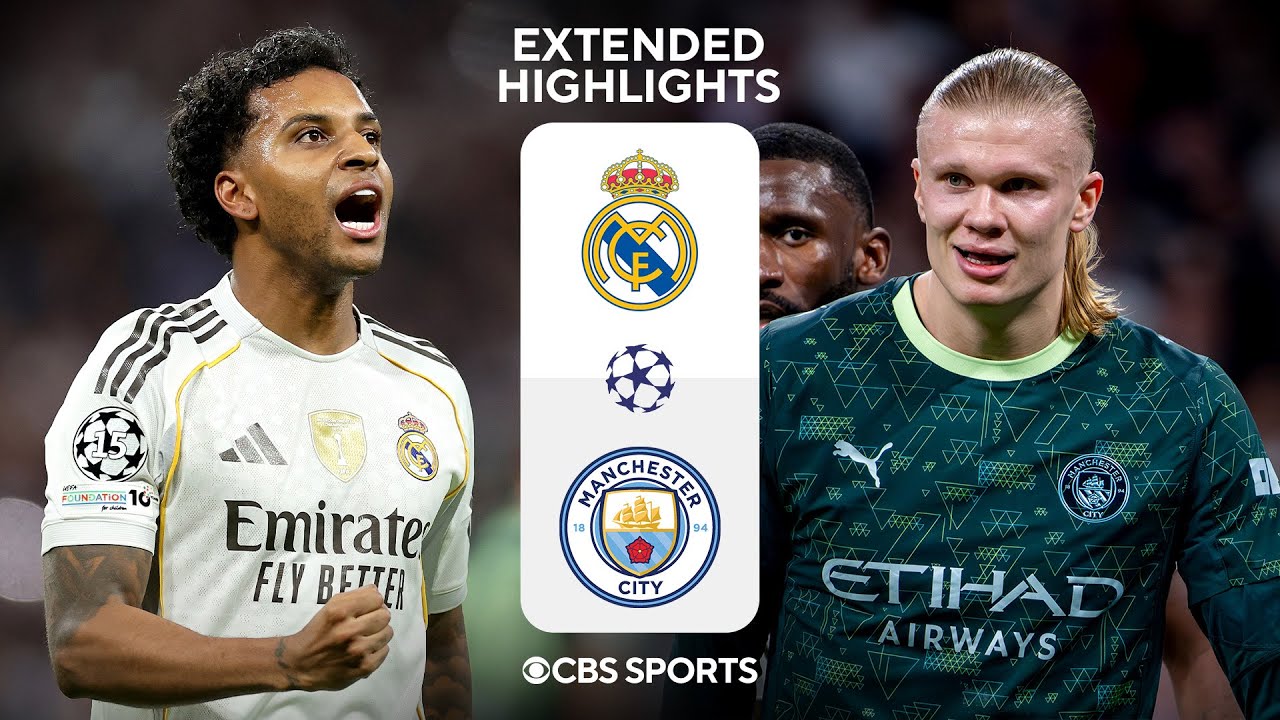


1️⃣ Match Context
There are Champions League nights that feel like football, and then there are nights that feel like judgement. Real Madrid vs Manchester City sits firmly in the second category — not just a tie between elite teams, but a collision of identities.
Madrid’s pressure is familiar: European expectation, the Bernabéu calendar marked in permanent ink, and the psychology of being “the club that always finds a way.” City’s pressure is different. It’s the modern kind: dominance domestically, constant control of game states, and the demand that control must translate into knockout certainty.
By March, the schedule stops being a list and becomes a load. Rotations are no longer luxury — they’re survival. Legs matter, but so does mental bandwidth: how quickly you reset after a bad five-minute spell, and how composed you stay when the stadium tilts the referee, the momentum, and your own decision-making.
This fixture is rarely decided by who is better. It’s decided by who blinks first in the moments when the game stops behaving like a plan.
2️⃣ Form & Advanced Metrics
Real Madrid’s recent profile tends to carry a familiar paradox: they don’t always dominate the shot count, but they consistently create shots that matter. Their best sequences aren’t about volume — they’re about arriving in the box with structure already broken. The numbers indicate that Madrid’s chance quality often outpaces their chance quantity, which is why they can look quiet for 25 minutes and still end a half with the better chances.
Defensively, Madrid’s volatility usually shows up in the same places: central access in front of the back line and moments where midfield protection disconnects from the press. That’s not always a “bad defense” problem; it’s a control problem. When Madrid want to accelerate the game, they accept more transitional exposure — and against City, that’s playing with fire.
Manchester City’s underlying performance generally reads like a possession machine with teeth. Their territory control and field tilt tend to be elite: long spells pinning opponents, recycling attacks, and forcing clearances that become second waves. But there’s an important nuance: City’s chance creation is often built on sustained pressure rather than constant big chances. That means their xG can accumulate steadily without always producing the kind of single-shot moments Madrid thrive on.
Pressing intensity is where City typically separate themselves. A low PPDA (passes allowed per defensive action) isn’t just “they press a lot” — it means opponents are denied calm buildup, forced into longer passes, and pushed into lower-percentage possession. If City can keep Madrid’s first phase uncomfortable, they reduce the frequency of Madrid’s most dangerous weapon: clean transitions into space.
Tempo patterns matter here. Madrid are comfortable with rhythm changes — slow, then sudden. City prefer to keep the game in one temperature: controlled, incremental, suffocating. Whoever wins that argument dictates the tie’s emotional tone.
3️⃣ League Table Snapshot
| Team | Domestic Position | Points | GF | GA |
|---|---|---|---|---|
| Real Madrid | Top 3 | High | High | Low–Moderate |
| Manchester City | Top 3 | High | High | Low |
Takeaway: both teams arrive with domestic performance that reflects quality rather than luck — but the way they get results differs. City’s consistency is usually process-driven (territory, control, repeatability). Madrid’s consistency often includes a higher share of game-state swings, where finishing, big moments, and psychological resilience do real work.
4️⃣ Head-to-Head Analysis
In recent seasons, this matchup has developed a tactical memory. City typically try to turn Madrid into a team that defends for long stretches and lives off isolated breakouts. Madrid typically try to turn City into a team that has the ball but can’t protect itself the moment possession is lost.
What’s notable is that the “who played better” debate after these games often diverges from the scoreboard. City can produce the cleaner underlying shot map — more touches in the final third, more sustained pressure — and still feel one transition away from chaos. Madrid can concede territory and still feel emotionally in control, because they trust their ability to create the first truly decisive chance.
Structurally, the matchup pattern repeats: City’s dominance looks stable until it doesn’t. Madrid’s “under siege” look seems dangerous until it suddenly becomes dangerous for City.
5️⃣ Tactical Breakdown (Core Section)
Who dictates tempo?
City will attempt to dictate tempo through possession length and territory. Their goal is to keep Madrid’s front line running backward, not forward. The longer City keep the ball, the fewer sprint opportunities Madrid get in transition.
Madrid, meanwhile, don’t need to “win possession” to win the match. They need to win the speed of the key moments: first pass after recovery, the timing of the runner behind the midfield line, and the decision to go vertical rather than reset.
Where is the overload zone?
City’s best work often comes from creating overloads around the half-spaces — those channels between fullback and center-back that bend defensive structures. They’ll use positional rotations to pull Madrid’s midfield line toward the ball, then find the third-man run to enter the box without forcing a hero pass.
Madrid’s counter-overload is usually central: win the ball, connect quickly through the first forward pass, and attack the space behind City’s advanced fullbacks. The key is whether Madrid can find that pass under pressure. If City’s counter-press lands cleanly, Madrid’s breakout becomes a clearance, not an attack.
Which flanks are exposed?
Madrid’s vulnerability tends to appear when their wide defenders are isolated and the winger support is inconsistent. City will test that with constant switches and underlaps. It’s less about beating a fullback one-v-one and more about forcing a choice: step out to the ball carrier or protect the cutback lane.
City’s flank exposure is more situational: when their fullbacks invert or push high, the space they leave behind can become a runway. Madrid love a runway. If Madrid can create 2–3 clean transition entries, it can outweigh 20 minutes of City territory.
Midfield control battle
This tie usually pivots on midfield spacing rather than midfield duels. City want compact distances to keep their counter-press lethal. Madrid want the distances to stretch, because stretched distances create individual moments — and Madrid historically weaponize individual moments better than anyone.
Pressing triggers and buildup resistance
City will press Madrid’s first phase with purpose: force play wide, trap near the touchline, and win the second ball. Madrid’s answer is composure and selective risk. If Madrid build short every time, they invite stress. If they go long every time, they surrender control. The sweet spot is mixed buildup: enough short play to prevent predictability, enough direct play to bypass pressure.
Transition vulnerability
The game’s most valuable currency won’t be shots — it will be unsettled defensive moments. City concede their most dangerous chances when their rest defense is stretched and the first counter-press action is bypassed. Madrid concede their most dangerous chances when they’re pulled into low-block defending and lose runners at the edge of the box.
Set-piece dynamics
In matches this tight, set pieces act like hidden xG. Madrid’s aerial threat and second-ball appetite can create a chance without “earning” open-play territory. City’s set-piece structure is usually strong, but the risk is not the first contact — it’s the loose ball after the first contact, when the box becomes a scramble.
6️⃣ Odds & Market Evaluation
| Market | Selection | Odds | Implied Probability |
|---|---|---|---|
| 1X2 | Real Madrid | 2.75 | 36.4% |
| 1X2 | Draw | 3.50 | 28.6% |
| 1X2 | Manchester City | 2.50 | 40.0% |
Market read: the pricing leans slightly toward City as the more controllable team, with the draw held in a relatively standard Champions League band.
The betlabel.games team evaluates this closer to a near-coinflip with a meaningful draw probability due to the tactical equilibrium: City can dominate territory, Madrid can dominate the most valuable moments. According to our calculations, the edge is marginal on the Madrid side in certain handicap/qualifier markets rather than a big 1X2 swing.
7️⃣ The Hidden Edge (Mandatory Section)
There’s a structural nuance here the market often underweights: City’s control does not automatically reduce variance against Madrid — it can increase it.
Against most opponents, City’s sustained pressure collapses counterattacks before they become dangerous. Against Madrid, the first clean exit pass can immediately become a box entry because Madrid’s runners time their movement as City’s shape expands. That means City can “play well,” post strong territory numbers, and still concede the highest-quality chances of the match.
On the other side, Madrid’s defensive phases are not purely reactive. They often bait opponents into wide possession and low-angle shots, then protect the central lanes until the moment they decide to jump. When that timing is right, City’s patient buildup can turn into sterile possession — lots of touches, fewer premium shots.
So the hidden edge is not a simple narrative like “Madrid in big games.” It’s a repeatable tactical reality: Madrid’s chance creation is more compatible with knockout football volatility. Markets tend to price control. This tie rewards timing.
8️⃣ Final Prediction
Main Pick: Real Madrid +0.25 (Asian Handicap)
Alternative: Under 3.25 Goals (Asian Total)
Risk Level: Medium
Why these angles:
1) Game-state symmetry: City can be the better “team” across 90 minutes and still not separate on the scoreboard because Madrid’s transition shot quality compresses the gap.
2) Market tendency to overpay for control: City’s ball dominance is real, but against Madrid it doesn’t reliably convert into a multi-goal cushion. The +0.25 protects against the draw while keeping Madrid’s win equity.
3) Knockout caution plus elite defenses: even when chances appear, both teams have long stretches of risk management. That keeps the total line honest — and gives the under a logical platform unless an early goal breaks the structure.





Leave a Reply