
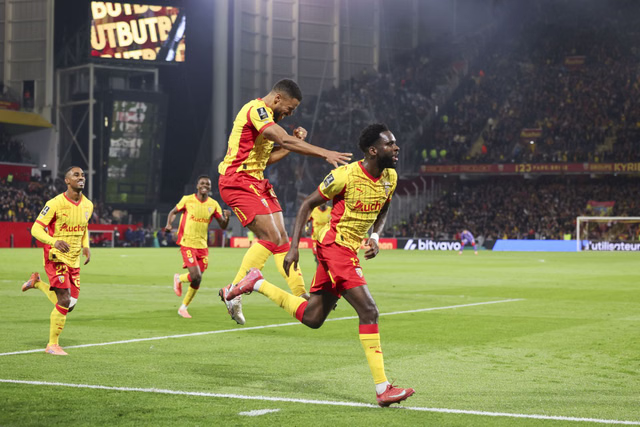


1️⃣ Match Context
Lens don’t play many “routine” Ligue 1 matches at Bollaert-Delelis. Not because every opponent is elite — but because the environment turns every point into a statement. This one matters for a cleaner reason: March fixtures are where table ambition becomes pressure, and pressure changes how teams defend leads, chase games, and manage risk.
Lens are typically judged by whether they can convert territorial dominance into consistent top-end results. At this stage of the season, that translates into a simple demand: bank home points, keep the European picture alive, and avoid the kind of flat performance that forces you to play catch-up in April.
Metz arrive in a very different psychological state. Their away games are rarely about aesthetics; they’re about survival mechanics: slowing tempo, lowering the number of “big” moments, and trying to keep the match within one swing. That mindset tightens decision-making — and it also creates fragility if they concede first, because their attacking plan isn’t built for sustained chance creation.
There’s also a subtle calendar angle. Early March often brings a compressed run for clubs with deeper objectives, while relegation-threatened sides can put full weekly focus into game plans. Lens have more moving pieces. Metz have fewer excuses. That contrast can show up most in second halves: substitutions, energy management, and how brave each side is when the game state changes.
2️⃣ Form & Advanced Metrics
Lens’ underlying profile tends to be recognizable even when results wobble: **high territory share, frequent entries into the final third, and shot volume built from sustained pressure rather than end-to-end chaos**. When Lens are “on,” they don’t just shoot more — they shoot from better zones because their positional play pins opponents and forces back-line distortion.
The key nuance: Lens’ chance creation often looks clean on xG, but it can be slightly sequence-dependent. If the wide rotations don’t pull fullbacks out, the box can get crowded and they settle for lower-value attempts. So the headline isn’t simply “Lens create a lot” — it’s that **Lens create best when their wingbacks and half-space runners connect early, before the opponent’s block is fully set**.
Metz’ defensive numbers generally reflect a side that concedes territory willingly. Their xGA can look manageable in games where opponents settle for low-percentage shots, but the risk is structural: **they can be forced into deep central defending for long spells**, and the longer you defend your box, the more likely you give up either a high-quality chance or a set-piece sequence.
Pressing intensity is where the stylistic gap becomes betting-relevant. Lens typically operate with a more assertive press — not necessarily “all-out” every minute, but enough to keep opponents from building comfortably. PPDA (passes per defensive action) is useful here as a concept: lower PPDA = more frequent pressure. Lens’ approach usually pushes opponents into rushed clearances, which in turn sustains Lens’ field tilt (share of final-third possession/entries). Metz, by contrast, are more likely to choose selective pressing triggers — often backward passes or poor first touches — because an aggressive high press would expose their rest defense in transition.
Tempo patterns matter too. Lens can increase pace through quick wide switches and second-ball recoveries; Metz generally try to drag pace down by taking the sting out of restarts, keeping their block compact, and limiting the number of open-field sprints. That creates a predictable match script: **Lens pushing, Metz resisting** — with the real question being whether Lens’ shot quality stays high or degrades into speculative volume.
3️⃣ League Table Snapshot
| Team | Position | Points | Goal Difference |
|---|---|---|---|
| RC Lens | 7th | 41 | +9 |
| Metz | 16th | 24 | -15 |
Takeaway: this is a classic “pressure from both ends” fixture. Lens’ position suggests a team that is broadly functioning with a positive balance of play, but still needing consistency to turn control into points. Metz’ spot signals thin margins: they can survive matches, but they can’t afford long winless stretches — and away games against territorial teams are where that survival model gets tested hardest.
4️⃣ Head-to-Head Analysis
Lens vs Metz meetings often revolve around one repeated theme: **who gets to choose where the game is played**. Lens typically want the match in Metz’ third, with sustained pressure and repeated wing entries. Metz want to pull the contest into fragmented phases — throw-ins, fouls, set plays — where variance increases and Lens’ rhythm decreases.
What’s important is not past scorelines, but the structural pattern: Metz have historically been most competitive when they can protect the central channel without overcommitting wide. When they get dragged to the touchline, the cutback zone opens — and that’s where Lens’ shot quality spikes. If we look deeper, this fixture tends to reward the team with better rest defense: the side that prevents the counter after losing the ball usually dictates the long-run xG flow.
5️⃣ Tactical Breakdown (Core Section)
Who dictates tempo?
Lens should. Their best football comes from compressing the pitch: high line, aggressive counter-press, and quick recycling to the far side. Against a low-to-mid block, the goal is to force the opponent’s wingers into fullback duties — then punish the moment they lose their reference points.
Metz will try to dictate tempo indirectly: slow restarts, conservative passing, and a block that prioritizes “no central penetration.” The risk is that if they defend too passively, Lens’ volume becomes relentless and the match becomes a siege.
Overload zones and the key spaces
The likely overload zone is Lens’ wide progression into the half-spaces. Expect Lens to build with patience, then accelerate with a third-man run or a quick switch to isolate a fullback. **The cutback lane around the penalty spot is the high-value target**, not the byline cross into a set box.
Metz’ best defensive version is compact, narrow, and brave at the edge of the box — stepping to the ball without opening passing lanes behind. If Metz’ midfield line gets pinned too deep, they stop contesting second balls, and Lens’ field tilt becomes suffocating.
Midfield control battle
This game can be decided by how Metz cope with Lens’ midfield rotations. Lens often create extra passing angles through movement rather than sheer individual dribbling. If Metz track runners too tightly, they open seams. If they pass runners on, they risk free receptions between lines.
Lens’ defensive concern is simpler: avoid the one mistake that turns a controlled match into a coin flip. Metz won’t generate a high shot count, but they will look for the single transition where Lens’ fullbacks are high and the nearest midfielder can’t slow the counter.
Pressing triggers and buildup resistance
Lens’ press should be most effective on Metz’ first phase. The trap is obvious: force Metz wide, then jump the touchline pass. That’s where rushed clearances happen, and where Lens can keep re-attacking without “resetting” into a new phase.
Metz’ buildup resistance will likely be based on direct outlets and second balls rather than clean progression. If they can win a few duels and earn territory, they can also buy set pieces — and set pieces are their most realistic equalizer.
Set-piece dynamics
Set pieces matter because they’re the most efficient way for an underdog to manufacture xG without sustained possession. Metz will want corners and wide free kicks; Lens must avoid cheap fouls near the flanks and manage their box spacing. On the other end, Lens’ volume should also create a steady stream of dead-ball chances, which adds pressure even if open-play shot quality dips.
6️⃣ Odds & Market Evaluation
| Market | Odds | Implied Probability |
|---|---|---|
| RC Lens Win | 1.60 | 62.5% |
| Draw | 3.90 | 25.6% |
| Metz Win | 6.20 | 16.1% |
Those implied probabilities sum above 100% due to bookmaker margin. Stripping the vig conceptually, the market is saying: Lens win is the base case, draw is the main spoiler, and Metz win requires either a set-piece swing or a rare finishing outlier.
The betlabel.games team evaluates this matchup slightly more cautiously than the raw home price suggests — not because Metz are “good,” but because **low-block underdogs can drag a match into a narrow finishing window**, and Lens’ main risk is turning dominance into low-quality volume. That said, the structural edge remains Lens: territory, shot share, and pressing control.
7️⃣ The Hidden Edge (Mandatory Section)
There’s a structural nuance here: **Metz can look “sturdy” on paper for long stretches, but their model depends on repeatedly defending the same zone without conceding a big chance**. That’s not stable over 90 minutes against a team that can sustain pressure.
The market often prices these games primarily on league position and recent results, but the slow-to-adjust factor is the way shot quality changes under repeated waves. When Lens keep opponents boxed in, the first 20 minutes might produce only moderate xG — then fatigue and loss of spacing begin to create the cutbacks and second-phase shots that spike expected goals late.
So the edge isn’t simply “Lens are better.” It’s that **Lens’ advantage tends to compound**, while Metz’ defensive plan tends to degrade. If this stays 0-0 for a while, bettors often overreact in-play toward the underdog, even though the game state may actually be moving closer to a Lens breakthrough as territory piles up.
8️⃣ Final Prediction
Main Pick: RC Lens -1 Asian Handicap
Alternative: Under 3.0 Asian Total Goals
Risk Level: Medium
Why these angles:
1) Structural control: Lens should dominate field tilt and territory, creating a one-way rhythm where Metz are mostly defending their box and conceding second phases.
2) Compounding pressure: Metz’ low-block can survive early, but spacing and duel intensity typically drop as repeated attacks stack up. That’s where Lens’ chance quality improves rather than declines.
3) Match script logic: Metz’ best path is a slow, low-event game. That naturally supports a lower total, but it also means if Lens score first, the underdog must open up — and Lens’ second goal becomes more live than many expect.
No guarantees — but on probability logic, Lens’ home control plus Metz’ limited attacking ceiling makes the handicap the cleanest way to express the matchup.



Leave a Reply