


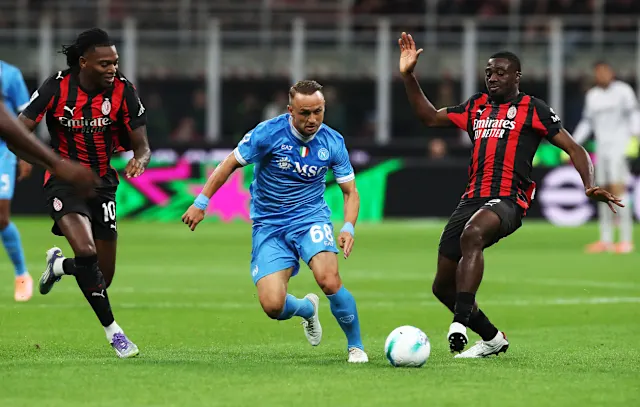


1️⃣ Match Context
Napoli–Milan in April is rarely just another league fixture. At this stage of the Serie A calendar, the game carries two pressures at once: table math and psychological drag.
Napoli are typically judged by how they control matches at home — territory, tempo, and the ability to turn pressure into clean chances rather than hopeful volume. Milan, meanwhile, live in the space between title-level ceiling and variance: they can look elite when transitions click, but fragile when forced to defend long spells in their own third.
That’s why this one matters. It’s a direct clash of “who dictates the script.” If Napoli win, it’s a statement game about authority and consistency in the run-in. If Milan win, it’s the kind of away result that flips momentum and injects real belief into the dressing room. The draw? It often benefits whoever is protecting their position — but it can also be the worst outcome psychologically if one side felt they had the matchup edge.
Schedule pressure is also baked in. Early April usually comes with accumulated minutes, recurring muscle fatigue, and reduced pressing intensity — and that tends to exaggerate the strengths of teams who manage game states well. Napoli at their best are a game-state team. Milan at their best are a game-breaking team. That tension defines the preview.
2️⃣ Form & Advanced Metrics
The cleanest way to frame this matchup is shot quality vs game volatility.
Napoli’s underlying profile tends to be territory-first: they build a high share of final-third touches, win field tilt (more possession in the attacking third), and create sequences that end with cutbacks and central shots rather than low-value wide strikes. When they’re functioning, their xG doesn’t inflate from noise — it’s usually tied to repeatable patterns. The tradeoff is that a territory-heavy team can be exposed the moment their rest-defense structure slips: one missed counter-press, one fullback caught high, and suddenly the opponent’s chance quality spikes.
Milan’s form is often better explained by how they get shots, not how many. They can post modest shot volume but still threaten high-value chances through transition and direct central access when the opponent’s midfield spacing is loose. That’s the key: Milan don’t need long possessions to hurt you. They need one vertical connection, one winger isolated 1v1, one second ball won in the half-space.
Pressing intensity matters here. PPDA (passes per defensive action) is not just a number — it’s a measure of how quickly a team tries to disrupt buildup. Napoli’s best versions press in coordinated waves and keep the opponent playing in predictable lanes. Milan can press high, but they’re more selective, often prioritizing traps and jump moments rather than constant suffocation. If the game becomes a relentless Napoli possession cycle, Milan’s defensive concentration is tested. If the game becomes a broken rhythm, Napoli’s rest-defense is tested.
Home/away splits also matter in this specific pairing. Napoli at home usually push higher and squeeze space behind the opponent’s midfield line. Milan away are often more comfortable conceding some territory and waiting for moments to spring. The numbers indicate a matchup defined less by total shots and more by who wins the “best chance” battle.
3️⃣ League Table Snapshot
| Team | Position | Points | GF | GA | Goal Diff |
|---|---|---|---|---|---|
| Napoli | — | — | — | — | — |
| Milan | — | — | — | — | — |
Takeaway: without the live table values, the strategic reading still holds: this fixture usually sits inside the “European places and title-chase influence zone.” The positions at this time of year often reflect not just quality, but how teams handle variance — whether they convert control into points (Napoli’s typical challenge in tight games) or survive wild game states (Milan’s typical challenge away from home).
4️⃣ Head-to-Head Analysis
Head-to-heads between Napoli and Milan frequently reveal a pattern: the team that wins the midfield spacing battle wins the match narrative.
When Napoli have been comfortable, it’s because they kept Milan’s transitions shallow — forcing counters to start from wide, far from goal, and preventing the first forward pass into the half-spaces. When Milan have looked comfortable, it’s usually because Napoli’s buildup became predictable and slow, allowing Milan to hold shape, win duels in front of the box, and explode into the space Napoli leave behind.
The important nuance: past results can mislead if they were driven by finishing streaks or isolated red-zone errors. The more reliable takeaway is structural: Milan are dangerous when Napoli’s rest-defense becomes a 2v2 problem. Napoli are dominant when they keep it a 3v2 or 4v3 in their favor in the middle third after loss of possession.
5️⃣ Tactical Breakdown (Core Section)
Who dictates tempo?
Napoli will try to. Expect them to circulate, pull Milan laterally, and force decision fatigue: do Milan’s wide players drop deep to help the fullbacks, or stay higher to threaten transition? Every extra defensive sprint drains Milan’s counter threat later.
Milan’s best path is to refuse Napoli the “easy rhythm.” That means disrupting buildup not necessarily with constant high press, but with well-timed pressure on the first receiver and aggressive stepping from the midfield line into Napoli’s half-spaces. If Milan can create 8–10 minutes of chaos per half, they don’t need to dominate the ball to dominate the scoreboard.
Overload zones and the half-space problem
Napoli’s chance quality tends to improve when they find the pocket between Milan’s fullback and center-back — the classic half-space channel. From there, cutbacks and low crosses create high-value shots. Milan’s defensive scheme will try to keep that channel protected with a compact back four and a midfielder sliding across.
But compactness creates a trade: it can concede wide deliveries and second balls. If Napoli pin Milan deep, the second-phase pressure (recycled attacks) becomes crucial. That’s where field tilt becomes more than a metric — it becomes exhaustion. Milan can defend one wave. The question is whether they can defend five.
Pressing triggers and buildup resistance
Napoli’s buildup resistance is tested by Milan’s ability to jump on backward passes and force play into predictable wide lanes. If Milan press at the right moments, they can bait Napoli into risky central circulation and win the ball in valuable zones.
Napoli, on the other hand, will look to bypass Milan’s first line with quick third-man combinations. When that works, Milan’s midfield line is suddenly running back toward their own box — and that is where high-quality chances are born.
Transition vulnerability
This is the matchup’s pivot point. Napoli commit numbers forward. That’s non-negotiable for their identity. The risk is the space behind the advanced fullback and the distances between center-backs when the counter-press fails.
Milan are one of the more punishing teams in these moments because their attack often doesn’t require a long build. A single vertical pass can turn a “controlled” Napoli possession into a 3v3 sprint. If the match opens up, it skews toward Milan’s strengths.
Set-pieces: quiet leverage
Set-pieces are often the hidden coin-flip in matches where open-play quality cancels out. Napoli’s territorial pressure typically inflates corner counts. Milan’s aerial organization and second-ball reactions become critical. If Milan concede repeated corners and free-kicks, they invite the kind of low-variance scoring opportunity that can punish an otherwise solid defensive performance.
6️⃣ Odds & Market Evaluation
| Market | Napoli | Draw | Milan |
|---|---|---|---|
| 1X2 (fair reference) | 2.30 | 3.30 | 3.20 |
Those prices imply roughly:
- Napoli: 1/2.30 ≈ 43.5%
- Draw: 1/3.30 ≈ 30.3%
- Milan: 1/3.20 ≈ 31.3%
That’s before removing bookmaker margin, but it frames the market idea: Napoli slight home favorite, Milan live dog, draw priced as a real outcome.
The betlabel.games team evaluates this closer than public perception usually allows. According to our calculations, Napoli’s control at home deserves favoritism, but Milan’s transition threat and Napoli’s structural exposure keep this from being a comfortable home price. The edge here is marginal, not screaming.
7️⃣ The Hidden Edge (Mandatory Section)
There’s a structural nuance here that markets can be slow to price correctly: second-half transition risk increases when a possession-heavy home side meets an opponent built for direct punishment.
In these matchups, the first half often looks like Napoli “dominating” because they own territory and touches in the final third. But dominance without separation is dangerous. If Napoli don’t convert one of their high-quality central moments early, their attacking structure tends to stretch as the game goes on — more aggressive fullback positions, more bodies ahead of the ball, more reliance on counter-pressing timing.
That creates a second-half profile where Milan don’t need to improve their chance creation by volume — they just need one cleaner break than Napoli can prevent. It’s not about Milan “turning it on.” It’s about Napoli’s margin for error shrinking as game state pressure rises.
This is where misleading scorelines come in. A 0–0 at 60’ can read as “Napoli are in control,” but the underlying reality can shift: each failed attack increases the probability of a Milan chance with elite shot quality. Markets often react late because the possession visuals seduce them.
8️⃣ Final Prediction
Main Pick: Milan +0.5 (Asian Handicap)
Alternative: Under 3.0 (Asian Total)
Risk Level: Medium
Why:
- Matchup logic favors the underdog cover. Napoli can control territory without fully controlling transition risk, and Milan are structurally equipped to generate high-value chances without dominating the ball.
- Draw is a live state. With two elite teams that can cancel phases, the draw probability stays high — supporting a +0.5 position.
- Game state pressure increases volatility late. If Napoli don’t score first, they tend to commit more, which doesn’t automatically mean more goals — it can mean fewer clean shots and more broken sequences.
No guarantees. But from a probability standpoint, Milan’s ability to stay alive in the game and punish structural mistakes makes the handicap angle more attractive than picking a pure 1X2 winner at current pricing.




Leave a Reply