
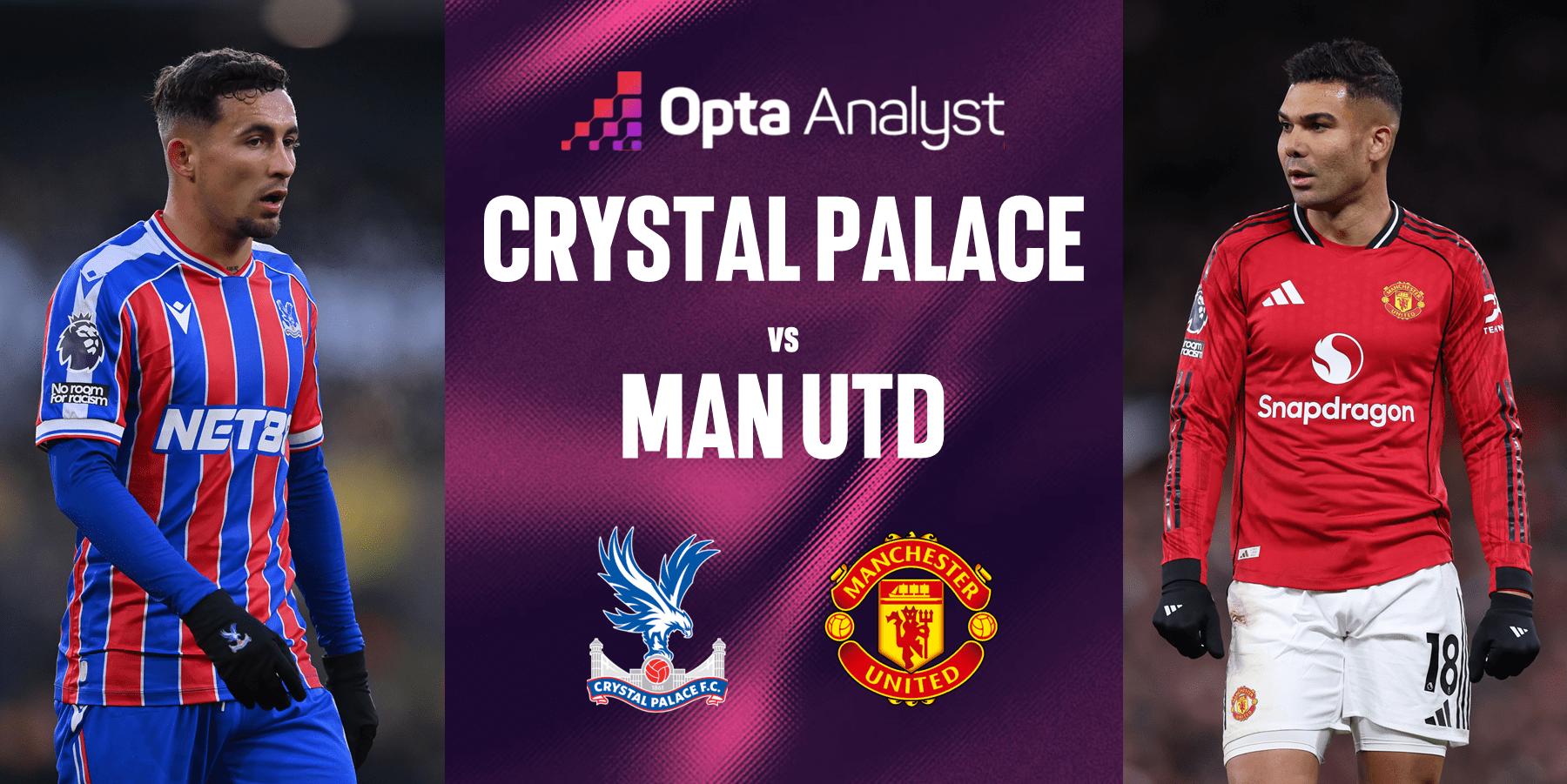


1️⃣ Match Context
March in the Premier League is where “good seasons” turn into either something tangible or something you regret. For Manchester United, this fixture sits in that pressure corridor: the table compresses, the margins tighten, and every dropped point becomes a storyline rather than a blip. At Old Trafford, the demand isn’t just to win — it’s to look convincing doing it, because the performances often shape how the market prices them the following week.
Crystal Palace arrive in a familiar psychological space: dangerous enough to spoil your weekend, inconsistent enough that they’re rarely trusted. That’s precisely why these matches create betting tension. United are expected to control territory and chances; Palace are comfortable living in the in-between, where transitions, set pieces, and one good 10-minute spell can rewrite 80 minutes of defending.
The scheduling context matters as well. This is the part of the calendar where fatigue becomes tactical: pressing teams press a fraction less, fullbacks stop sprinting back twice per phase, and squads with depth can maintain intensity while others start managing minutes. If United are juggling Europe or cups, you often see a subtle trade-off — slightly slower ball circulation, fewer counter-press sprints, and more reliance on “moments.” Palace, with less congestion, can prepare specifically for United’s buildup patterns.
2️⃣ Form & Advanced Metrics
United’s recent form profile tends to look like this: **high shot volume, but not always high shot quality**. They can generate sustained pressure — long spells of possession, repeated entries into the final third — yet the best chances aren’t guaranteed unless the central zones are accessed with tempo. When the ball speed drops, United’s attacks can become wide and predictable, inflating shot counts without inflating expected goals at the same rate.
In underlying terms, their attacking value is usually driven by territory control (field tilt) and second balls around the box. The key question isn’t “Do they create chances?” It’s “Do they create shots from the prime corridor — the zone between the posts, inside the box — or do they settle for angles and distance?” That distinction determines whether they win comfortably or get dragged into a one-goal game.
Defensively, United’s volatility often comes from transition phases rather than settled defending. When they commit numbers forward, the rest-defense structure (the positioning of the players behind the ball during attack) can be exposed if the counter-press fails. That shows up in xGA not through constant pressure conceded, but through **a smaller number of higher-value shots** allowed — the kind that swing matches.
Palace’s metrics profile usually leans the opposite direction. Their best spells come when they can keep games at a lower tempo, defend compactly, and break into space with directness. If we look deeper at their shot quality, Palace can be selective: fewer shots, but a reasonable share coming from transitions and quick entries. That makes them annoying to play against — and sometimes misleading in results. A match where they “didn’t do much” can still feature two or three very live chances.
Pressing intensity is a major clue here. PPDA (passes allowed per defensive action) isn’t just a number — it describes posture. Lower PPDA means an aggressive press; higher means sitting off. Palace’s more pragmatic posture often invites buildup and then tries to win the ball in pre-defined zones. United’s buildup resistance — how cleanly they exit the first line and connect into midfield — becomes the hinge. If United bypass pressure cleanly, they will camp in Palace’s half. If they don’t, Palace will get the game state they want: broken rhythm, turnovers, counters.
3️⃣ League Table Snapshot
| Team | Position | Points | GF | GA | Goal Diff |
|---|---|---|---|---|---|
| Manchester United | — | — | — | — | — |
| Crystal Palace | — | — | — | — | — |
Takeaway: Without anchoring on exact positions, this matchup usually reflects a classic Premier League dynamic: a possession-heavy side that “should” win at home against a mid-table disruptor. The market often overweights brand and underweights game-state risk — especially when the underdog is structurally built for low-event football.
4️⃣ Head-to-Head Analysis
Head-to-heads between these profiles tend to repeat tactically more than people expect. United generally see a lot of the ball, Palace generally concede territory without panicking, and the match swings on whether United can play through the middle or are forced into crossing volume.
There’s also a psychological pattern: when Palace survive the first wave, United can start forcing the game — shots taken earlier, riskier passes, more turnover exposure. If past meetings felt tighter than the pre-match odds implied, it’s usually because Palace’s compactness reduces the quality of chances even when shot counts rise.
The key is alignment with underlying metrics. If previous outcomes were driven by set pieces, penalties, or finishing spikes, they’re less predictive. If the pattern was consistent: United territory dominance but limited central access, then the structural matchup remains intact.
5️⃣ Tactical Breakdown (Core Section)
Who dictates tempo?
United will try to dictate the tempo through controlled possession and sustained pressure. Palace’s goal is to dictate tempo without the ball: slow the game, shrink spaces, and turn United’s possession into something sterile. The first 20 minutes matter. If United score early, the game opens and Palace’s compact block has to take risks. If it stays level, Palace’s plan gains value by the minute.
Where is the overload zone?
United’s best path is usually the half-spaces — those channels between fullback and center-back where cutbacks and short combinations create high xG chances. Palace will try to protect that zone with tight midfield lines and force play wide. That creates a clear tactical trade: United can accept a crossing game, or they can accelerate through midfield rotations to break the line.
Which flanks are exposed?
Palace’s threat often comes when United’s fullbacks are high and the nearest midfielder is late to cover. If Palace can spring a runner into the space behind the advanced fullback, it becomes a 3v3 or 3v2 sprint situation — exactly the type of chance that inflates shot quality despite low shot volume.
The midfield control battle
The central duel is less about tackles and more about access. United need clean connections into the No.10 zone to avoid recycling possession endlessly. Palace’s midfield screen will aim to block the lane and bait passes into wide areas. If United’s central progression becomes too slow, Palace can hold shape and wait for a loose touch or predictable pass to trigger a counter.
Pressing triggers and buildup resistance
Palace’s pressing is often situational: not constant hunting, but targeted traps when United pass into certain zones. The danger for United is forcing a vertical ball into a crowded midfield, losing it, and immediately defending a counter with poor rest-defense spacing. For Palace, the danger is sitting too deep and allowing United to build confidence through repeated entries — eventually one cutback finds a runner.
Transition vulnerability
This is the match’s volatility engine. United can dominate territory and still be one turnover away from conceding a massive chance. Palace don’t need sustained possession; they need two or three clean transition moments. That’s why live-game swings are common: one Palace counter can flip the emotional temperature in the stadium and the tempo on the pitch.
Set pieces
Set pieces often decide games like this because Palace are comfortable defending deep for long spells, which naturally increases the volume of United corners and wide free-kicks. United’s edge here is repetition and territory; Palace’s edge is that one well-executed delivery can equalize a match they’ve otherwise spent defending.
6️⃣ Odds & Market Evaluation
| Market | Selection | Odds | Implied Probability |
|---|---|---|---|
| 1X2 | Manchester United | 1.60 | 62.5% |
| 1X2 | Draw | 4.00 | 25.0% |
| 1X2 | Crystal Palace | 6.00 | 16.7% |
Those implied probabilities sum above 100% because of bookmaker margin. According to our calculations at betlabel.games, the fair win distribution is tighter than the public often assumes in this matchup type: **United still deserve favoritism, but Palace’s draw equity is real** if they keep the game low-event.
The market typically prices United’s territory dominance as if it guarantees high-quality chance creation. It doesn’t — not against compact teams that protect the half-spaces well. The edge here is not “Palace to win.” It’s identifying where Palace’s structure increases the probability of a stalemate or a one-goal margin.
7️⃣ The Hidden Edge (Mandatory Section)
The hidden edge is game-state fragility. United can look dominant in the data — field tilt, touches in the box, shots — and still be vulnerable to the specific kind of chance Palace generate: transitions and quick entries that create high-value shots without needing volume.
This is where the market can be slow. Recency bias often rewards teams that “controlled” their last home match, even if the shot quality was mediocre. Meanwhile, Palace’s recent scorelines can be misleading because their attacking output is naturally spiky: one match looks dead, the next they score twice from three big moments. That variance isn’t randomness — it’s the product of their chance profile.
There’s also a subtle second-half angle in fixtures like this. If United haven’t scored by the hour mark, urgency increases, spacing gets worse, and counters become cleaner for the underdog. The market tends to price the favorite’s late pressure but underprices the underdog’s late transition value.
8️⃣ Final Prediction
Main Pick: Crystal Palace +1.25 Asian Handicap
Alternative: Under 3.0 Goals (Asian Total)
Risk Level: Medium
Why these angles hold up: (1) Palace’s compact block can reduce United’s shot quality even if they concede volume, which increases draw and one-goal-game probability. (2) United’s main defensive risk is transition-based; Palace don’t need long spells to land a high-xG chance. (3) The market often overprices a comfortable home win in games where the favorite’s central access can be denied for long stretches.
No guarantees — but the probability logic points away from a blowout narrative and toward a controlled, tense match where Palace’s structure keeps them in it.



Leave a Reply