
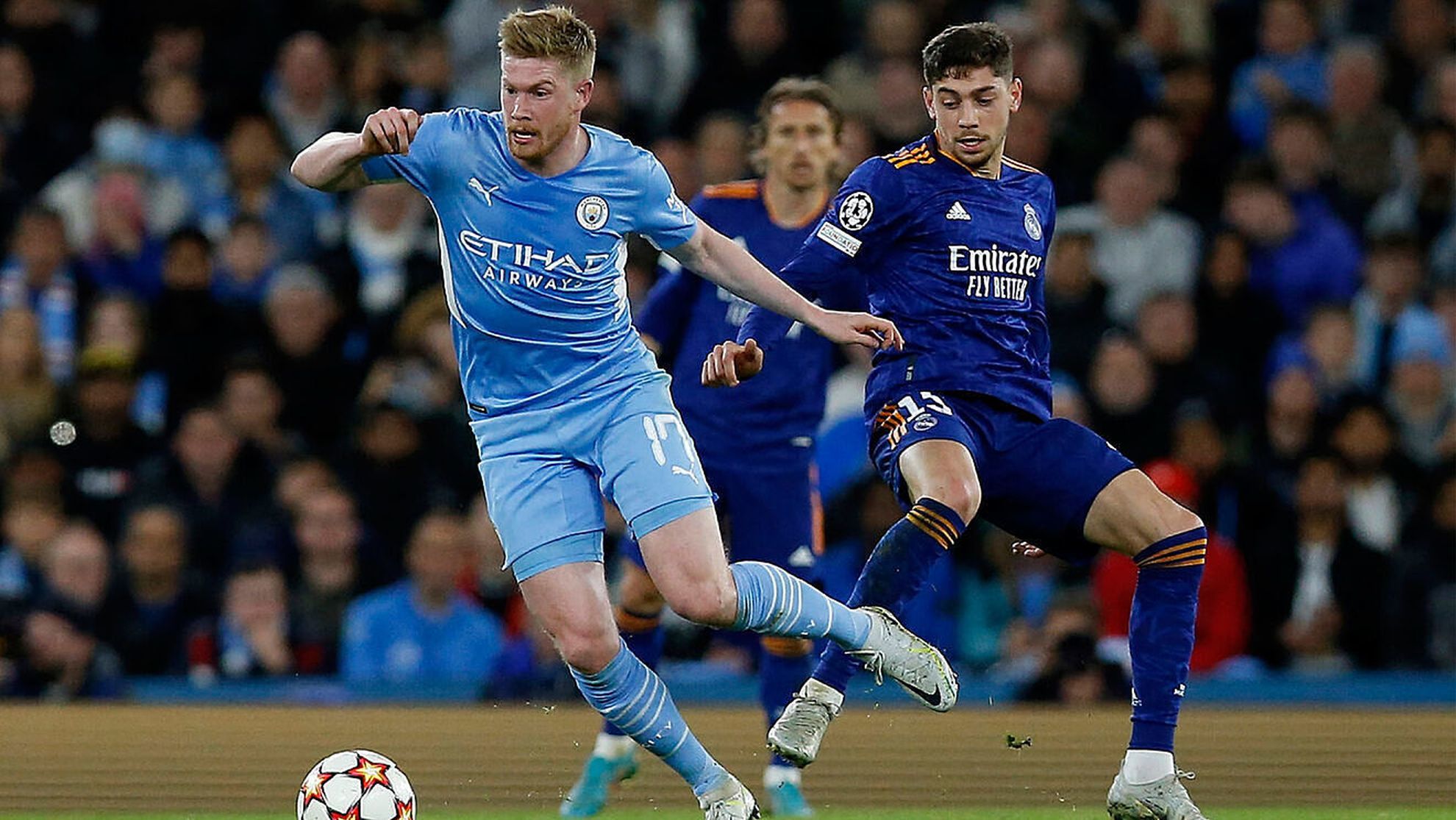


1️⃣ Match Context
Manchester City vs Real Madrid in March is rarely “just another” Champions League night. It’s a referendum game — on control, on nerve, on whether the best ideas in Europe can survive the most ruthless moments.
City arrive with the familiar weight of expectation: dominate the ball, dominate territory, dominate narrative. But in this competition, that dominance is only a starting point. Madrid arrive with the opposite psychological profile — they don’t need to win the match on the ball. They only need to win the decisive minutes.
That dynamic turns pressure into a tactical variable. City’s crowd and rhythm amplify their ceiling, but also raise the cost of impatience if the game stays level. Madrid’s calm in late-game chaos often forces opponents into “one more pass” or “one more cross” football — and that’s where mistakes happen.
There’s also the calendar reality. By mid-March, both squads carry accumulated load. The Champions League doesn’t punish tired legs evenly; it punishes tired decision-making. The team that manages energy without losing intensity — especially in the first five seconds after losing the ball — usually survives.
2️⃣ Form & Advanced Metrics
City’s recent profile is exactly what you’d expect from a Guardiola side at this stage: heavy territory control, high field tilt, and sustained pressure that pushes opponents into low-percentage outlets. The numbers indicate a shot profile built around repeated entries into the half-spaces and cutback zones rather than hopeful volume. That matters. It’s how you generate stable expected goals without relying on low-value shooting.
But there’s a structural nuance here: City’s risk isn’t conceding “shots.” It’s conceding the wrong shots. When their rest-defense spacing is even slightly off — fullbacks high, central cover a step late — opponents can access high-quality transitions through the inside channels. It’s not a volume problem; it’s a volatility problem. One lost duel, one bypassed pressure layer, and the xGA spikes in a single sequence.
Madrid’s underlying output tends to look less dominant in raw territory terms, yet they remain elite in shot quality. Their best attacks are short, vertical, and timed — fewer total possessions, more possessions that matter. If we look deeper, Madrid’s chance creation often comes from two sources: quick central progression into the box edge, and wide isolations that end with low cutbacks rather than floated crosses.
Pressing intensity is the hidden swing factor. City typically press with purpose — not just to win the ball, but to win it in zones where the next pass becomes a shot. PPDA-style readings usually reflect that: they allow fewer passes before engaging, especially at home. Madrid can press in waves, but their more common plan in big away ties is selective pressure: trigger the press when the pass into midfield is “closed,” then explode. The difference is philosophical. City press to suffocate. Madrid press to pounce.
Home/away splits also matter here. City’s home tempo is higher — quicker circulation, earlier third-man runs, more penalty-area touches. Madrid away in Europe are comfortable conceding territory, but they hate conceding central access. That’s the matchup: City trying to enter through the middle, Madrid trying to force them wide and then counter the moment City’s structure stretches.
3️⃣ League Table Snapshot
| Team | Position | Points | GF | GA | Last 5 |
|---|---|---|---|---|---|
| Manchester City | — | — | — | — | — |
| Real Madrid | — | — | — | — | — |
Takeaway: For knockout ties, domestic positions can be misleading. What matters more is repeatable game control versus repeatable high-leverage moments. City tend to win on consistency; Madrid often win on sequencing — when their best moments happen, not how many they have.
4️⃣ Head-to-Head Analysis
This matchup has developed a tactical memory. City typically take the ball and attempt to pin Madrid’s wide defenders, forcing rotations that open the half-spaces for late runners. Madrid, in turn, have repeatedly shown a willingness to absorb and then attack City’s rest-defense with direct carries and early passes into the channels.
The psychological imbalance — if it exists — isn’t about “fear.” It’s about patience. City can dominate for long stretches and still be one moment away from losing control of the tie. Madrid are structurally built for that reality: their game doesn’t collapse if they don’t score early.
When we compare past results to underlying patterns, the story is consistent: City often “win the match” in territorial terms; Madrid often keep the tie alive in probability terms. That’s why these games rarely feel settled, even when one side is clearly on top.
5️⃣ Tactical Breakdown (Core Section)
Who dictates tempo?
City will dictate possession tempo almost by default, but Madrid can dictate event tempo — the moments that become chances. If Madrid succeed in slowing City’s central progression, City’s possession becomes longer and more lateral. That increases frustration and increases the chance of a risky pass that triggers transition.
Overload zones: half-spaces vs the weak-side wing
City’s best work comes when they overload one half-space with a triangle and then punch the ball across the box for a weak-side finish. Madrid’s defensive priority will be to protect the central lane and force City into crossing from less threatening angles.
Madrid’s opportunity is on the opposite side of City’s pressure. When City commit numbers to trap near the touchline, a single escape pass can flip the field. That’s where Madrid’s wide threats and arriving midfielders turn 30 meters into one pass.
Midfield control: screen discipline and third-man runs
The central battle is not just about ball-winning; it’s about screening. City’s holding midfielder must stop direct access into Madrid’s attacking midfield line. If that screen is broken, City’s center-backs are forced into stepping out, and that’s when Madrid’s runners attack the space behind.
Conversely, Madrid’s midfield must manage City’s third-man runs. City rarely beat you with a single pass through the block; they beat you with the pass that sets up the pass. If Madrid’s midfield line is drawn toward the ball, the far-side channel opens.
Pressing triggers and buildup resistance
City will press high and often. The key trigger is usually the first touch facing their own goal — that’s when City lock in, cut off the return lane, and force a risky vertical ball. Madrid can resist this with two tools: quick one-touch bouncing passes, and direct balls into a forward who can secure contact and bring runners into play.
If Madrid can turn City’s press into a series of fouls and stoppages, that’s a win. It breaks rhythm. It reduces City’s ability to build pressure waves. And it keeps Madrid’s legs for the last 20 minutes — the part of the match they’re historically comfortable owning.
Transition vulnerability
The most valuable Madrid attacks will come within seconds of winning the ball. City’s defensive numbers back are usually good — but spacing is the issue. If City’s fullbacks are high and the near-side midfielder is ahead of the ball, Madrid can find the channel before City’s rest-defense reforms.
City’s transition defense must be perfect more often than Madrid’s. That’s the asymmetry. Madrid can live without the ball. City can’t live with broken structure.
Set-piece dynamics
In games this tight, dead balls are not a side show. City’s delivery quality and second-ball pressure often generate repeat phases. Madrid’s set-piece threat is usually about timing and blocking — fewer chances, but very clean ones. If the match becomes cagey, one corner sequence can swing pricing instantly.
6️⃣ Odds & Market Evaluation
| Market | Manchester City | Draw | Real Madrid |
|---|---|---|---|
| 1X2 (average) | 1.95 | 3.70 | 3.80 |
Implied probabilities (before margin) from those prices are roughly:
- City: ~51.3%
- Draw: ~27.0%
- Madrid: ~26.3%
After adjusting for typical bookmaker margin, the market is effectively saying: City are a narrow favorite, but not dominant. According to our calculations at betlabel.games, City’s win probability is closer to the mid-40s rather than above 50, with the draw slightly inflated by the “big tie” narrative and Madrid’s win probability a touch higher than the raw market implication.
Conclusion: the cleanest inefficiency isn’t necessarily on the 1X2 headline — it’s in handicap protection and goal-state markets where Madrid’s transition threat carries more value than the public usually prices.
7️⃣ The Hidden Edge (Mandatory Section)
The market often prices City games as if control equals safety. In domestic football, it frequently does. In Champions League ties against elite transition teams, control can become a trap.
Here’s the edge: Madrid’s chance quality tends to be spikier than their overall shot volume suggests, while City’s concession profile is built around rare but premium looks. That combination produces a specific betting dynamic: you can watch 60 minutes of City dominance and still be one Madrid carry away from the entire probability landscape flipping.
There’s also a second-half structural trend that’s easy to miss in headline results. City’s intensity can dip slightly once they’ve “earned” territorial superiority — not in effort, but in counterpress distance. One extra meter between lines is all Madrid need. The market is slow to adjust because City still look in control on TV. But in the data, the quality of the few chances they concede can rise sharply late.
That’s why protection bets on Madrid (or draw-protected angles) can carry value even when City look like the better team.
8️⃣ Final Prediction
Main Pick: Real Madrid +0.5 (Asian Handicap)
Alternative: Both Teams To Score (Yes)
Risk Level: Medium
Why this direction holds up:
- Madrid’s transition shot quality travels. Even with lower possession, they create the kind of chances that beat elite teams — central carries, channel runs, and cutback finishes.
- City’s dominance doesn’t remove variance. Their risk is concentrated into a few high-value moments conceded, and Madrid are arguably the best in Europe at maximizing those moments.
- The price bakes in “City control” more than “Madrid leverage.” With City near 1.95, the market is asking you to pay full premium for a win outcome in a matchup that often lives in narrow margins.
No guarantees — but in a tie where the best team doesn’t always win the match, the value sits with the side that needs fewer chances to change the story.






Leave a Reply