
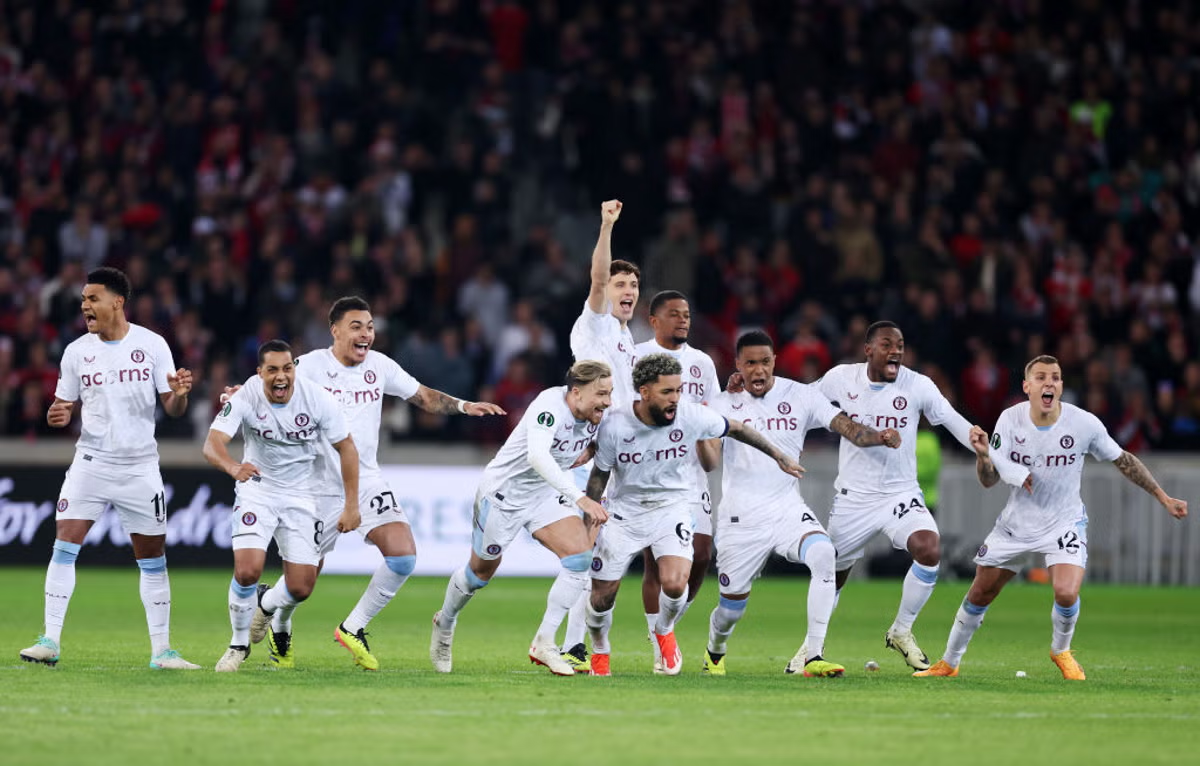


1️⃣ Match Context
This is the kind of Europa League night where the game starts long before kick-off. Lille are at home, in a stadium that naturally compresses opponents and forces them to play faster than they want. Aston Villa arrive with the bigger-brand aura and a squad built for two-competition life — but that status cuts both ways in knockout football. Expectations travel with you.
For Lille, the context is simple: they need to make their home performance count. Their European route in recent seasons has often been defined by controlled home legs and complicated away ones. Villa’s context is more psychological than geographic: they’re typically priced like a side that should “handle” this stage, yet away legs in France have a habit of turning into tempo traps. If Villa don’t manage the first 25 minutes, they risk a match played on Lille’s terms — and Lille’s terms are about pressure waves, not patient exchanges.
Schedule pressure matters too. English sides in March often carry domestic top-four or cup demands, and Unai Emery’s teams tend to play high-intensity, detail-heavy football. That’s excellent when legs are fresh; it gets fragile when distances between lines start to stretch. Lille, by contrast, are usually more accustomed to making one big European night per week feel like a final. Different stress. Different rhythm.
2️⃣ Form & Advanced Metrics
The numbers indicate two teams who can both look “in control” while creating very different types of risk. Lille’s profile is typically built on territory and repeat entries: they want sustained pressure, second balls, and a steady stream of shots created from semi-settled possession. That often inflates shot volume, but not always shot quality — and that distinction matters in knockout ties.
When Lille are at their best, their xG comes from getting the ball into the box early and often, with runners arriving in waves. The downside is volatility when their attacks break down: if their fullbacks are high and their midfield spacing is even slightly loose, transitions become clean for the opponent. Their xGA can look “fine” over a sample while still allowing a worrying share of shots from central lanes — the kind you feel in real time, because one pass eliminates three players.
Villa’s metrics tend to read as more efficient than abundant. They don’t always need 18 shots to create threat; they can manufacture high-value chances through structured progression and third-man combinations. Their shot quality can spike quickly once they get established in the final third, especially when they lure pressure and then play through it. The question is whether they can do that consistently away to a side that presses in coordinated bursts.
Pressing intensity is the hinge. Lille generally prefer a higher press at home — not just chasing, but pressing with a purpose: steering build-up wide, locking a fullback, then pouncing on the next touch. Villa, under Emery, are comfortable baiting a press, but that comfort requires precision. If the first pass is slow or the receiver’s body shape is closed, the whole build-up becomes a gamble.
Tempo patterns matter as well. Lille can accelerate games with field tilt — long spells of play in the opponent’s half — but that can also reduce their own control if they force entries. Villa, meanwhile, often manage games through possession sequences that end in either a shot or a foul won. It’s less romantic. More surgical.
3️⃣ League Table Snapshot
| Team | Domestic Position | Points per Game | GF/GA Trend | European Profile |
|---|---|---|---|---|
| Lille OSC | Top 6 range | Solid | Often narrow margins | Home-control focused |
| Aston Villa | Top 6 range | High | More goal swing | Game-management oriented |
Takeaway: these positions usually reflect two credible European-level teams — but achieved in different ways. Lille’s domestic profile often leans on structure and repeatability; Villa’s tends to include higher variance because their attacking sequences can create big chances quickly, while their aggressive line management can occasionally invite chaos.
4️⃣ Head-to-Head Analysis
There isn’t a deep modern head-to-head that should dominate pricing here, but stylistically the matchup is familiar. French sides with strong home pressing and compact mid-blocks have often been awkward for English teams who prefer controlled build-up. The reason is simple: the press doesn’t need to win the ball every time — it just needs to speed up decisions and force longer second balls.
What matters more than past scores is the structural pattern: if Villa can escape the first press and establish possession in Lille’s half, they can quiet the crowd and turn this into a tactical game of spacing. If they can’t, it becomes a series of broken phases — and Lille are very comfortable making the night messy.
5️⃣ Tactical Breakdown (Core Section)
Who dictates tempo?
Lille will try to dictate tempo without necessarily dominating the ball. Their best version is “territory first”: pin Villa back, win second balls, and create repeat entries. Villa’s best version is the opposite: “control first,” then pick moments to accelerate. The first 20 minutes are crucial because they decide whose rhythm becomes the default.
Where is the overload zone?
Lille’s attacks often tilt to one side to create crossing or cutback situations, but the key is the second wave — midfielders arriving late at the top of the box. Villa have to protect that zone. If Villa’s midfield sits too deep, Lille will take shots from the edge and rack up xG through rebounds and chaos. If Villa step out aggressively, they open the channel for diagonal runs behind the fullback.
Which flanks are exposed?
Villa can be exposed when their fullbacks step high and the rest-defense isn’t perfectly staggered. Lille’s wide players don’t need to “beat” their man every time; they need to force Villa’s wingers to defend deeper than they want, then attack the space left behind on the turnover. For Villa, the counter is to target the space behind Lille’s advanced wide defenders with early diagonals — not hopeful long balls, but fast switches that arrive before Lille can reset their pressing shape.
Midfield control: pressure vs composure
This is a midfield game dressed up as a European night. Lille’s midfield will look to collapse around the first reception and force Villa into one-touch play. Villa’s central players will try to create “free man” solutions by rotating and using the goalkeeper as an extra pass. If Villa’s build-up is clean, Lille’s press becomes a risk: one broken line and Villa are driving at a retreating back four.
Pressing triggers and buildup resistance
Lille’s pressing triggers are usually predictable but effective: a pass into a fullback facing his own goal, a sideways ball across the back line, or a central midfielder receiving on the half-turn with a marker tight. Villa’s answer is to receive open, play forward early, and avoid the extra touch. That’s easier said than done under crowd noise and European intensity.
Transition vulnerability
The cleanest path to goals here is transition. Lille can over-commit numbers to keep pressure alive; Villa can punish that if they win the first duel and then play the second pass with quality. Conversely, Villa’s desire to play through pressure can become a self-inflicted wound: lose the ball centrally and Lille are immediately in shooting territory. The team that protects central turnovers wins the night.
Set pieces
Europa League ties are often decided on restarts because they bypass structure. Lille’s home energy tends to generate corners and wide free-kicks. Villa, meanwhile, are usually strong in set-piece organization but can concede second phases if their clearances drop into the box edge. One scrappy rebound shot is sometimes all it takes.
6️⃣ Odds & Market Evaluation
| Market | Selection | Odds | Implied Probability |
|---|---|---|---|
| 1X2 | Lille | 2.55 | 39.2% |
| 1X2 | Draw | 3.25 | 30.8% |
| 1X2 | Aston Villa | 2.85 | 35.1% |
| Totals | Under 2.5 | 1.83 | 54.6% |
The implied probabilities above include bookmaker margin, so the raw percentages won’t sum to 100. According to our calculations at betlabel.games, this matchup is tighter than public perception often assumes for an English side. We price it closer to a near-symmetric game state with Lille’s home leverage keeping them slightly above Villa in win probability, but with the draw very live due to tactical caution and the “don’t lose the first leg” mentality that often emerges.
Market note: the clearest inefficiency is usually not in the straight 1X2, but in handicap and totals derivatives — where the market can overreact to league reputation rather than matchup dynamics.
7️⃣ The Hidden Edge (Mandatory Section)
There’s a structural nuance here the market can be slow to price: Villa’s away control is real, but it is also fragile when opponents can sustain pressure without overextending. Lille are one of the better sides in this competition at creating repeat attacks that don’t look like “big chances” individually, but add up to decision fatigue.
That fatigue shows up in two places. First, in fouls conceded in wide areas — which inflates set-piece volume and produces high-variance moments. Second, in second-half spacing: the distance between Villa’s midfield and defensive line can grow if their press timing drops by half a second. That’s when cutbacks and edge-of-box shots start landing in the danger zone.
On the Lille side, recent scorelines can be misleading in the opposite direction. They can dominate territory and still finish 1-0 or 1-1 because their chance profile leans on volume and second phases. That tends to depress public confidence. But in a one-off home leg, that same profile is valuable: it keeps the opponent under pressure for long spells and increases the odds of a single decisive event.
In short: Lille’s “messy control” is often undervalued against a Villa team that prefers clean structure. If the match becomes chaotic, it doesn’t automatically favor the Premier League side. It can do the opposite.
8️⃣ Final Prediction
Main Pick: Lille OSC Draw No Bet (DNB)
Alternative: Under 2.75 Goals (Asian total)
Risk Level: Medium
Three reasons the angle makes sense:
- Home leverage with a press that travels well across competitions: Lille’s ability to pin teams in creates territorial advantage that doesn’t rely on early scoring.
- Villa’s upside is real, but it requires clean build-up: against coordinated pressure, that’s where away legs can wobble — not catastrophically, but enough to turn a win into a draw.
- Knockout incentives often compress goal expectation: both teams have reasons to avoid opening the game too early, especially if this is a first-leg scenario in practice or mindset.
No guarantees — but on probability logic, the value is in protecting against the draw while leaning into Lille’s structural home strengths.






Leave a Reply