
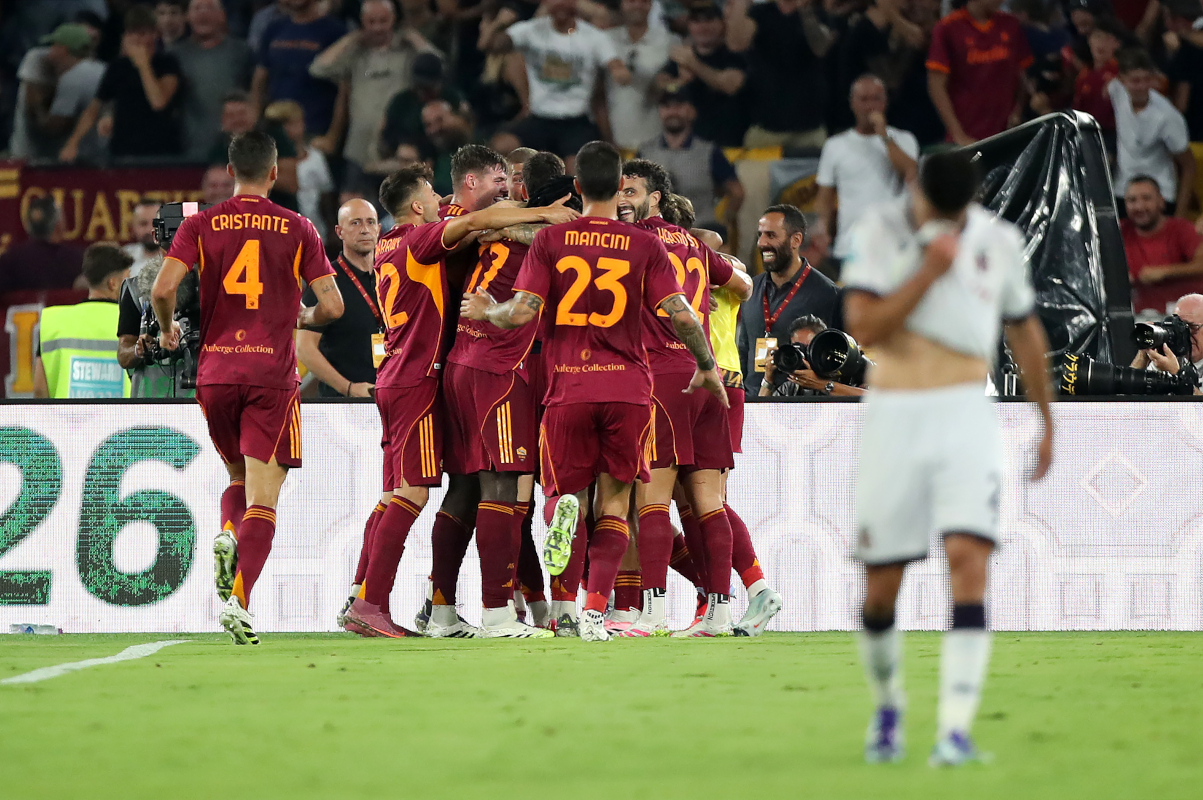


1️⃣ Match Context
Europa League football compresses decision-making. Not just on the pitch — in the mind. Bologna 1909 vs Roma lands in that familiar knockout window where the first mistake is rarely “just a mistake”; it becomes a swing in qualification probability, in squad confidence, and in how the second leg is managed.
For Bologna, this is the type of European night that tests identity. Their domestic rise has been built on structure, clean spacing, and a clear plan in possession — but continental ties punish even small lapses in rest-defense and transition coverage. The pressure is different: you can’t “win the xG battle” and call it progress if you concede the away goal equivalent or lose control of game state for ten minutes.
Roma, meanwhile, are a club that treats the Europa League as a realistic route to silverware and — often — a backdoor into Champions League prestige. That creates a very particular psychology: less romance, more business. They’re comfortable playing ugly stretches, comfortable with low-possession leads, comfortable manipulating tempo. In knockout football, that’s a weapon.
There’s also the calendar reality. Mid-March is where rotation becomes less about freshness and more about risk management. Bologna’s intensity-based game typically costs more physically, while Roma’s squad depth and experience in managing two competitions often shows in the final half-hour — especially if the tie is level and nerves kick in.
2️⃣ Form & Advanced Metrics
Both teams arrive with credible form profiles, but the paths are different. Bologna’s recent performances usually read like “control first, chances second.” They tend to build territorial dominance through patient possession, then manufacture high-quality looks when the opponent’s block tilts and gaps appear between fullback and center-back. Their shot profile is often healthier than it looks on raw volume: fewer low-value blasts, more cutbacks and central-zone entries.
The trade-off is volatility when the ball is lost. Bologna can look secure for long stretches, but if their rest-defense is stretched — particularly when both fullbacks are high and the pivot gets pulled toward the ball — opponents can attack the space behind the midfield line. That’s where xGA can spike in short bursts: not constant concession, but concession of valuable chances when structure breaks.
Roma’s underlying numbers generally point to a team that doesn’t need to dominate the ball to create danger. Their chance creation leans more on transition moments, direct entries, and set-piece pressure. In advanced terms, Roma often generate “efficient xG”: not necessarily a high shot count, but a strong share of shots from high-leverage zones when the opponent is open. Their defensive phase is similarly pragmatic: they’ll concede territory, but try to protect the central lane and force shots from poorer angles.
Pressing intensity is the key stylistic contrast. Bologna’s pressure is usually more proactive — earlier engagements, more attempts to win the ball back quickly — while Roma are more situational, pressing on triggers rather than constantly. PPDA (passes allowed per defensive action) matters here not as a number, but as a signal: Bologna generally aim to reduce the opponent’s comfort in buildup; Roma aim to reduce the opponent’s access to the most dangerous spaces.
Home/away dynamics sharpen this further. Bologna at home tend to impose field tilt — long spells in the opponent’s half, more touches in the final third, more sustained pressure. Roma away are typically content to let that happen, so long as it’s sterile. The match can become a chessboard: Bologna pushing, Roma waiting for the one carry or one diagonal that breaks the press and turns the stadium quiet.
3️⃣ League Table Snapshot
| Team | League Position | Points | GD | Last 5 (All Comps) |
|---|---|---|---|---|
| Bologna 1909 | — | — | — | — |
| Roma | — | — | — | — |
Analytical takeaway: the table matters less than the shape of performances. Bologna’s profile usually reflects repeatable structure and territory control, while Roma’s reflects game-state management and moments. Over a league season, Bologna’s style tends to “earn” points; in Europe, Roma’s style tends to “steal” them.
4️⃣ Head-to-Head Analysis
Recent meetings between these types of sides often follow a pattern: Bologna trying to build through midfield triangles and wide rotations, Roma compressing central space and daring the game to be decided by crosses and second balls. The key question isn’t who had more possession historically — it’s whether Bologna’s possession translated into clean chances or just perimeter circulation.
If we look deeper, the structural matchup often comes down to how well Bologna can access the half-spaces without exposing themselves to the counter. When they manage it, Roma’s back line gets stretched laterally and the box becomes vulnerable to cutbacks. When they don’t, Roma’s defensive block stays compact and the match becomes a low-event contest where one set piece or one transition decides everything.
5️⃣ Tactical Breakdown (Core Section)
Who dictates tempo?
Bologna will try. They’re at home, and their best football comes when they can set the rhythm: controlled buildup, steady territory, repeated entries. Roma’s preference is the opposite: break the rhythm, slow the match, and make every Bologna attack feel like it has to be perfect.
That tension matters for totals betting. If Bologna score first, the game opens and Roma’s transition threat becomes sharper. If Roma score first, Bologna face the hardest version of this matchup: high possession against a compact defense with constant counter risk.
The overload zone: Bologna’s wide-to-half-space progression
Bologna’s most reliable route is typically the wide overload that becomes a half-space entry. They’ll pull a winger inside, push a fullback high, and create a third-man option to slip passes behind the first press line. Roma will respond by narrowing their midfield line and protecting the channel between center-back and fullback — the corridor where cutbacks are born.
The quality of Bologna’s chances depends on whether they can arrive at the byline under control, not forced. Forced wide deliveries play into Roma’s aerial and box-defense mechanics.
Roma’s transition geometry
Roma’s threat isn’t just “counterattack.” It’s the way they position to counter: one runner pinning the center-backs, one outlet in the inside channel, and support arriving late at the top of the box. Bologna’s rest-defense has to be disciplined — especially the spacing between the pivot and the center-backs. If that gap opens, Roma can create high-quality shots with very few passes.
There’s a structural nuance here: Bologna’s desire to keep numbers ahead of the ball can make them vulnerable after turnovers in the half-space. That’s the most dangerous turnover zone in modern football because it immediately exposes both central lanes and wide exits.
Midfield control and pressing triggers
Bologna’s press is usually built to force play wide, then trap. Roma’s buildup resistance will be about not panicking in those traps — using the goalkeeper, using a bounce pass into midfield, or going long into a controlled second-ball scenario. If Roma can repeatedly escape the first wave, Bologna’s press becomes less aggressive over time. That’s when Roma start to own the “hidden” territory: not possession territory, but territory of decision-making — making Bologna choose between pressing and protecting.
Set pieces: the quiet swing factor
Knockout ties often turn on dead balls because they compress variance. Roma typically treat set pieces as a primary chance creation channel. Bologna must avoid cheap fouls in wide areas and manage second balls. On the other end, Bologna’s set pieces can be valuable if Roma sit deeper and concede corners — but they need delivery quality and coordinated blocks to convert pressure into real xG, not just noise.
6️⃣ Odds & Market Evaluation
| Market | Selection | Odds | Implied Probability |
|---|---|---|---|
| 1X2 | Bologna 1909 | 2.55 | 39.2% |
| 1X2 | Draw | 3.10 | 32.3% |
| 1X2 | Roma | 2.90 | 34.5% |
Market read: the implied probabilities sum above 100% (as expected with margin). Stripping the vig conceptually, the market frames this as close to even, with a slight lean toward Bologna due to home control.
According to our calculations at betlabel.games, the pricing is broadly efficient — but there’s a small nuance: knockout dynamics tend to inflate the draw probability more than bettors initially expect, especially when one side (Roma) is comfortable playing for a low-event game state. That matters because a “good team away” often gets overbet in 1X2, while the draw sits quietly with real structural support.
7️⃣ The Hidden Edge (Mandatory Section)
The hidden edge is game-state insulation. Bologna’s process is strong, but it’s also more dependent on rhythm. Their chance creation improves when they can sustain pressure and recycle quickly after losses. Roma are built to disrupt that: slow restarts, selective pressing, and deliberate pacing that turns Bologna’s home-field tempo advantage into frustration.
This is where the market can be slow. Bettors see “Bologna at home, strong metrics, Roma away” and lean toward a home result. But in Europa League ties, the away side’s ability to keep the match in a narrow band of variance is often worth more than raw territorial dominance.
There’s also a second-half angle that frequently appears in this matchup archetype: Bologna’s intensity can dip late if they’ve pressed aggressively early, while Roma’s substitution patterns and experience in closing phases often improve their shot quality in the final 20 minutes — not through volume, but through better transition spacing against tired legs. If this is level entering the last half-hour, it tends to look like Roma’s preferred movie.
8️⃣ Final Prediction
Main Pick: Draw (1X2)
Alternative: Under 2.5 Goals
Risk Level: Medium
Why:
1) Tactical friction favors a low-event band. Bologna’s possession meets Roma’s compact central protection, often producing territory without clean looks.
2) Roma’s transition threat discourages overcommitment. Bologna can’t fully load the box without exposing the half-space turnover counter — that reduces shot volume and increases caution.
3) Knockout psychology inflates draw probability. Especially when one team is comfortable managing the tie rather than chasing a “statement” win.
Scoreline lean: 0–0 or 1–1, with long spells of Bologna control and Roma threat concentrated in specific transition moments.



Leave a Reply