
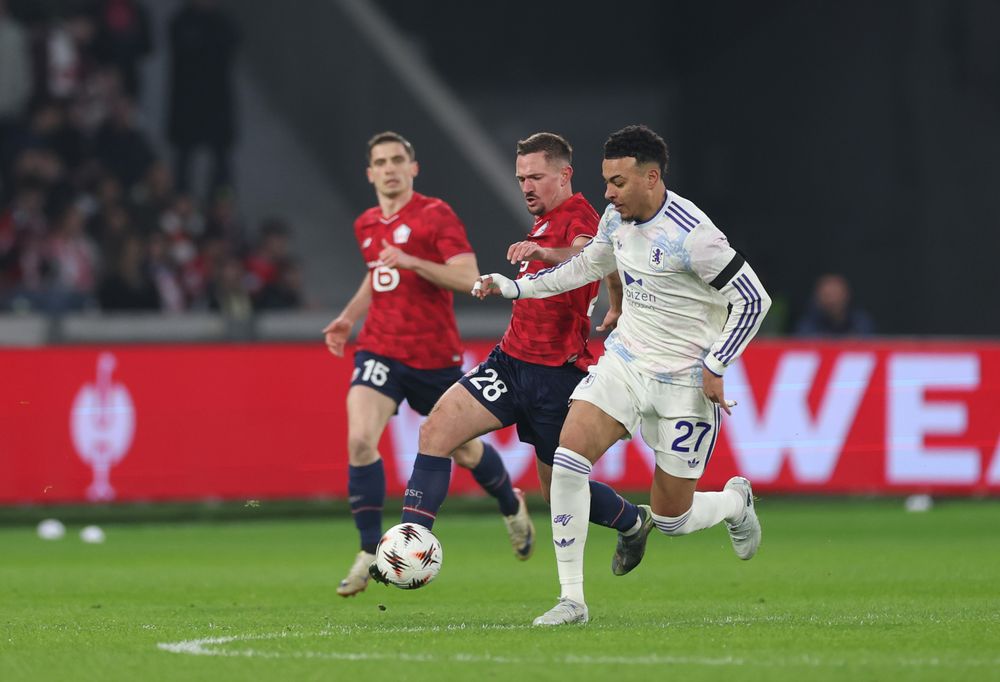


1️⃣ Match Context
European knockout nights don’t reward sentiment. They reward control: control of tempo, control of space, control of nerves.
Aston Villa host Lille OSC with the Europa League tie entering its decisive stretch, and the psychological balance is as important as the tactical one. Villa Park under the lights amplifies momentum — but it also amplifies pressure. If Villa start fast, the crowd becomes a multiplier. If they don’t, it becomes a weight.
There’s also the calendar reality. By mid-March, Premier League legs carry more mileage than most Ligue 1 squads, and Villa’s game model (aggressive rest-defence positioning, high full-backs, quick vertical attacks) is physically demanding. Lille, meanwhile, are built to survive chaotic phases: compact without the ball, and direct enough to punish loose distances on the break.
This is a classic Europa League hinge game: one team expected to impose, the other designed to frustrate. That dynamic shapes everything — from the shot map to the betting market.
2️⃣ Form & Advanced Metrics
Villa’s recent profile is usually defined by volume and territorial pressure rather than pure chance quality. They tend to generate a steady stream of entries and shots, but the key detail is where those shots come from. When Villa’s structure is clean — midfield angles available, wide rotations timed, central access created — the chance quality climbs quickly. When it isn’t, the attack becomes “loud”: many actions, fewer premium looks.
The numbers indicate Villa’s underlying chance creation remains healthy, but with a volatility driver: their defensive concessions are often situational rather than systemic. In other words, they don’t constantly get pinned back — yet when they lose the ball in the wrong zone, they can allow opponents into high-value central lanes before the block resets. That’s an xGA pattern that doesn’t always show up in simple shot counts.
Lille’s form is typically more controlled. Their attacking output isn’t built on endless shots; it’s built on shot quality and timing. They are comfortable letting matches breathe, then accelerating through the half-spaces once a pressing trap is triggered or an opposing pivot is isolated. In Europa League ties, that translates well because away games rarely allow you to play at full attacking volume.
Pressing intensity matters here. Villa are not a “press every second” team — they pick moments. Their PPDA profile (passes allowed per defensive action) tends to reflect that: not reckless, but assertive when cues appear (back-pass, poor body shape, full-back receiving under pressure). Lille’s build-up is generally press-resistant because they can go long without losing structure. That reduces the upside of Villa’s press and increases the importance of second-ball control.
Home/away splits tilt this further. Villa at home usually increase pace and field tilt — more possession in the attacking third, more crosses, more cutback attempts. Lille away are comfortable ceding territory if it keeps the central corridor protected. The match becomes a question of patience: can Villa create clear central shots without giving Lille the transition they’re waiting for?
3️⃣ League Table Snapshot
| Team | Domestic Position | Points Trend | Style Indicator |
|---|---|---|---|
| Aston Villa | Upper-tier contention | High-variance stretches | Proactive, vertical |
| Lille OSC | European places mix | More stable baseline | Compact, transition-led |
Takeaway: Villa’s league positioning generally reflects a higher-ceiling game model with more variance (especially when distances open up). Lille’s domestic profile tends to reflect consistency: fewer “runaway” performances either way, and fewer tactical abandonments. In a two-leg European tie, consistency can travel.
4️⃣ Head-to-Head Analysis
This isn’t a fixture with deep historical memory, so the head-to-head angle isn’t about tradition — it’s about matchup logic.
When teams like Villa face compact, transition-ready sides, the same themes repeat: Villa’s full-backs and advanced midfielders create width and numbers high up the pitch, but that also stretches their rest-defence. If the counter-press is even half a second late, opponents can run into the channels behind the first line.
Lille, structurally, are built to exploit exactly that. They don’t need to “win the ball high” to hurt you; they need one clean outlet pass and one runner timing the space behind the wide defender. Past outcomes in similar matchups often look like this: the possession-heavy team records more shots, but the other team produces fewer, cleaner chances. That’s the underlying-metrics story to watch.
5️⃣ Tactical Breakdown (Core Section)
Who dictates tempo?
Villa will try to. The home game script is clear: early territorial squeeze, high line, sustained pressure, and repeated attacks from the wings into the box. But Lille aren’t obliged to accept Villa’s rhythm. Their best defensive weapon is tempo denial — slowing the game with compact spacing, forcing Villa into wide circulation, and choosing when to jump.
Overload zones and the key lane
The decisive zone is the space just outside Lille’s box, centrally. If Villa can access that “Zone 14” pocket with clean receptions, they can turn Lille’s block and create cutbacks — the highest value chance type in modern football. If they can’t, Villa’s attacks become more cross-dependent, and Lille’s centre-backs can defend facing the ball.
Lille will try to screen that pocket with a disciplined midfield line, forcing Villa to play around rather than through. The trade-off is that it concedes territory. But Lille will accept that if it prevents central shots.
Flanks: where Villa can win and where they can lose
Villa’s wide play is both their engine and their risk. Their best sequences come when the winger pins the full-back, the overlapping run drags the defensive line, and the half-space runner arrives late for a cutback. That’s how they manufacture high-quality chances without needing 70% possession.
The danger is the turnover. When Villa’s full-backs are high, the channels behind them are open. Lille’s counters don’t need many passes; they need the first pass to be clean and the second run to be decisive. If Lille can repeatedly find that outlet, Villa’s centre-backs are forced into wide defending — a scenario that produces fouls, set pieces, and high-xG cut-throughs.
Midfield control battle
This match will be won by the team who controls second balls and stops the opponent’s “first clean pass” after a duel. Villa’s press is most effective when their midfield line is tight behind the first wave. If that spacing loosens, Lille can bypass pressure and attack into a backpedaling defence.
For Lille, the aim is to lure Villa into committing one extra body forward, then break into the half-spaces. The numbers indicate that against proactive sides, Lille’s shot quality can spike even if their overall shot volume stays modest.
Set pieces
Europa League ties often swing on dead balls, not dominance. Villa’s aerial threat is real, but it’s also an area where markets sometimes overreact to narrative. The more important detail is who concedes set pieces in bad zones. If Villa’s high line forces recovery fouls near the corners, Lille can turn a low-possession night into a steady stream of dangerous restarts.
6️⃣ Odds & Market Evaluation
| Outcome | Market Odds | Implied Probability | betlabel.games Fair Probability |
|---|---|---|---|
| Aston Villa win | 1.75 | 57.1% | 54.0% |
| Draw | 3.70 | 27.0% | 26.0% |
| Lille win | 4.80 | 20.8% | 20.0% |
The raw implied probabilities here sum above 100% (the bookmaker margin), but the shape is clear: Villa are priced as firm home favourites. According to our calculations, the market slightly overprices the Villa win. Not dramatically — but enough to make “Villa to win” a thin-value position at current levels.
Where the edge starts to appear is in outcomes that benefit from Lille’s structural resilience: double chance, Asian lines, and totals depending on game state.
7️⃣ The Hidden Edge (Mandatory Section)
There’s a structural nuance here that markets don’t always price correctly: Villa can dominate territory without dominating shot quality against compact, transition-competent opponents.
Territory control and field tilt are visually persuasive. They also push recreational money toward the home favourite. But if we look deeper, Lille’s defensive approach is designed to concede “acceptable shots” — wide angles, contested headers, low-probability efforts — while keeping central lanes protected. That can make Villa look in control while the expected goals remain closer than the shot count implies.
On the other side, Lille’s chance creation can be low-volume but high-leverage. A single clean transition or a single set-piece sequence can generate a chance worth more than five speculative efforts at the other end. In tight European ties, that asymmetry matters.
The market also tends to price Premier League home teams at a premium in Europe. Sometimes that’s deserved. Sometimes it’s simply brand weight. This matchup leans toward the second category: Villa are better, but the pathway to a comfortable win is narrower than the odds suggest.
8️⃣ Final Prediction
Main Pick: Lille +1.0 (Asian Handicap)
Alternative: Under 3.0 Goals (Asian Total)
Risk Level: Medium
Why this works:
- Matchup logic: Lille’s compact block can reduce Villa’s central shot quality, pushing them toward lower-value wide attempts.
- Transition threat: Villa’s high positioning creates a real counter window; Lille don’t need many attacks to create one big chance.
- Pricing: Villa’s win probability is slightly inflated relative to our fair line, making Lille on the handicap the cleaner value angle.
No guarantees — but in a game where Villa may have more of the ball and still find the margins tight, backing Lille with a goal start aligns better with both the tactical reality and the pricing.






Leave a Reply