
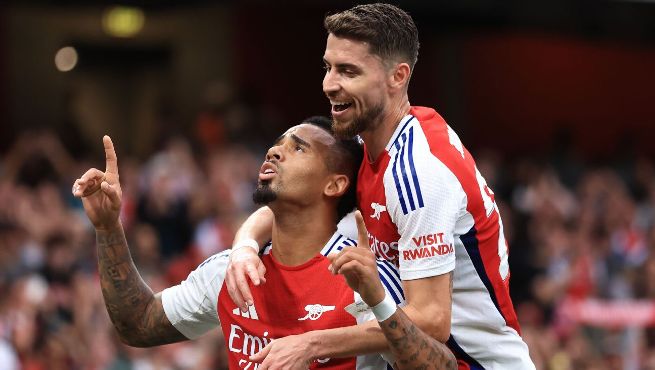


1️⃣ Match Context
This is a Champions League night with real weight to it, not a group-stage sparring session. Arsenal host Bayer 04 Leverkusen in a tie that reads like a modern European stress test: elite possession structure versus one of the most aggressive, transition-ready systems in the game.
At this stage, the margins aren’t just technical — they’re psychological. Arsenal’s home crowd expects control and progression; anything that looks chaotic quickly becomes pressure. Leverkusen arrive with the underdog freedom that often sharpens decision-making: fewer “don’t make mistakes” minutes, more “punish the first wobble.”
Schedule context matters too. Both sides are built to play at high intensity, but intensity is not infinite. If either manager has had to rotate domestically, the timing of substitutions, the ability to re-press after turnovers, and the late-game running power become decisive. In this type of matchup, fatigue doesn’t only reduce sprint count — it increases the frequency of bad distances between lines. That’s where ties swing.
2️⃣ Form & Advanced Metrics
Arsenal’s recent profile is built on territorial authority. They tend to produce a strong share of final-third touches and sustained pressure sequences, with **shot quality often coming from cutbacks and central-zone arrivals** rather than speculative volume. When they’re “on,” they don’t just shoot a lot — they shoot from good places.
The flip side is volatility when the opponent can break the first wave. Arsenal’s defensive work is usually clean in settled phases, but the moments that hurt them tend to be transitional: a lost pass in the half-space, a fullback high, and suddenly the recovery runs are long. The numbers indicate a generally healthy xGA profile, yet the type of concession can be high leverage — fewer shots, but some of them premium.
Leverkusen’s metrics typically show a more aggressive rhythm. Their pressing intensity is reflected in a lower PPDA profile (fewer passes allowed per defensive action), but the real story is what that press is for: it’s a chance-creation mechanism. They’re comfortable forcing play wide, trapping, and then springing forward with runners arriving early. That often creates **high-tempo, low-settle games**, which is exactly what you want when visiting a team that prefers controlled possession.
If we look deeper, Leverkusen can concede territory without conceding panic. They often allow possession in non-damaging zones, then protect the box with numbers. This is where shot quality vs shot volume matters: opponents may outshoot them, but not necessarily outchance them. However, that trade-off becomes risky against Arsenal’s ability to generate high-value chances through patient circulation and late box entries.
Home/away splits also matter stylistically. Arsenal at home usually tilt the pitch hard. Leverkusen away often accept a lower share of possession — not passively, but as a platform to counter. That makes game state huge: **the first goal changes the entire geometry.**
3️⃣ League Table Snapshot
| Team | Domestic Position | Points | GF | GA |
|---|---|---|---|---|
| Arsenal | 2nd | — | — | — |
| Bayer 04 Leverkusen | 1st | — | — | — |
Takeaway: the headline positions point to two elite teams, but they win in different ways. Arsenal’s profile is often about controlled territory and repeatable chance creation. Leverkusen’s is about compressing time and space, creating turnovers, and turning small mistakes into big chances. This isn’t “who’s better,” it’s “whose game shows up first.”
4️⃣ Head-to-Head Analysis
Head-to-head history matters less than how styles interact, but there are still useful patterns to watch. When Arsenal face high-press, transition-heavy opponents, the decisive question is whether they can keep buildup clean without becoming sterile. If they play through pressure with composure, the opponent’s press turns into open grass behind it.
Leverkusen, meanwhile, are at their best when the opponent’s midfield receives with their back to goal. They don’t need constant ball wins — they need a few high-quality steals in the right lanes. If past meetings show anything, it’s that these games tend to be decided by **two or three sequences**, not by 90 minutes of dominance.
Underlying metrics often align with that story: not endless chance volume, but a small number of very high-value looks created from broken structure. That’s the psychological dynamic too — one bad pass can feel like a goal conceded.
5️⃣ Tactical Breakdown (Core Section)
Tempo control: Arsenal want a metronome, Leverkusen want a drumbeat
Arsenal will try to dictate with possession that has purpose: dragging Leverkusen’s block side-to-side, then snapping the ball into the half-spaces to attack the box. Their most valuable moments often come when the ball reaches advanced midfielders between lines and the next pass is a cutback or a squared ball across the face of goal.
Leverkusen’s mission is the opposite: shorten Arsenal’s time. They’ll look to press in waves, using triggers like a backward pass, a slow center-back touch, or a fullback receiving facing his own goal. If the press lands, Arsenal’s structure can get stretched — and stretched structure is what Leverkusen feed on.
Where the overload lives: half-spaces and the far-post run
The key zone is the half-space just outside Arsenal’s box — not because Leverkusen want to shoot from there, but because that’s where they can slip runners behind the fullback or pull a center-back out of line. Arsenal’s defenders are generally strong in the box, but the danger is the pass that forces a rotation: center-back steps, fullback tucks, far-post runner arrives.
On the other side, Arsenal can hurt Leverkusen by turning their press into a disadvantage. If Arsenal’s first and second lines break cleanly, Leverkusen’s back line can be asked to defend open-field runs. That’s where Arsenal’s shot quality spikes: not from 20-yard efforts, but from **arrivals inside the width of the posts** after a quick third-man combination.
Midfield battle: security vs disruption
Arsenal’s priority will be midfield security — clean receiving angles, support triangles, and minimizing “loose” touches that invite the swarm. If they manage that, they can pin Leverkusen and force long defensive sequences.
Leverkusen’s priority is disruption. They don’t need to win midfield in a classical possession sense; they need to create second-ball moments and transitional attacks. Watch the spacing between Arsenal’s midfielders and fullbacks: if that gap opens, Leverkusen can play straight into it.
Transitions and rest defense
This is the structural hinge. Arsenal’s rest defense (the shape left behind during attacks) must be immaculate. If their fullbacks are both high and the counterpress is late, Leverkusen can reach the final third in two passes. Conversely, if Arsenal counterpress quickly and force Leverkusen to reset, the visitors lose their most dangerous weapon: speed into space.
Set pieces: not volume, leverage
In tight Champions League games, set pieces aren’t about “who gets more corners” — they’re about leverage moments. Arsenal are generally well-drilled here, but Leverkusen’s aggressive attacking runs can force awkward clearances and second phases. One poorly defended second ball can be the difference between a clean 1-0 and a nervous 1-1.
6️⃣ Odds & Market Evaluation
| Market | Odds | Implied Probability |
|---|---|---|
| Arsenal win | 2.05 | 48.8% |
| Draw | 3.55 | 28.2% |
| Leverkusen win | 3.60 | 27.8% |
Those implied probabilities sum above 100% due to margin, but the shape is clear: Arsenal are priced as a narrow home favorite, draw is respected, and Leverkusen are treated as live away opposition.
The betlabel.games team evaluates this matchup as closer than a typical “big home club vs away challenger” template. According to our calculations, Arsenal’s edge is real — home territory and chance quality — but it’s not overwhelming because Leverkusen’s transition threat travels well. **The market looks broadly efficient, with only marginal inefficiencies in draw-protection angles.**
7️⃣ The Hidden Edge (Mandatory Section)
There’s a structural nuance here that markets can be slow to price: **Leverkusen’s press doesn’t just create chances — it changes the opponent’s shot map.** Arsenal can still end up with decent xG totals, but if Leverkusen force them into earlier shots (before the box is loaded) the “headline xG” can hide a lower probability of scoring multiple goals.
Meanwhile, Arsenal’s defensive record can look stable until you isolate the phase: their most dangerous concessions tend to be high-speed attacks after turnovers, which are relatively low-frequency events. That’s exactly why they’re hard for models and bettors to “feel” week to week — you can dominate 70 minutes and still be one mistake away from an equalizer.
In other words, this is a game where the better team can still fail to cover a -0.5 type line. The market often over-rewards general dominance and underweights the specific opponent capable of turning two transitions into one goal. That’s the mispricing window: not necessarily on who wins, but on **how tight the win margin is likely to be.**
8️⃣ Final Prediction
Main Pick: Arsenal – Draw No Bet (DNB)
Alternative: Under 3.0 Asian Total Goals
Risk Level: Medium
Why:
1) Home control is meaningful here. Arsenal’s ability to tilt the field and generate higher-quality central chances gives them the clearest path to a one-goal lead.
2) Leverkusen’s transition threat increases draw probability. Even if Arsenal lead the metrics, the visitors have the structure to steal an equalizer from a turnover-and-run sequence.
3) Margin matters more than outcome. This matchup profile often produces “one decisive swing” games rather than open, end-to-end chaos. That’s why draw protection and goal suppression lines make more sense than chasing a pure 1X2 at thin prices.
No guarantees — just probability logic. Arsenal are the likelier winner, but the smartest exposure respects Leverkusen’s ability to keep this tight.





Leave a Reply