
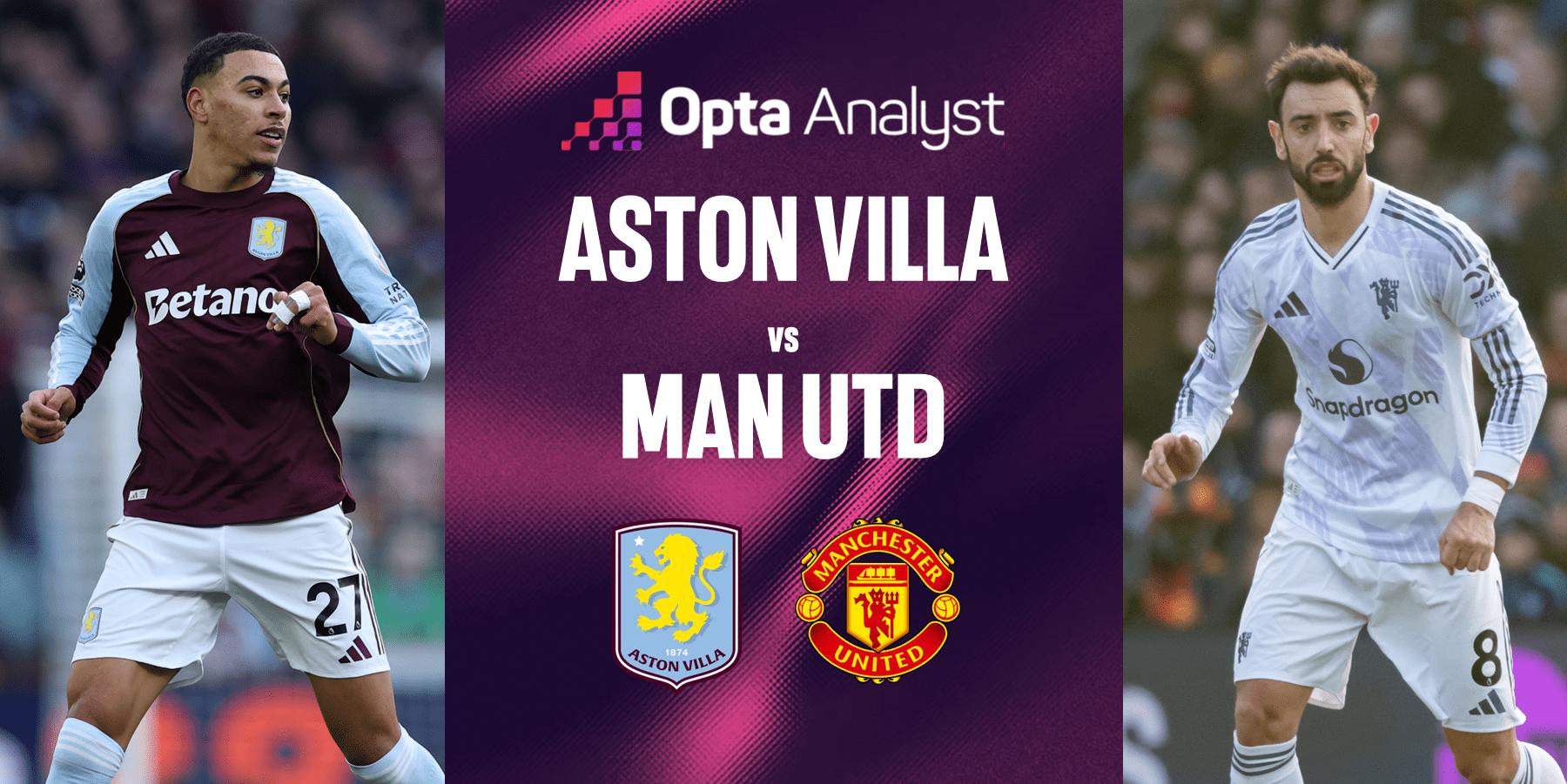


1️⃣ Match Context
Mid-March in the Premier League is where narratives stop being theories and start becoming table pressure. Manchester United at home is rarely “just another fixture,” but this one has an extra layer: it sits in the part of the calendar where Europe places a tax on legs and attention, and where top-four (or top-five) races tighten into margins.
United’s context is typically binary at this stage: either chasing Champions League positioning or trying to protect it. Either way, Old Trafford becomes a stress test. The crowd expects front-foot control; the team often oscillates between dominance and fragility depending on whether they can secure rest-defense behind attacks.
Aston Villa arrive with a different psychological load. Their progress in recent seasons has been built on structure and repeatability — but away days at elite venues still demand emotional discipline. Villa don’t need to “win the occasion.” They need to win the phases: survive pressure, land transitions, and make United defend their own box for uncomfortable spells.
Schedule congestion matters here. If United are coming off a European week, the first 20 minutes can look sharp, and the last 25 can look like a different sport. Villa’s ability to keep the match alive deep into the second half is the silent subplot.
2️⃣ Form & Advanced Metrics
The numbers around Manchester United usually tell the same story in different dialects: they can create shot volume when they pin teams in, but their match control depends on the quality of their rest-defense and the spacing behind the ball after turnovers.
If we look deeper at chance creation, United’s best spells tend to come when they generate high-value chances from the half-spaces — cutbacks, pulled-back passes, and second-phase shots after sustained pressure. The risk is that their attacking shape can become stretched, which invites counter-punches into the channels. That’s where xGA tends to spike: not from patient build-up conceded, but from transition sequences where opponents get central access too quickly.
Aston Villa’s underlying profile is more deliberately engineered. Their chance creation is less about raw shot counts and more about shot quality: fewer hopeful attempts, more entries that end in clear looks — particularly if they can isolate a fullback or draw a midfielder out of line. Villa’s attacking efficiency tends to rise when they can force the opponent to defend facing their own goal.
Pressing intensity is the lever that decides the tempo. PPDA (passes per defensive action) isn’t just a stat — it’s a proxy for how early a team tries to win the ball back. United can press high in bursts, but their real issue is not winning the ball; it’s what happens if they don’t. Villa are comfortable using a mid-block to bait passes into predictable zones, then jumping aggressively on triggers — a backwards pass, a heavy first touch, or a fullback receiving with closed body shape.
Home/away splits matter as well. United at Old Trafford generally play with more territory and field tilt — more possession in the attacking third, more touches around the box. Villa away can accept less territory without losing their identity, because their threat is phase-based: they don’t need 60% possession to produce high-grade transitions.
3️⃣ League Table Snapshot
| Team | Position | Points | GF | GA |
|---|---|---|---|---|
| Manchester United | TBD | TBD | TBD | TBD |
| Aston Villa | TBD | TBD | TBD | TBD |
Takeaway: without the exact live table data embedded, the key interpretive point remains: United’s season outcomes are often shaped by variance in game-state control (how often they protect leads cleanly), while Villa’s are shaped by repeatable structure (how often they keep matches within one goal and let their transition game decide it).
4️⃣ Head-to-Head Analysis
Head-to-head in this matchup tends to hinge less on “who wants it more” and more on which team can dictate where the game is played. When United have beaten Villa convincingly, it’s usually because Villa were forced into too many low-percentage clearances, giving United constant re-entries and second balls around the box.
When Villa have made it ugly for United, it has often followed a repeatable pattern: United dominate territory, but Villa win the best moments — the first clean transition after a turnover, the overload on the weak-side, the isolated winger running at a retreating defender, or the set-piece sequence that swings momentum.
Psychologically, Villa are not intimidated by long spells without the ball. That matters at Old Trafford, where many visitors lose shape chasing the crowd’s rhythm. Villa’s discipline is a structural advantage — but it only pays off if they keep their distances tight and don’t concede cheap central entries.
5️⃣ Tactical Breakdown (Core Section)
Who dictates tempo?
United will try to turn this into a territorial match: high line, sustained pressure, and fast recycling to keep Villa defending deep. The risk is that “fast” becomes “forced.” Villa’s block is designed to invite a pass that looks available, then collapse on it.
Villa, meanwhile, are happy to let the match breathe — then accelerate suddenly. Their ideal tempo is asymmetric: slow without the ball, fast with it. If Villa can keep United’s attacking possessions ending in wide shots or low-quality crosses, the game tilts toward them as minutes pass.
Where is the overload zone?
The critical zone is the space just outside United’s midfield line on turnovers — the first pass after regaining possession. If Villa can consistently find that pass into the half-space, United’s back line gets dragged into uncomfortable decisions: step out and leave space behind, or drop and concede territory.
For United, the overload is typically created by pinning Villa’s wingers deep, then attacking the seam between fullback and center-back. Cutbacks are the premium chance type here. Villa’s defensive success depends on protecting the box central channel — not just the wings.
Which flanks are exposed?
United’s fullbacks often determine whether they are stable or chaotic. If both push high simultaneously, the rest-defense becomes thin, and Villa’s wide counters have daylight. Villa will target the far-side flank on switches: one or two passes to flip the point of attack, then immediate direct running.
Villa’s potential exposure is behind their own fullbacks if their midfield doesn’t slide quickly enough. If United can lock Villa into long defending spells and move the ball quickly side-to-side, Villa can end up defending the back post repeatedly — a classic fatigue concession.
Midfield control battle
This match is often decided by midfield spacing rather than individual duels. United need a stable platform to circulate possession without being baited into vertical passes that Villa can intercept and counter from. Villa want United’s midfield receiving under pressure, facing their own goal.
If United’s midfield becomes stretched — one player too high, one too low — Villa’s counter structure becomes lethal. If United stay compact and patient, they can force Villa’s wide players deeper and reduce Villa’s transition frequency.
Pressing triggers and buildup resistance
Villa’s press is selective but sharp. The triggers are predictable: a slow center-back circulation, a pass into a fullback with poor body orientation, or a midfield receive without a clean third-man option. When Villa jump, they jump to win the ball and attack immediately, not just to “press.”
United’s counter-press — the first five seconds after losing the ball — is the hinge. If they win those moments, Villa spend the afternoon defending. If they lose them, Villa get high-value transitions and United’s xGA profile rises quickly.
Set-piece dynamics
In matches like this, set-pieces are not a side note — they are a volatility spike. United at home will likely generate corners through territory. Villa will look for free-kicks in wide areas to create first-contact chaos. The key is not only delivery quality but second-ball organisation: who is positioned to recycle and who is positioned to stop the counter after a cleared corner.
6️⃣ Odds & Market Evaluation
| Market | Odds | Implied Probability |
|---|---|---|
| Manchester United win | 2.05 | 48.8% |
| Draw | 3.60 | 27.8% |
| Aston Villa win | 3.65 | 27.4% |
Those implied probabilities sum above 100% due to margin. According to our calculations at betlabel.games, the “true” price leans slightly away from a strong United home bias. The market is paying for the Old Trafford effect, but this matchup is structurally awkward.
The edge here is not screaming. It’s marginal — but playable if you pick the right wrapper (handicap, draw protection, or totals) rather than going all-in on a 1X2 stance.
7️⃣ The Hidden Edge (Mandatory Section)
There’s a structural nuance here: Villa are one of the better teams in the league at turning opponent possession into low-quality territory. They can allow touches in the final third without conceding the central shot that truly hurts. That often looks like “United dominance” on TV — but the xG beneath can be flatter than perception.
On the other side, United’s profile can be misleading because their chance creation is sometimes front-loaded. They start fast, produce a burst of pressure, and if they don’t score, the match can drift into a transition exchange — exactly the type of game Villa prefer.
The hidden edge is second-half game state. If United have European load or simply carry their usual intensity drop after the hour, Villa’s chance quality tends to increase late: fresher runners, clearer transition lanes, and more set-piece opportunities as defending becomes reactive. Markets often price “United at home” as a constant for 90 minutes. It rarely is.
8️⃣ Final Prediction
Main Pick: Aston Villa +0.5 (Asian Handicap)
Alternative: Both Teams To Score (BTTS) – Yes
Risk Level: Medium
Why this makes sense:
- Matchup logic: Villa’s mid-block + transition structure directly targets the spaces United can leave when chasing territory.
- Game-state realism: United’s control can be strong early but tends to become volatile if the first goal doesn’t arrive; Villa are built to stay alive and strike later.
- Market framing: Old Trafford bias is often priced as if dominance equals chance quality. Villa are one of the better sides at breaking that assumption.
No guarantees — but in probability terms, taking Villa with draw protection aligns with how this game is likely to be played, not just how it will look.






Leave a Reply