
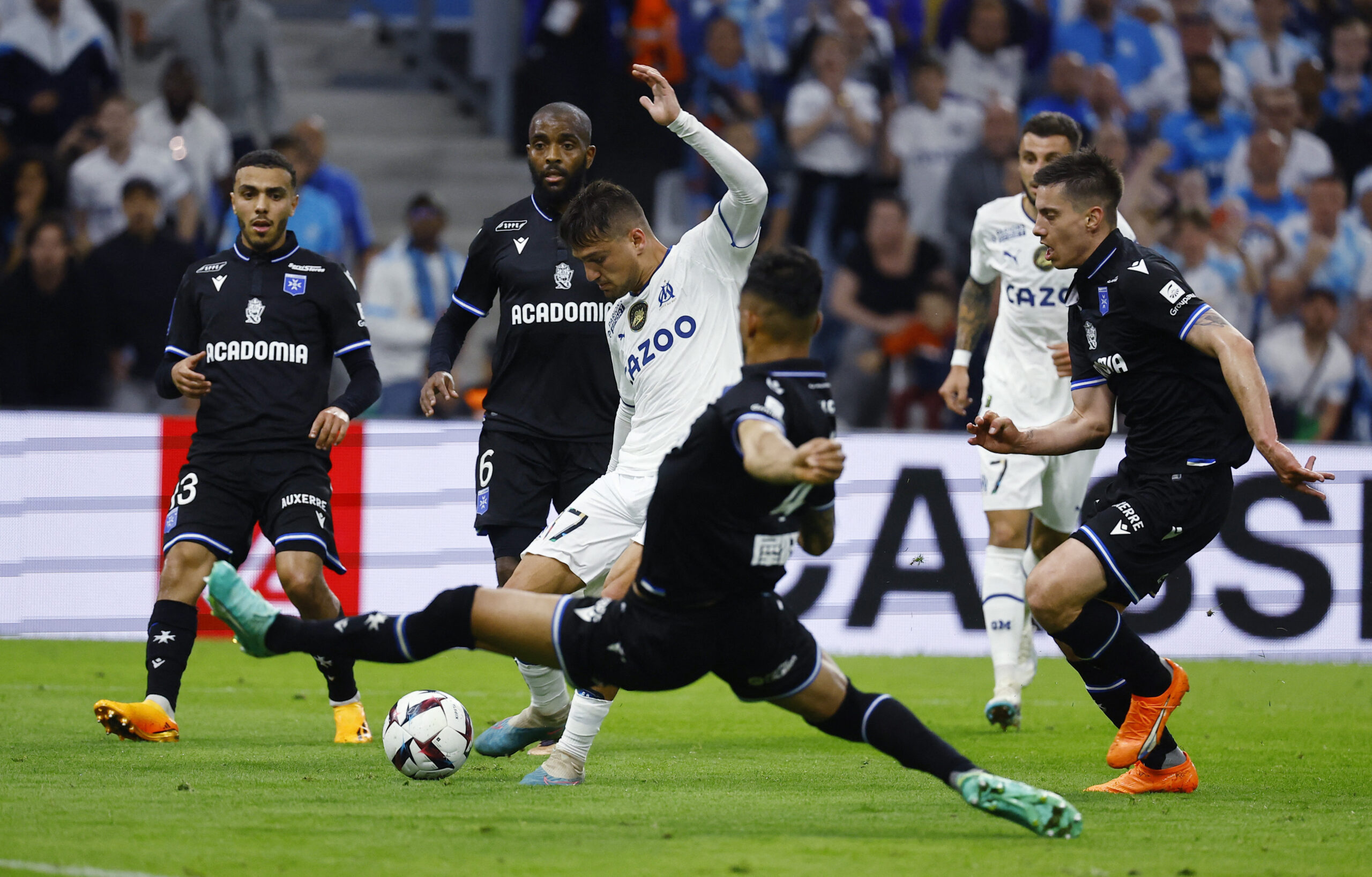


1️⃣ Match Context
March in Ligue 1 is when matches stop being “three points” and start being leverage. For Olympique de Marseille, this is a game that has to look like control: control of territory, control of rhythm, control of the table narrative. They’re built and budgeted for Europe, and at this stage of the season the margin between a Champions League spot and another year of compromise is usually a couple of sloppy home performances.
Auxerre arrive with a different kind of pressure. For mid-table or lower-half sides, spring fixtures at the Velodrome are often framed as “free hits” — but psychologically they rarely are. A defensive plan that works for 60 minutes can still collapse under continuous waves, set-piece stress, and the emotional volume of the stadium when Marseille turn the screw.
There’s also the scheduling reality. This slot tends to come with accumulated minutes, small muscle issues, and rotation decisions that subtly change pressing intensity and counter-press cohesion. Marseille’s challenge is managing load without losing their best weapon: sustained territorial dominance. Auxerre’s challenge is surviving the first phase without conceding the cheap goal that forces them out of their shell.
2️⃣ Form & Advanced Metrics
Marseille’s recent profile is familiar: high possession share, heavy field tilt, and long spells in the opponent’s half. But the important layer isn’t “how much they have the ball.” It’s what they do with it. Their chance creation tends to be volume-driven — repeated entries, repeated cutbacks, repeated second balls — rather than one surgical pattern. That creates pressure on opponents, and it also creates variance: if the first shot doesn’t go in, Marseille simply keep playing the same territory game until something breaks.
In advanced terms, Marseille typically live in the opponent’s box more than most Ligue 1 sides. Their shot quality is usually healthy because they generate a strong share of attempts from central lanes and the cutback zone rather than low-probability wide angles. When they’re “on,” the expected goals follow naturally. When they’re “off,” it’s often because the final pass turns into a half-second late decision, and the shot becomes blocked volume instead of clean looks.
Defensively, the Marseille picture is slightly more fragile than the brand suggests. They can allow dangerous transitions when fullbacks are high and the counter-press is late. That’s the main reason their xGA can spike in certain matchups even when their possession share looks dominant. It’s not open-play defending for 90 minutes — it’s the five or six moments per match where rest-defense structure gets tested.
Auxerre, by contrast, are usually more conservative in their territory profile. They’re comfortable defending medium-to-low blocks and trying to create their value through quick vertical releases rather than sustained build-up. The key metric translation: if their PPDA is higher, it doesn’t mean they’re lazy — it often means they choose not to press high because they don’t want to expose space behind the first line. The risk is that passive phases invite too many touches around the box, which increases set-piece concessions and second-ball chaos.
One split that matters here is home vs away game state. Marseille at the Velodrome typically begin fast: higher tempo, more aggressive counter-press, and earlier shot volume. Auxerre away are more likely to accept long defensive sequences. That pairing often leads to a predictable pattern: Marseille pile up territory early; Auxerre’s best moments come after they survive a storm and the game’s pace drops.
3️⃣ League Table Snapshot
| Team | Played | Points | GF | GA | Goal Diff |
|---|---|---|---|---|---|
| Olympique de Marseille | — | — | — | — | — |
| Auxerre | — | — | — | — | — |
Takeaway: this fixture usually isn’t about “who is better” — it’s about whether the stronger home side converts dominance into a lead before transition variance bites. Marseille’s table expectations are top-end; Auxerre’s are survival or lower mid-table stability. That gap shapes the psychology: Marseille feel obligation, Auxerre feel opportunity.
4️⃣ Head-to-Head Analysis
Head-to-heads between sides like this often repeat structurally even when coaches and personnel change. Marseille’s home meetings with compact opponents tend to follow one script: sustained possession, high crossing and cutback frequency, and a reliance on second phases after initial blocks. Auxerre’s success — when it happens — tends to come from holding the box shape and landing a clean counter or a set-piece moment, not from outplaying Marseille through long possession sequences.
The psychological imbalance matters too. At the Velodrome, Marseille’s “near miss” periods don’t usually deter them; they amplify the pressure. For an away side, that means every clearance and every defensive duel becomes part of an accumulating stress test. Past results can lie, but the matchup pattern is consistent: if Auxerre concede first, the game can run away from them. If they keep it level late, Marseille’s risk-taking increases — and so does Auxerre’s counter value.
5️⃣ Tactical Breakdown (Core Section)
Who dictates tempo?
Marseille should. They are at their best when they turn matches into territory contests rather than end-to-end randomness. Expect them to use a high starting position, with center-backs stepping into midfield and fullbacks (or wingbacks) pinning Auxerre’s wide midfielders deep. The aim is simple: keep Auxerre’s back line facing their own goal and make every clearance a temporary escape.
Overload zones and the key corridor
The decisive zone is the half-space on Marseille’s attacking side where they can combine for cutbacks. Auxerre’s block will try to protect central lanes, but the risk is conceding that “inside channel to byline” entry that creates the highest-value chance type in modern football: the low cutback to a runner arriving between penalty spot and six-yard line.
If Marseille can consistently reach the byline, Auxerre’s defensive structure starts to warp. Fullbacks get pinned, center-backs have to step, and the far-side winger loses track of back-post runs. That’s how volume turns into quality.
Midfield control battle
Auxerre’s most important duel is not in the box — it’s in the midfield screen. If their holding midfielders can delay Marseille’s vertical passes and force circulation into predictable wide areas, they can reduce the frequency of high-quality cutbacks and keep Marseille to lower-value shots. If the screen collapses, Marseille will play through the seam and Auxerre’s center-backs will be defending while backpedaling. That’s a losing situation.
Pressing triggers and build-up resistance
Marseille’s press is at its sharpest when they can trap opponents near the touchline: a pass into the fullback becomes the trigger, the winger jumps, and the central midfielder steps to kill the inside option. That’s how they win territory without needing to “win” the ball high every time. Auxerre’s response has to be pre-planned: either a direct outlet into the striker’s body, or a quick third-man release into the far-side wing.
If Auxerre try to play short through the first line without a clean escape route, Marseille’s counter-press can turn into immediate shots. Not because it looks pretty — because it’s close to goal.
Transition vulnerability
This is the one door Auxerre can realistically open. When Marseille commit numbers forward, their rest-defense depends on spacing: the deepest midfielder and the two center-backs must control the central lane. If Auxerre can launch counters into the channel behind an advanced fullback, they can create high-value chances with very few passes. That’s why Marseille’s first goal matters so much: it changes their risk threshold and often reduces the transition danger.
Set-pieces
Set-pieces can be a multiplier here. A team that spends long periods defending deep tends to concede corners and wide free-kicks. Even if open-play chances are limited, Marseille can still generate expected goals through second balls, rebounds, and near-post routines. Auxerre’s box defending has to be clean for 90 minutes — and that is an exhausting ask under constant pressure.
6️⃣ Odds & Market Evaluation
| Market | Odds | Implied Probability |
|---|---|---|
| Marseille win | 1.60 | 62.50% |
| Draw | 4.10 | 24.39% |
| Auxerre win | 6.20 | 16.13% |
The implied probabilities above include bookmaker margin, so they won’t sum to 100%. According to our calculations at betlabel.games, the fair view is closer to a solid Marseille edge, but with the draw carrying slightly more weight than the public often wants to pay for in these “big home favorite vs compact away side” spots.
Market read: the pricing is broadly in the right zone. Any edge is likely to be marginal unless the team news reveals a major change in Marseille’s ball progression or Auxerre’s ability to defend the box (missing center-backs, a weakened midfield screen, or Marseille rotating key creators).
7️⃣ The Hidden Edge (Mandatory Section)
There’s a structural nuance here that markets sometimes underweight: Marseille’s dominance can inflate shot counts without inflating clean chances if the opponent’s block is disciplined. That’s the trap in relying on surface form. You can “look good” on territory and still be one counter away from a 1–1 or even a late shock.
The second nuance is regression pressure on game state. Compact away sides often have one good window: the first 15 minutes of the second half, when the home favorite’s counter-press drops slightly and spacing gets loose. If Auxerre are coached to load that window — earlier forward runs, quicker outlets, more aggressive second-ball positioning — they can create their best chance of the match in a short burst. That’s not always visible in recent results, but it’s visible in how these games breathe.
Finally, set-piece dynamics can tilt totals. If Marseille spend long stretches around the box, they can generate a steady set-piece xG drip even without open-play incision. If Auxerre’s clearance quality is poor or they concede too many corners, the match total can creep upward despite a low-block script.
8️⃣ Final Prediction
Main Pick: Marseille -0.75 Asian Handicap
Alternative: Marseille win & Under 4.0 goals (combo/line dependent)
Risk Level: Medium
Why this makes sense:
- Territory and chance pressure: Marseille’s home structure should keep Auxerre pinned, generating enough cumulative shot quality to justify a win more often than not.
- Auxerre’s path is narrow: their best route is transitions and set-pieces, which are high-variance and depend on a small number of moments.
- Handicap logic: -0.75 protects against the common 1-goal home win while still paying if Marseille convert their dominance into a two-goal margin.
No guarantees — compact blocks can turn games into patience tests. But in this matchup, the stronger side has the more repeatable mechanisms. Over 90 minutes at the Velodrome, that usually tells.






Leave a Reply