
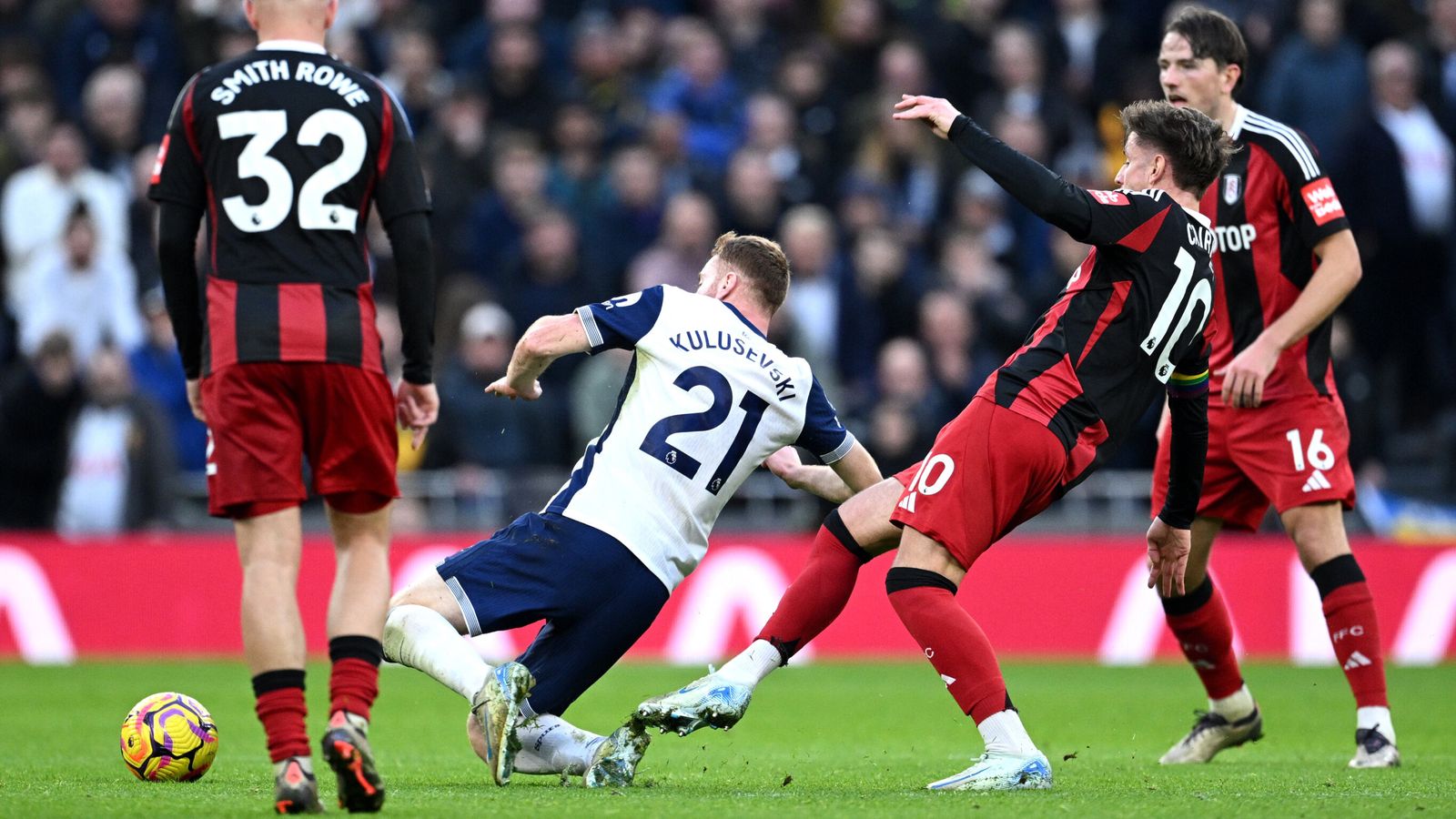


1️⃣ Match Context
This is the type of Premier League fixture that quietly shapes the spring narrative. Fulham aren’t in the weekly title-or-relegation headlines, but games like this decide whether their season finishes as “comfortable mid-table” or “late wobble with pressure attached.” Tottenham, meanwhile, live in the Champions League conversation by default — and that’s exactly why the psychological weight is heavier on them.
Spurs arrive with the familiar expectation tax: control the game, create volume, win. Fulham arrive with a different form of leverage — they can play with more tactical freedom, and when that happens against a possession-heavy opponent, the underdog’s threat isn’t about dominating. It’s about choosing the moments to strike.
Schedule dynamics matter too. Early March typically compresses minutes for clubs still juggling cup priorities or European rhythms. Even without naming specific competitions, Tottenham’s squad tends to carry more “high-intensity minutes” across the season — and that often shows up not in the first 30 minutes, but in the second-half control phase.
This match matters because it’s a leverage point: Tottenham’s top-four equity versus Fulham’s ability to turn home fixtures into points through structure, not chaos.
2️⃣ Form & Advanced Metrics
Fulham’s recent performances tend to look modest in scorelines, but the underlying story is usually clearer: they’re at their best when their shot profile stays disciplined. They don’t need 18 shots. They need 8–11 shots with a few coming from the corridor between penalty spot and the edge of the six-yard box — the “real xG” territory.
When Fulham struggle, it’s often because their chance creation gets pushed wide. The ball moves, the possession numbers look healthy, but the shots become low-value: wide angles, blocked attempts, or rushed cutbacks. That’s a structural issue, not just finishing.
Tottenham, on the other hand, are built to generate repeatable pressure. Their attacking output is typically a blend of shot volume and territory: sustained phases in the final third, plus quick vertical attacks when the press lands. In xG terms, that profile is powerful — but it can also be volatile if they concede transitions, because the same aggressive rest-defense that wins territory can leave space behind.
Pressing intensity is a key lens here. PPDA (passes allowed per defensive action) isn’t just a number — it’s a statement of intent. A lower PPDA means a team engages earlier and more often, forcing build-up decisions under pressure. Tottenham’s approach tends to drive opponents into rushed clearances or sideways buildup. Fulham’s challenge is whether they can resist that first wave without turning the game into a pinball match.
Tempo patterns will decide the value in this game: if Tottenham can keep Fulham penned in, they’ll accumulate high-probability sequences. If Fulham can slow the rhythm, draw Spurs forward, and then play through the first press, the match becomes a transition contest — and that’s where underdogs can create real edge.
3️⃣ League Table Snapshot
| Team | Position | Points | GF | GA |
|---|---|---|---|---|
| Fulham | 12th | 34 | 36 | 40 |
| Tottenham Hotspur | 5th | 49 | 52 | 38 |
The positions reflect two different realities. Fulham’s slot is typical of a team with a stable baseline but limited margin — they can beat teams around them, but elite opponents often force them into low-quality shots. Tottenham’s place near the top is consistent with a side that wins territory and chance volume. The question is whether they convert dominance into points efficiently enough — and whether their defensive concessions are structural or situational.
4️⃣ Head-to-Head Analysis
Head-to-heads between teams like Fulham and Tottenham often mislead because the storyline becomes “big club wins.” The more useful angle is repetition: does Fulham’s defensive block consistently force Spurs wide? Does Spurs’ counterpress consistently trap Fulham in their own half?
In many recent matchups of this type, the pattern is predictable: Tottenham push the game into Fulham’s third, Fulham defend with compactness, and the outcome depends on whether Spurs can create central access rather than settling for perimeter shots. When Spurs win these games convincingly, it’s usually because their chance quality stays central — cutbacks, second balls, and late runners — not because they spam crosses.
If the past meetings show anything, it’s structural: Fulham need the game to be played in “segments,” not in one continuous Tottenham wave.
5️⃣ Tactical Breakdown (Core Section)
Who dictates tempo?
Tottenham will try to own the rhythm through field tilt — keeping the ball in Fulham’s half, recycling quickly, and using the counterpress to prevent clean exits. Fulham’s goal isn’t to out-possess Spurs. It’s to choose when the game is fast and when it’s slow. That’s the underrated skill in these matchups: controlling tempo without controlling the ball.
Where is the overload zone?
Expect Spurs to create overloads in the half-spaces, not purely down the touchline. That matters because Fulham’s back line can usually deal with straight-line wing play if the box is protected. The danger comes when Tottenham pull a midfielder out, then attack the gap between fullback and center-back — the channel where cutbacks turn into high-xG shots.
Fulham’s counter is to keep their midfield screen intact and force Spurs into wide deliveries from deeper zones. Crosses aren’t automatically bad, but they tend to reduce shot quality unless the delivery arrives after a defensive rotation.
Midfield control battle
This is the key duel. If Fulham’s midfield can receive under pressure and play forward early, Spurs’ press becomes a risk. Beating the first line doesn’t just create a counter — it creates a numerical advantage for 5–8 seconds, when Tottenham’s structure is still resetting.
Tottenham’s job is to make those receptions uncomfortable. Pressing triggers will likely be the first backward pass, a heavy touch near the sideline, or a central defender stepping too far onto the ball. When Spurs press well, Fulham’s build-up becomes one-dimensional.
Transition vulnerability
Here’s the swing factor. Tottenham’s attacking volume can be elite, but if their rest-defense spacing stretches, Fulham don’t need many breaks to generate big chances. One well-timed release into space, one cutback, one second-phase shot. That’s all it takes for an underdog to flip expected points.
If Fulham can keep the game level into the final half hour, the tactical leverage shifts: Spurs push numbers higher, and the home side’s transitions become cleaner.
Set-piece dynamics
In matches where open-play territory leans heavily one way, set pieces become the underdog’s equalizer. Fulham’s path to real probability often includes corners and wide free kicks — not just for direct headers, but for second-ball shots and scrambles. Tottenham’s defensive organization on dead balls has to be sharp because conceding a set-piece goal changes the entire match script.
6️⃣ Odds & Market Evaluation
| Market | Odds | Implied Probability |
|---|---|---|
| Fulham win | 3.60 | 27.8% |
| Draw | 3.55 | 28.2% |
| Tottenham win | 2.05 | 48.8% |
The implied probabilities (before accounting for margin) tell you the market story: Tottenham are rightful favorites, but not treated as overwhelming. According to our calculations at betlabel.games, Tottenham’s win chance is slightly higher than the raw market implication, while Fulham’s win probability is close but marginally under the price’s suggestion.
Translation: the clean “Spurs to win” angle isn’t automatically value unless pricing drifts. The more interesting edge may live in protection markets (DNB) or totals depending on tempo expectations.
7️⃣ The Hidden Edge (Mandatory Section)
There’s a structural nuance here that markets often price slowly: Tottenham’s dominance can be real while their control is fragile. Those are not the same thing.
Spurs can rack up field tilt and shot volume, but if the shot quality distribution skews toward low-value attempts (wide shots, blocked efforts, long-range), their “dominance” becomes less predictive of a clean win. That’s exactly where Fulham can hang around longer than expected, especially at home, where teams are typically braver about stepping into midfield duels.
On the other side, Fulham’s results can undersell their chance potential in matches where they create fewer but cleaner looks. That profile is high variance — and variance is a friend of the underdog. If Tottenham’s finishing runs hot, they win comfortably. If it’s normal, and Fulham land one transition or one set-piece second ball, the game becomes a coin flip late.
The hidden edge is game state timing: if Fulham can keep Tottenham to the outside for 55–65 minutes, the final phase becomes less about Spurs’ baseline strength and more about exposure to transitions and set pieces.
8️⃣ Final Prediction
Main Pick: Tottenham Hotspur – Draw No Bet (DNB)
Alternative: Under 3.25 Asian Goals
Risk Level: Medium
The DNB angle fits the matchup logic: Tottenham’s territorial advantage and chance volume make them the more likely winner, but Fulham’s transition/set-piece routes create enough variance to respect the draw. The under 3.25 is the tactical hedge: Fulham’s best defensive version pushes Spurs wide and lowers shot quality, which reduces the likelihood of a full shootout unless there’s an early goal.
Why these picks make sense: (1) Tottenham are more likely to control territory and accumulate chances across 90 minutes, (2) Fulham’s upset path is narrow but real — mostly game-state dependent — and (3) the market tends to overpay for “big team dominance” without fully pricing how shot quality can flatten outcomes.






Leave a Reply