
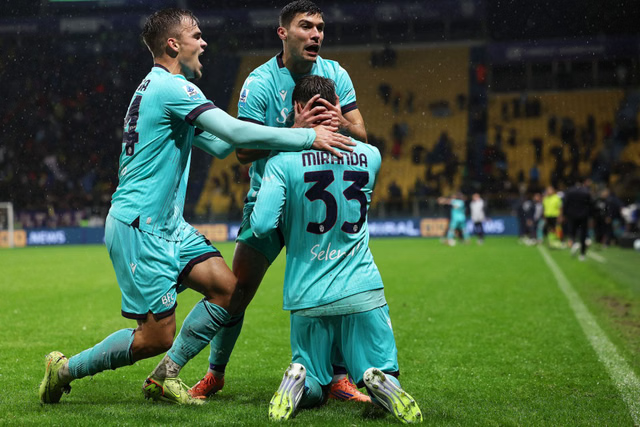


1️⃣ Match Context
Late-February in the Europa League is where ties stop being “interesting” and start being defining. Bologna 1909 at home in Europe carries a different kind of weight: the expectation to control the game, justify the gap in squad value, and avoid the one thing knockout football punishes most — emotional impatience.
For Brann, the pressure is inverted. They arrive with permission to be pragmatic, to suffer without shame, and to turn the match into a series of episodes: defend the box, win second balls, and make Bologna feel the clock. That psychological dynamic matters because it shapes tempo. Bologna want a clean rhythm. Brann want interruptions, restarts, and a match that never becomes continuous.
There’s also a seasonal context edge that markets often price imperfectly at this time of year. Italian sides are deep in domestic rhythm; Norwegian sides can be in a different competitive cadence depending on their calendar. Even if Brann are fit, the intensity of decision-making under sustained pressure — especially away — tends to be the separator at this stage.
2️⃣ Form & Advanced Metrics
Bologna’s profile in recent months has looked like a team built to manage knockout ties: territorial control first, shot quality second, and defensive spacing that keeps opponents away from central, high-value zones. They don’t need to play fast to be dangerous. Their best spells come when the ball lives in the opposition half and the opponent’s clearances become predictable.
In advanced-metric terms, Bologna’s attacking story is usually about repeatable shot creation rather than miracle finishing. They are most stable when they create cutback opportunities and second-phase shots from the edge of the box — not glamorous, but sustainable. When they get sloppy, it tends to be through over-committing fullbacks and allowing counters into the channels. That is where game-state volatility appears: one transition can rewrite 70 minutes of dominance.
Brann’s European away pattern is typically more reactive. Their chance creation often leans on efficiency over volume: fewer shots, but a heavy emphasis on set plays, wide deliveries, and quick attacks into space. That makes their baseline xG output lower, but it also makes them annoying to price because their goals can come from repeatable “moments” rather than long possession spells.
Pressing intensity is another key interpretive layer. Bologna can press high, but more importantly they can press selectively. PPDA (passes allowed per defensive action) is less about a single number and more about when the press turns on: Bologna often trigger pressure on backwards passes and slow switches, trying to lock teams on one side and win the next duel. Brann, in contrast, are more likely to sit in a mid-block and choose their jump moments — usually when the ball travels into a fullback under pressure.
Home/away splits matter here because Bologna’s home identity tends to be territory-heavy: more touches in the final third, more time pinning the opponent, and a higher share of attacks ending in the box. Brann away games tend to show the opposite — longer defensive phases, fewer high possessions, and more reliance on defending the width of the penalty area.
3️⃣ League Table Snapshot
| Team | Domestic Position (Snapshot) | General Trend |
|---|---|---|
| Bologna 1909 | Upper-table profile | Control-based, low-chaos |
| Brann | Top-side profile domestically | Compact, transition-led |
The table positions (even when simplified) usually reflect something important stylistically: Bologna’s consistency tends to come from repeatable territory and defensive spacing. Brann’s domestic strength often comes from timing, set-piece edge, and game management. In Europe, the question is whether Brann’s strengths scale up when they don’t have the ball for long spells.
4️⃣ Head-to-Head Analysis
There’s no deep head-to-head history that should override the present matchup. When teams meet infrequently, the useful “H2H” angle is structural rather than historical: how does an Italian possession-control side typically fare against a Scandinavian compact block with set-piece threat?
Those matchups usually hinge on two things. First, whether the favorite can generate central access (cutbacks, through balls, third-man runs) rather than sterile crossing. Second, whether the underdog can make their limited attacks count via dead balls and transitions. The past isn’t a script here — the pattern is.
5️⃣ Tactical Breakdown (Core Section)
Who dictates tempo?
Bologna should. At home, they are most comfortable turning the match into a steady siege: circulating, resetting, and forcing the opponent to defend width-to-width until the weak-side winger is late by half a second. That’s when the cutback window appears.
Brann’s best route to disrupting that is not constant pressing — it’s tempo denial. Slow restarts, longer clearances into organized chase patterns, and making Bologna restart attacks from deeper zones. If Brann can keep Bologna’s possessions starting 10–15 meters further back, Bologna’s “inevitable” pressure becomes more manageable.
Overload zones and where the game tilts
Expect Bologna to tilt the field toward one side and look for the switch. Field tilt in practice looks like this: sustained possession in the final third, repeated recoveries after clearances, and a constant stream of second balls. Bologna’s best attacking sequences often come when they lock the opponent on a flank, then find the far-side runner arriving into space.
For Brann, the priority is protecting the half-spaces — the channels between fullback and center-back where the most valuable passes are played. If they keep those lanes closed, Bologna will be pushed wider. And wide attacks can be defended — especially if Brann’s box defending is disciplined.
Midfield control: the real battle
This match likely turns on Bologna’s ability to sustain pressure after the first wave is cleared. The first cross is rarely the goal. The second phase is. Bologna want their midfield to win the rebound, reset quickly, and force Brann to defend again before their block can breathe.
Brann’s midfield task is brutally simple and brutally hard: win enough duels to prevent repetition. If they can turn Bologna’s attacks into one-and-done possessions, the game becomes level. If they can’t, fatigue accumulates, and concentration drops — exactly where set pieces and late goals appear.
Pressing triggers and buildup resistance
Bologna’s press is most dangerous when the opponent’s first pass after regaining the ball is sideways or backwards. That’s when Bologna can trap, force a long ball, and re-start the cycle. Brann need clear outlets: a target for direct play, and a second runner to collect the knockdown. Without that, they’ll be pinned.
Transition vulnerability
The one clear avenue for Brann is transition into the channels. Bologna can be aggressive with their fullbacks, and if rest defense spacing is even slightly off, Brann can create a 3v3 or 3v2 running situation. That’s where underdogs land their best punches: not through long build-up, but through one clean vertical pass that bypasses the press.
Set-piece dynamics
This is where Brann can keep themselves alive. Even in games where they are out-possessed heavily, set pieces can equalize expected goals quickly. Bologna, meanwhile, can’t afford careless fouls in wide areas. The market often assumes the favorite’s defensive superiority covers everything; set pieces are the loophole.
6️⃣ Odds & Market Evaluation
| Market | Selection | Odds | Implied Probability |
|---|---|---|---|
| 1X2 | Bologna 1909 | 1.45 | 68.97% |
| 1X2 | Draw | 4.40 | 22.73% |
| 1X2 | Brann | 7.50 | 13.33% |
Note: implied probabilities above are raw (not margin-adjusted), so they sum above 100% due to bookmaker overround.
The betlabel.games team evaluates this closer to a home win probability in the mid-to-high 60s, with the draw more live than casual bettors expect because of Brann’s ability to compress the match and weaponize dead balls. That means the 1X2 home price is not an automatic value play — it’s more “fair” than “soft.”
Where the market can be more interesting is in derivative lines: Bologna win paired with lower totals, or Bologna on a safer handicap if you believe control translates into few high-quality concessions.
7️⃣ The Hidden Edge (Mandatory Section)
There’s a structural nuance here: favorites against compact blocks often look less dominant on the scoreboard than they are in territory. That can create a mispricing if the market overreacts to recent “only 1–0” type wins or to a perceived lack of attacking explosiveness.
If we look deeper, Bologna’s edge is not about constant clear-cut chances; it’s about repeat pressure that gradually degrades the opponent’s spacing. Against teams like Brann, the goal often comes from a small tactical error: a winger not tracking the far-side fullback, a midfielder arriving late to the top of the box, or a center-back stepping out a fraction too far.
On the other side, Brann’s threat can be overestimated in generic models because set pieces are high-variance. They can absolutely score from one delivery — but that doesn’t mean they’ll sustain chance creation. If Bologna avoid cheap fouls and defend restarts cleanly, Brann’s open-play path to scoring is narrower than the raw upset narrative suggests.
So the hidden edge is this: the market often prices “underdog threat” as if it’s continuous. Here it may be episodic. That favors Bologna controlling the game and the total staying relatively contained.
8️⃣ Final Prediction
Main Pick: Bologna 1909 -1.0 Asian Handicap
Alternative: Bologna 1909 win & Under 3.5 Goals
Risk Level: Medium
The logic is straightforward and probability-driven:
1) Territory and repeat pressure: Bologna’s game should live in Brann’s half, creating second-phase chances that are more sustainable than Brann’s moment-based attack.
2) Brann’s scoring path is narrow: much of their realistic upside is set-piece and transition-led. If Bologna manage rest defense and avoid cheap fouls, Brann’s open-play xG ceiling drops.
3) Market framing: the 1X2 home win price is not screaming value, but handicap and win/under combinations align better with how this matchup is likely to play — Bologna control without a wild shootout.



Leave a Reply